Global Neutrino Telescopes Set to Decode the Milky Way’s Hidden Particle Accelerators Within a Decade
Combining observatories across both hemispheres could soon measure elusive neutrino flavor ratios, testing cosmic origins and fundamental physics.“, _meta_description: ”New research forecasts how global neutrino telescopes will measure the Milky Way’s flavor composition within a decade, testing cosmic particle origins.
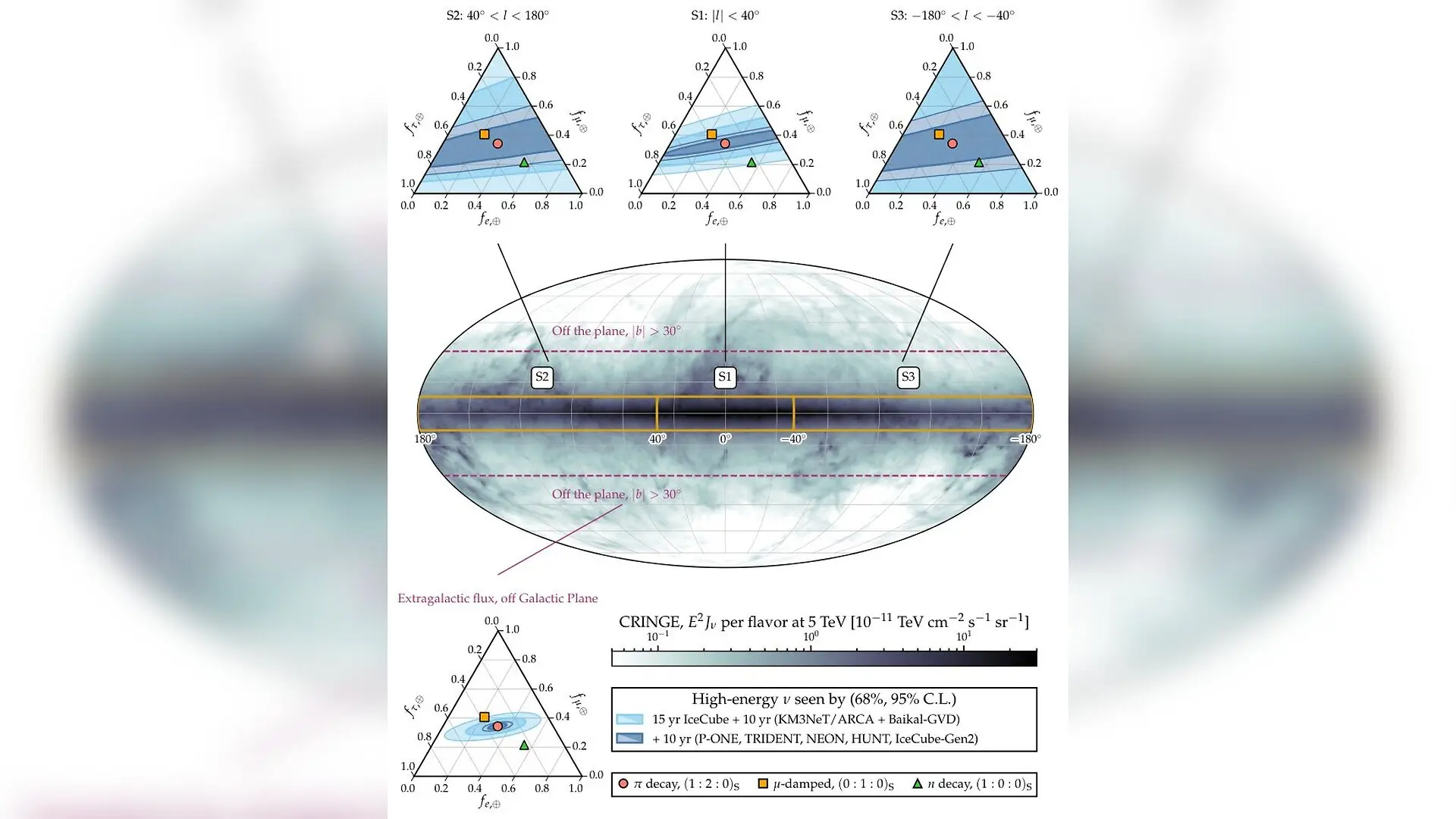
High-energy ghost particles streaming from the center of our Milky Way could soon reveal how cosmic accelerators forge them, thanks to a new forecasting method developed by theoretical physicist Mauricio Bustamante from the Niels Bohr Institute at the University of Copenhagen. Neutrinos are nearly massless subatomic particles that travel across the universe almost completely undisturbed by magnetic fields or matter, making them pristine messengers from extreme astrophysical engines. Although astronomers have previously detected high-energy neutrinos originating from the Galactic plane, their exact flavor composition, meaning the relative proportions of electron, muon, and tau variants, has remained unmeasured until now. By combining data from existing and upcoming global neutrino observatories, researchers expect to map these flavor ratios within a decade, opening an unprecedented window into particle physics and high-energy astrophysics.
The study, published on the arXiv preprint server, demonstrates that different production mechanisms inside cosmic sources leave distinct flavor fingerprints on the arriving neutrinos. When cosmic rays collide with interstellar gas, they produce charged pions that subsequently decay into a mixture of electron and muon neutrinos alongside antineutrinos in a ratio of one to two, with virtually no tau neutrinos involved. Alternative production scenarios, such as neutron decay in flight or extreme magnetic fields that damp energetic muons before they can decay, would alter this signature entirely. The authors report that current and planned telescopes can exploit these differences to test foundational assumptions about how the Milky Way accelerates particles to tera-electronvolt energies.
How Will Global Telescopes Team Up to View the Inner Galaxy?
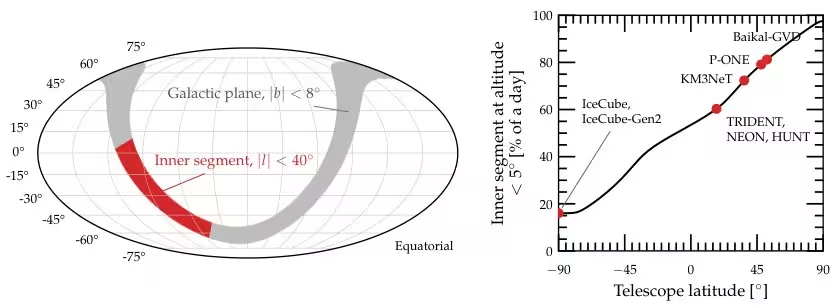
To untangle these elusive flavor signatures, the research framework combines the capabilities of eight major neutrino detectors spanning opposite hemispheres and different geographic latitudes. Instruments such as the IceCube Neutrino Observatory at the South Pole excel at detecting particle showers generated primarily by electron and tau neutrinos, while the KM3NeT array in the Mediterranean Sea observes long, energetic muon tracks pointing back toward their cosmic origins. Because the inner region of the Milky Way sits predominantly in the southern sky, northern detectors view it from complementary angles under the horizon.
By coordinating fifteen years of IceCube data with ten years of operation from KM3NeT and other instruments including Baikal-GVD, P-ONE, TRIDENT, NEON, HUNT, and IceCube-Gen2, the collaboration forecast that scientists can measure the electron neutrino fraction at the Galactic sources to within twenty-seven percent. This level of precision is sufficient to distinguish standard pion decay from neutron decay and strongly magnetized source environments with high statistical confidence. Furthermore, comparing the flavor composition of the Milky Way against the diffuse extragalactic neutrino background originating from beyond our galaxy offers a powerful baseline to test fundamental physical laws over cosmological distances.
What Could Comparing Galactic and Extragalactic Neutrinos Uncover?
Contrasting local Galactic neutrinos with those arriving from distant extragalactic sources provides a sensitive probe for new physics and extreme environments. Extragalactic neutrinos travel millions or billions of light-years across the cosmos, exposing them to subtle physical phenomena that local galactic particles bypass. For instance, if extragalactic neutrinos encounter exceptionally strong magnetic fields at their sources, muon cooling alters their flavor spectrum in ways that local Milky Way neutrinos do not experience. The models indicate that combining all eight telescopes would detect such muon cooling at high significance for magnetic fields exceeding ten kilogauss, potentially pointing toward gamma-ray bursts or magnetar winds as dominant extragalactic neutrino engines.
In addition to probing magnetic fields, the comparative analysis sets stringent constraints on hypothetical processes like the invisible decay of neutrino mass eigenstates over cosmological scales. Because neutrino oscillations average out over kiloparsec and intergalactic distances, any spontaneous decay of heavier neutrinos into invisible lighter particles during their multi-megaparsec journeys would distort the observed flavor ratios at Earth. The forecasting models suggest that a coordinated global telescope network could probe neutrino lifetime-to-mass ratios up to roughly fifteen thousand seconds per electron volt, extending present experimental limits by more than an order of magnitude.
What Limitations Remain and What Lies Ahead for Neutrino Astronomy?
While the projections outline a clear path toward high-precision neutrino flavor measurements, several technical and observational challenges remain before these goals are realized. Detector calibration, background subtraction from atmospheric muon and neutrino showers, and uncertainties in neutrino interaction cross-sections introduce systematic errors that require careful statistical profiling. The authors note that their analysis relies on assumptions about uniform emission across Galactic segments and incorporates sophisticated nuisance parameters to account for detector efficiencies and pointing resolutions.
As next-generation detectors come online over the coming decades, advanced experimental techniques such as detecting delayed light echoes after particle showers or identifying starting tracks will further sharpen flavor separation capabilities. Establishing the Milky Way as a precisely measured flavor reference point transforms our own galaxy into a reliable laboratory for testing particle physics. This empirical baseline will ultimately allow astronomers to decode the hidden workings of distant cosmic accelerators and search for physics beyond the Standard Model using the universe as their laboratory.
The study was posted to the arXiv preprint server on November 25, 2026.
This article has been fact checked for accuracy, with information verified against reputable sources. Learn more about us and our editorial process.
Last reviewed on .
Article history
- Latest version
Reference(s)
- Bustamante, Mauricio. “Measuring the flavor composition of high-energy neutrinos from the Milky Way.” arXiv.org <http://arxiv.org/abs/2611.34797v1>.
Cite this page:
- Posted by Deepak Malhotra