Rare Celestial Alignment As Jupiter’s Two Largest Moons Cross Paths In The Night Sky
A unique orbital alignment between Ganymede and Io has unveiled the complex, hidden choreography governing the moons of Jupiter.
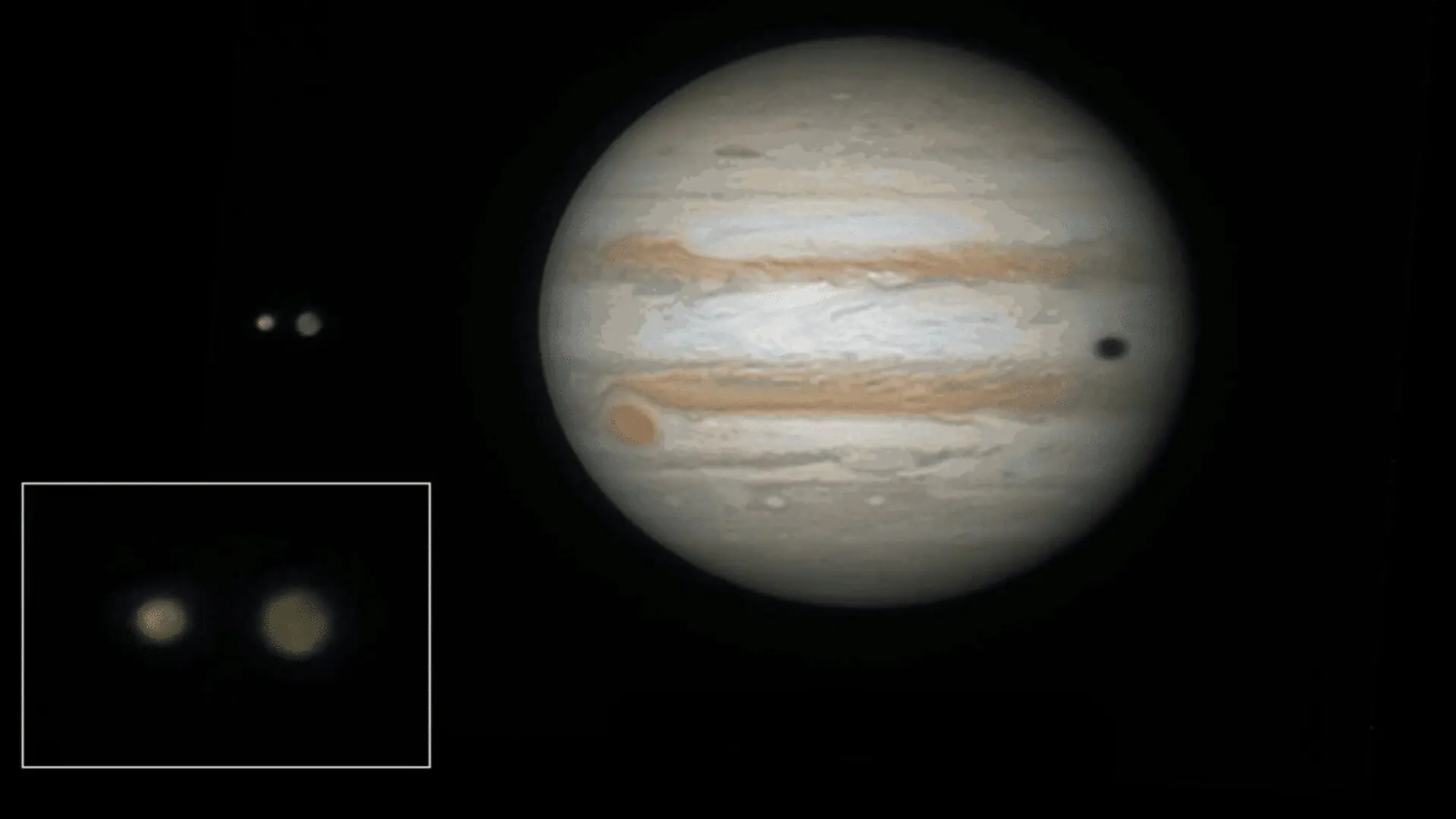
Astronomers have captured a rare celestial dance as two of Jupiter’s largest moons crossed paths, creating a stunning visual phenomenon known as a mutual occultation. The alignment, which temporarily merged the silhouettes of Ganymede and Io from the perspective of observers on Earth, offers a unique window into the complex orbital mechanics governing the Jovian system.
Cosmic Intersection of Two Distinct Moons
The event was highlighted in NASA’s Astronomy Picture of the Day on October 28, 2026, showcasing the rare moment one moon masked the other. While the moons appear to collide in the frame, the event is entirely a result of perspective rather than physical proximity. The two bodies are separated by vast spans of space, merely sharing a single line of sight from Earth at that specific juncture in their orbits.
The encounter paired two of the solar system’s most significant satellites, each with vastly different profiles. Ganymede, the solar system’s largest moon, boasts a diameter of 5,268 kilometers (3,273 miles), making it larger than the planet Mercury. In contrast, Io represents a world of extreme geological violence. Roughly the size of Earth’s Moon, Io is recognized as the most volcanically active body in our neighborhood, with a surface constantly transformed by molten sulfur and persistent eruptions.
The Mechanics Behind the Jovian Dance
Since their discovery by Galileo Galilei in 1610, the four massive Galilean moons—Io, Europa, Ganymede, and Callisto—have been central to our understanding of planetary motion. Because these satellites share a nearly flat orbital plane relative to their host planet, they frequently cross one another’s paths from our terrestrial viewpoint.
The frequency of these events is dictated by the vastly different orbital velocities of the moons. While Io completes a full circuit around the gas giant in just 1.77 Earth days, the more distant Ganymede requires approximately 7.15 days to finish its journey. As these moons traverse their paths at varying speeds, they inevitably slide past one another.
Scientists differentiate between these alignments based on the physics involved. While a mutual occultation describes one body physically blocking another from sight, an eclipse occurs when a moon moves into the shadow cast by another object. Beyond the visual spectacle, these occurrences serve a practical scientific purpose. By recording the precise timing and shifts in brightness during these occultations, astronomers can refine their orbital models and gain a clearer understanding of the gravitational dynamics that define Jupiter’s miniature solar system.
This article has been fact checked for accuracy, with information verified against reputable sources. Learn more about us and our editorial process.
Last reviewed on .
Article history
- Latest version
Reference(s)
- Bonnell, Jerry. “APOD: 2026 October 28 - The Mutual Occultation of Ganymede and Io - NASA Science.”, October 28, 2026 NASA <https://science.nasa.gov/image-article/apod-2026-october-28-the-mutual-occultation-of-ganymede-and-io/>.
Cite this page:
- Posted by Aisha Ahmed