Strange Stellar Vibrations Reveal Hidden Histories of Stars That Swallowed Companions
Astronomers have discovered that red giants with unusual vibrations may have gained mass from stellar companions, altering their internal magnetic fields.
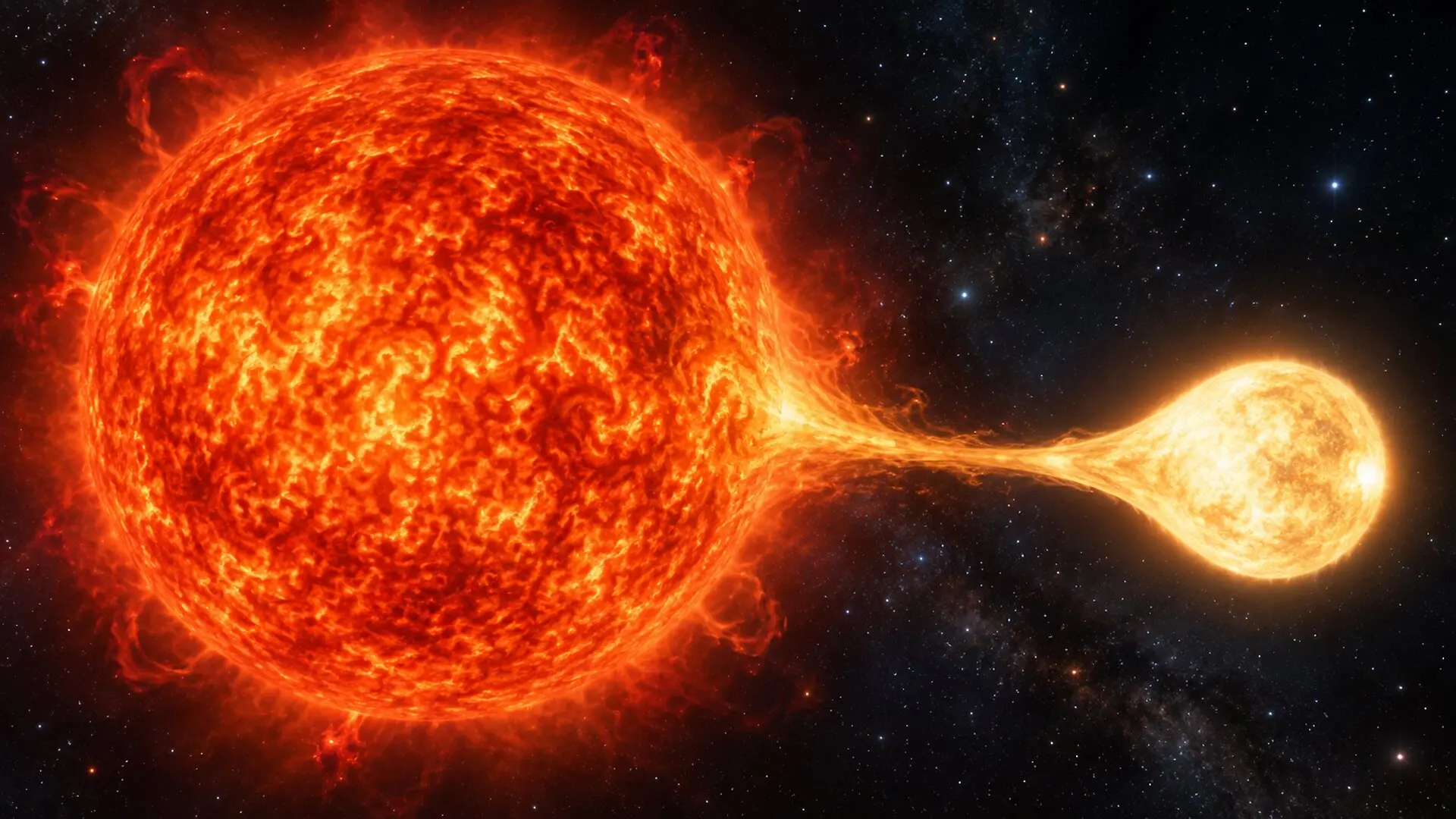
The history of a star is often written in its internal structure, but deciphering that record requires looking past its current appearance. New research suggests that red giants that have swallowed material from a companion star may harbor internal conditions vastly different from those that evolved in isolation, fundamentally changing how their vibrations interact with hidden magnetic fields.
This insight, published in Astronomy & Astrophysics, challenges the traditional assumption that a star’s mass directly reflects its singular evolutionary path. By modeling stars with and without histories of mass gain, a team led by the Institute of Science and Technology Austria (ISTA) found that the accretion of material can leave a star significantly more sensitive to its own internal magnetism.

Unmasking Magnetic Signatures
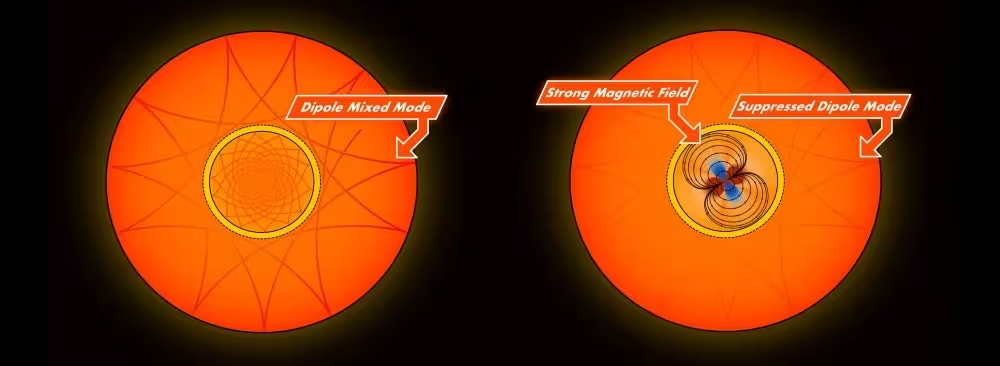
Because stellar interiors are impossible to observe directly, astrophysicists rely on asteroseismology—the study of stellar oscillations. These vibrations, which manifest as minute, rhythmic fluctuations in brightness, act as probes of the star’s deep internal architecture. In red giants, astronomers frequently observe “dipole mixed modes,” which provide a bridge between the star’s outer layers and its dense, helium-rich core.
A persistent puzzle in this field is “dipole-mode suppression,” where these expected oscillations appear unusually faint. One common theory suggests that strong internal magnetic fields are responsible, essentially muting the signal by interacting with the gravity-wave component of the stellar pulse. However, standard models have often struggled to account for this without invoking magnetic fields of unrealistic intensity.
The Impact of a Hidden Past
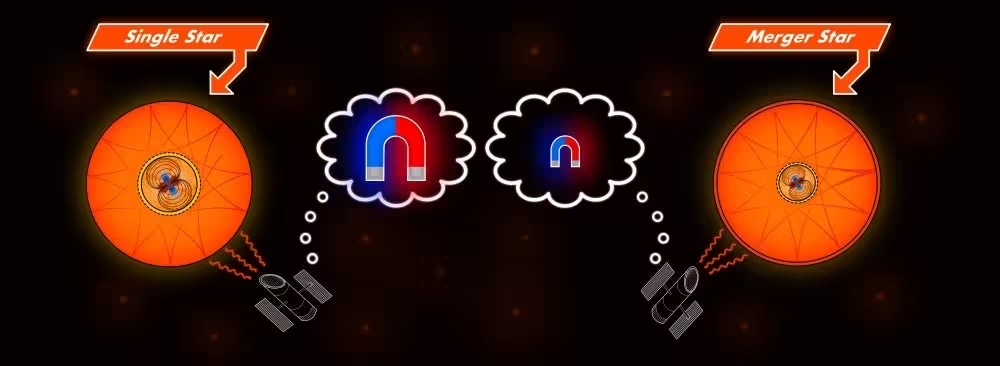
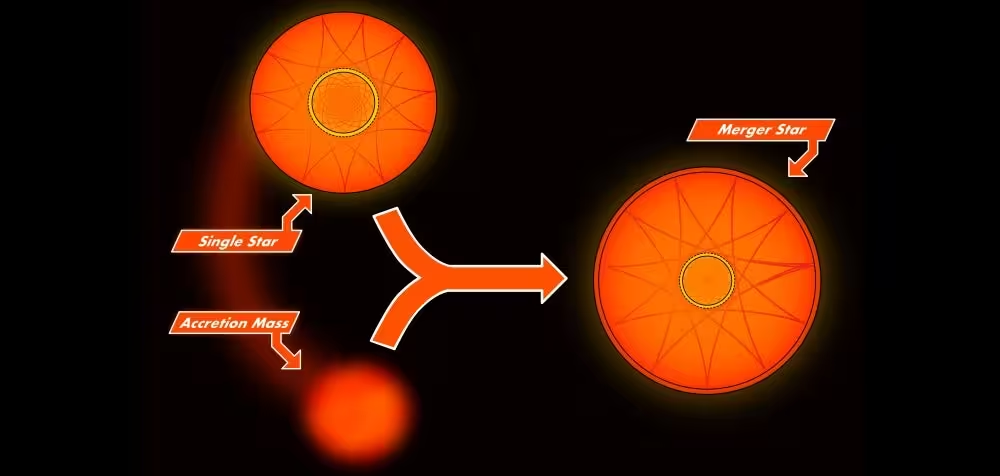
The research team, which included collaborators from Universidad de La Laguna and Université Paris Cité, used the MESA (Modules for Experiments in Stellar Astrophysics) software to simulate the life cycles of stars that gained mass during their time as red giants. Their results suggest that when a star acquires mass, the added material primarily alters its outer envelope, while the core remains largely a remnant of the star’s original configuration.
This creates a discrepancy between the star’s observed total mass and its internal history. Consequently, an “accretion-fed” red giant may react to its magnetic field with heightened sensitivity compared to a single star of the same observed mass.
Lowering the Threshold for Magnetism
The findings indicate that for many higher-mass red giants, the magnetic threshold required to explain observed mode suppression could be significantly lower than previously calculated. In the most dramatic models, the necessary magnetic field strength dropped by approximately 80 percent, moving from over one million gauss to under 600,000 gauss.
“The idea is that our previous interpretation may be biased because we assume that a star evolved on its own,” said Assistant Professor Lisa Bugnet. “If we instead suppose that it gained mass, the observed oscillations become more sensitive to a magnetic field.”
The team tested this framework against two known candidates, KIC 4350501 and KIC 9508757. While their mass-gain models provided a better fit for the stars’ properties than standard single-star models, the researchers noted that the simulations still exhibited discrepancies—such as surface temperature mismatches—emphasizing that this approach remains an early-stage attempt to refine stellar evolution theory.
Refining Future Stellar Models
The study highlights that failing to account for binary interactions or past mass transfer can lead to a misunderstanding of a star’s internal physics. Magnetic fields are central to driving the evolution of angular momentum and the transport of chemical elements, meaning that miscalculating their strength can ripple through broader models of galactic and stellar aging.
While the study does not claim to have solved every mystery regarding stellar vibrations, it provides a crucial new lens for viewing red giants. By recognizing that some stars carry the baggage of a companion in their very core, astronomers may soon find that the “unusual” signals from the deep reaches of the galaxy are not so mysterious after all.
Further Reading
- Near-critical magnetic fields in Kepler red giants
- Asteroseismic signatures of core magnetism and rotation in hundreds of low-luminosity red giants
- Magnetic fields of 30 to 100 kG in the cores of red giant stars
This article has been fact checked for accuracy, with information verified against reputable sources. Learn more about us and our editorial process.
Last reviewed on .
Article history
- Latest version
Reference(s)
- <https://www.aanda.org/articles/aa/full_html/2026/11/aa61734-26/aa61734-26.html>.
- “ISTA Homepage.” Institute of Science and Technology Austria (ISTA) <https://ista.ac.at/>.
- “En.” <https://www.ull.es/en/>.
- “Université Paris Cité.” <https://u-paris.fr/>.
- Deheuvels, S.., et al. “Near-critical magnetic fields in Kepler red giants.” Astronomy & Astrophysics, vol. 709, May 19, 2026, pp. A224 EDP Sciences, doi: 10.1051/0004-6361/202659344. <https://doi.org/10.1051/0004-6361/202659344>.
- <https://academic.oup.com/mnras/article/534/2/1060/7746778>.
- Li, Gang. “Magnetic fields of 30 to 100 kG in the cores of red giant stars - Nature.”, vol. 610, no. 7930, pp. 43-46. Nature, doi: 10.1038/s41586-022-05176-0. <https://www.nature.com/articles/s41586-022-05176-0>.
Cite this page:
- Posted by Aisha Ahmed