Exoplanet Ionospheres Could Hide Alien Radio Signals Behind a Natural Frequency Filter
New research suggests unintentional technological leakage from distant worlds would be shaped by stellar radiation into a predictable orbital signature.

When radio waves from a planetary surface try to escape into space, they hit an invisible wall of charged particles in the ionosphere known as the local plasma frequency, which bounces lower-frequency signals straight back down. For over sixty years, the search for extraterrestrial intelligence has focused on narrow, intentional communication beams, but recent proposals suggest listening for unintentional broadband radio leakage from planetary-scale technologies. A study available on the arXiv preprint server models how these signals would be shaped by the overlying ionosphere across different worlds.
How Star Radiation Shapes Planetary Radio Filters
The authors investigated how ultraviolet and X-ray radiation from a host star ionizes the upper atmosphere to create this natural radio shield. Because the peak electron density relies on a balance between photoionization and recombination, the resulting plasma cutoff frequency depends on the fourth root of the incoming stellar energy flux. This weak scaling means that even large differences in host star activity translate into relatively modest changes in the cutoff boundary.
For terrestrial planets orbiting Sun-like stars and K-dwarfs, the turnover frequency typically sits between 5 megahertz and 30 megahertz, similar to Earth. However, planets in the habitable zones of active M-dwarfs experience much harsher irradiation environments. For instance, Proxima b sits at an estimated cutoff frequency of 28 megahertz during quiet periods, while a planet in the habitable zone of the active M-dwarf AD Leo reaches approximately 38 megahertz. During strong stellar flares, these values could transiently climb toward 100 megahertz.
Why Orbital Geometry Creates a Moving Signature
The ionosphere is not static, because the illuminated dayside features a much higher electron density than the dark nightside. Because this day-night ionization pattern remains locked to the substellar point facing the star rather than the rotating surface of the planet, a distant observer sees a predictable variation over the course of the orbit. As the exoplanet moves around its host star, the visible hemisphere scans across this star-anchored ionospheric map, causing the apparent turnover frequency to swing by roughly 48 percent in standard models.
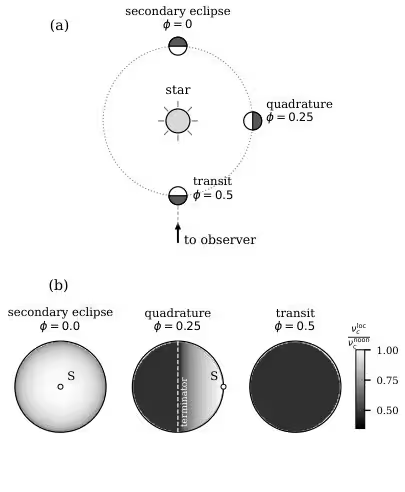
This orbital phase locking provides a powerful diagnostic tool. While natural astrophysical sources can also produce low-frequency spectral turnovers, reproducing a periodic shift that matches the planet’s orbital period and follows specific atmospheric scaling laws would be extremely difficult for conventional phenomena.
What Catches and Limits Future Searches
Detecting this signature requires overcoming significant observational hurdles. Faint broadband leakage from exoplanets is expected to be in the microjansky range, meaning individual observations lack the sensitivity to capture the modulation directly. Instead, astronomers would need to use matched template searches to fold data over many orbital cycles, similar to techniques used in pulsar timing and transit photometry.
The authors note that confirming such a signal would demand strict verification criteria, including phase coherence, ephemeris agreement with known orbits, weak polarization compared to bursty auroral emissions, and independence from stellar flare activity. While ground-based low-frequency observations below 30 megahertz face severe interference from Earth’s own ionosphere, future space-based or lunar-farside radio observatories could unlock this hidden diagnostic window.
The study was posted to the arXiv preprint server on November 19, 2026.
This article has been fact checked for accuracy, with information verified against reputable sources. Learn more about us and our editorial process.
Last reviewed on .
Article history
- Latest version
Reference(s)
- Garrett, Michael. “The Ionospheric Cut-off as a Potential Radio Technosignature.” arXiv.org <http://arxiv.org/abs/2611.26025v1>.
Cite this page:
- Posted by Aisha Ahmed