Extreme Black Hole Gravity Completely Overturns How Stars Are Shredded
Simulations reveal that close encounters near rapidly spinning black holes erase the natural defenses of counter-rotating stars.
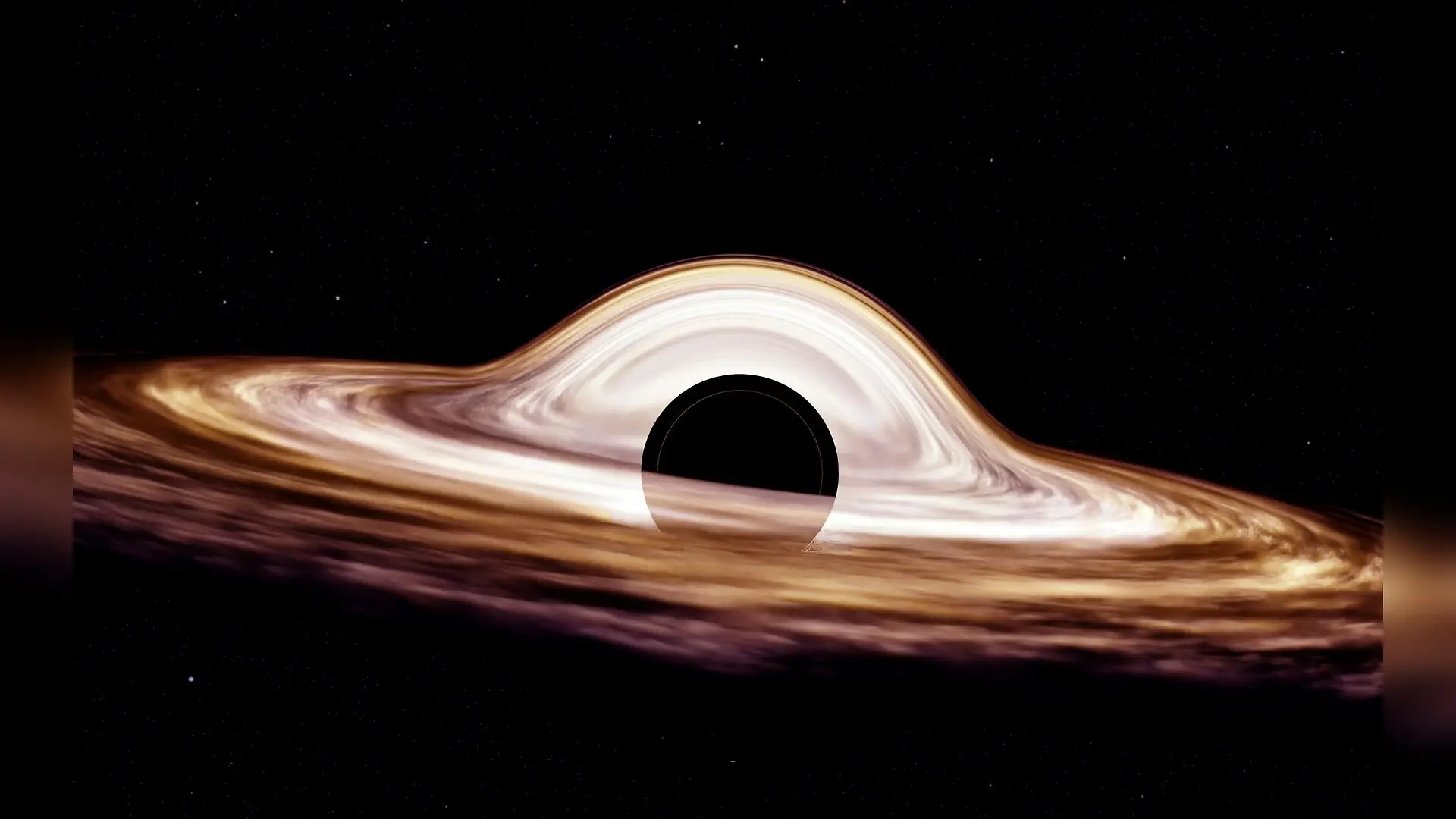
When a star passes near a spinning supermassive black hole, intense gravitational forces can tear it apart in what astronomers call a tidal disruption event. New research reveals that when these encounters occur very close to the black hole, the traditional rules governing how stars resist destruction completely break down.
Astronomers previously understood that a star rotating in the opposite direction of its orbit gained natural protection against being shredded. However, simulations indicate that this protective effect vanishes in extreme gravitational fields near rapidly rotating black holes. The study was published in the arXiv preprint server, detailing how strong-field gravity and stellar rotation interact.
Extreme Gravity Overturns Familiar Rules
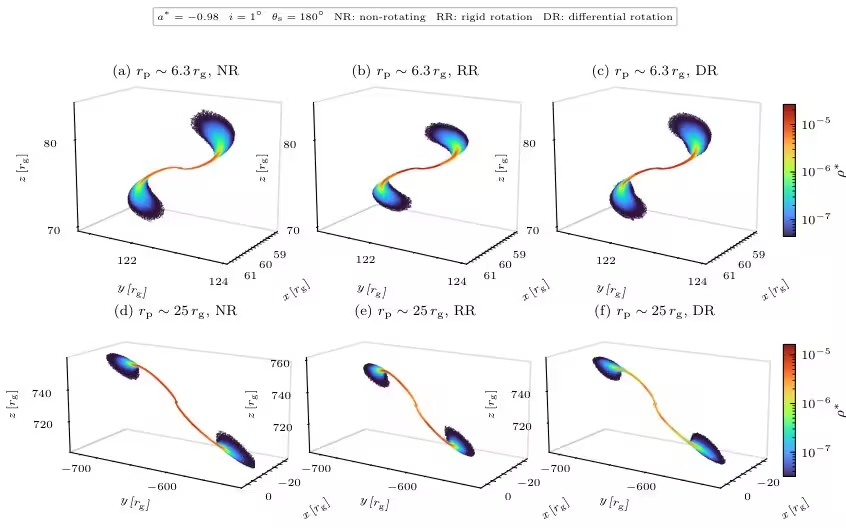
Led by researchers Niles Mondal, Kowsona Chakraborty, Pratap Alte, Pritam Banerjee, and Tapobrata Sarkar, the team modeled the fate of a solar-type star approaching a black hole with a mass of 50 million Suns. Using advanced hydrodynamic simulations that account for general relativity, the authors examined how black hole spin, orbital tilt, and internal stellar rotation combine during close encounters.
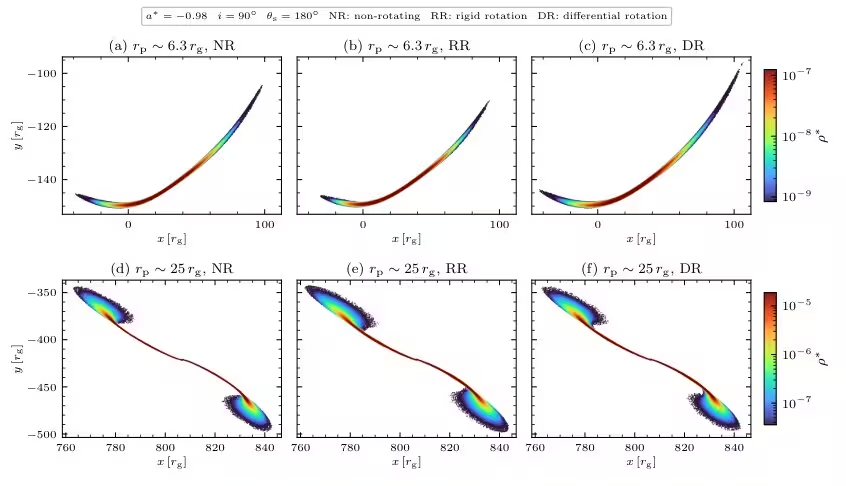
In weaker gravitational encounters occurring farther out, stars spinning against their orbital motion retain more of their mass because counter-rotation helps resist tidal stretching. But when the closest approach shrinks to roughly 6 gravitational radii, the powerful gravitational pull prolongs the strong-tide phase. This extended interaction forces the stellar core to reverse its rotation before stripping even begins, exposing the remnant to intense mass loss regardless of its initial spin orientation.
Rigid Versus Differential Rotation Inside the Star
The simulations also compared rigidly rotating stars with differentially rotating stars, where the interior spins faster than the outer envelope. The authors found that differential rotation reduces the central concentration of the star, making the outer layers easier to strip away. Consequently, differentially rotating stars leave behind slightly smaller surviving cores compared to rigidly rotating counterparts under the same orbital conditions.
Furthermore, the final spin rate of any surviving stellar core is determined entirely by the dynamics of the encounter rather than the star’s initial rotation state. Deep partial disruptions spin these remaining cores up to two to three times their break-up velocity, forcing them to shed mass and angular momentum as they settle into a new equilibrium.
What This Means for Black Hole Mass Measurements
Tidal disruption events serve as crucial laboratories for measuring the masses of quiescent supermassive black holes in distant galaxies. Current observational models often rely on the assumption that black hole mass alone dictates the resulting fallback rate of stellar debris and the subsequent UV and optical light curves.
However, the new findings suggest that black hole spin and stellar rotation act as hidden parameters that can introduce significant scatter into these astrophysical scaling relations. Because surviving stellar cores are frequently spun up to near break-up velocities, successive flares from repeating partial disruptions may exhibit distinct peak times and decay slopes even along identical orbits, highlighting the complex nature of extreme gravitational encounters.
The study was posted to the arXiv preprint server on November 19, 2026.
This article has been fact checked for accuracy, with information verified against reputable sources. Learn more about us and our editorial process.
Last reviewed on .
Article history
- Latest version
Reference(s)
- Mondal, Niles. “Strong Field Tidal Disruptions of Rotating Stars by Spinning Black Holes.” arXiv.org <http://arxiv.org/abs/2611.26043v1>.
Cite this page:
- Posted by John Williams