MIT Scientists Develop Breakthrough Device That Generates Linked Microwave Signals Without Cooling
MIT researchers have developed a magnetic device that generates linked microwave signals at room temperature, potentially transforming secure communication.
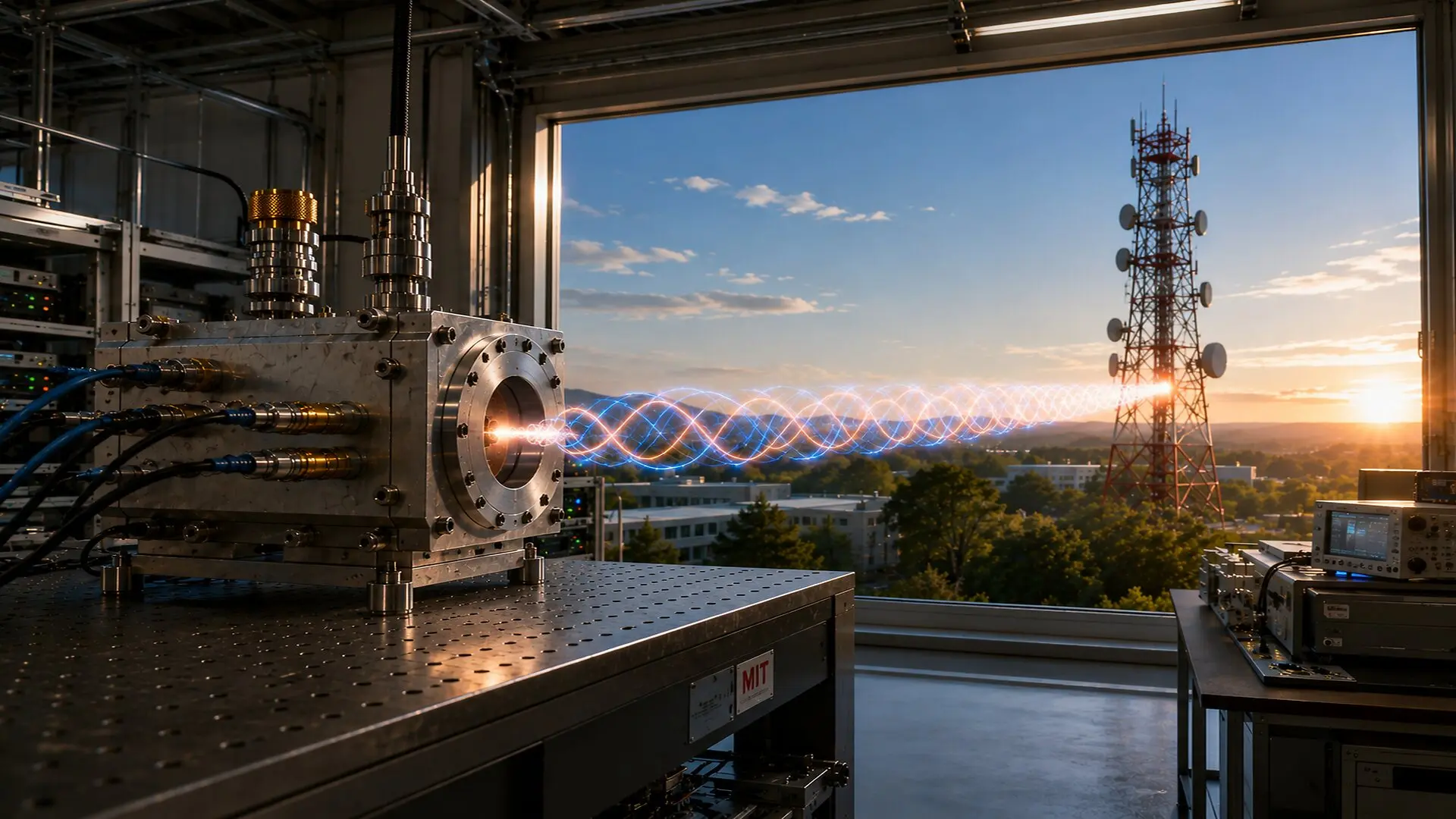
Researchers at MIT have engineered a compact electronic platform capable of generating highly correlated radio-frequency signals at room temperature. By moving away from the intensive cryogenic cooling required by traditional superconducting circuits, this new approach could significantly lower the barriers to entry for advanced sensing, secure communications, and emerging microwave quantum technologies.
Typically, the creation of paired, linked microwave photons relies on devices like Josephson junctions. These components require temperatures near absolute zero to function, necessitating bulky and energy-demanding cryostats that largely confine such technology to specialized laboratory environments. The MIT team’s new platform bypasses these thermal constraints by utilizing the unique properties of magnetic materials.
Harnessing Magnetism to Generate Signal Pairs
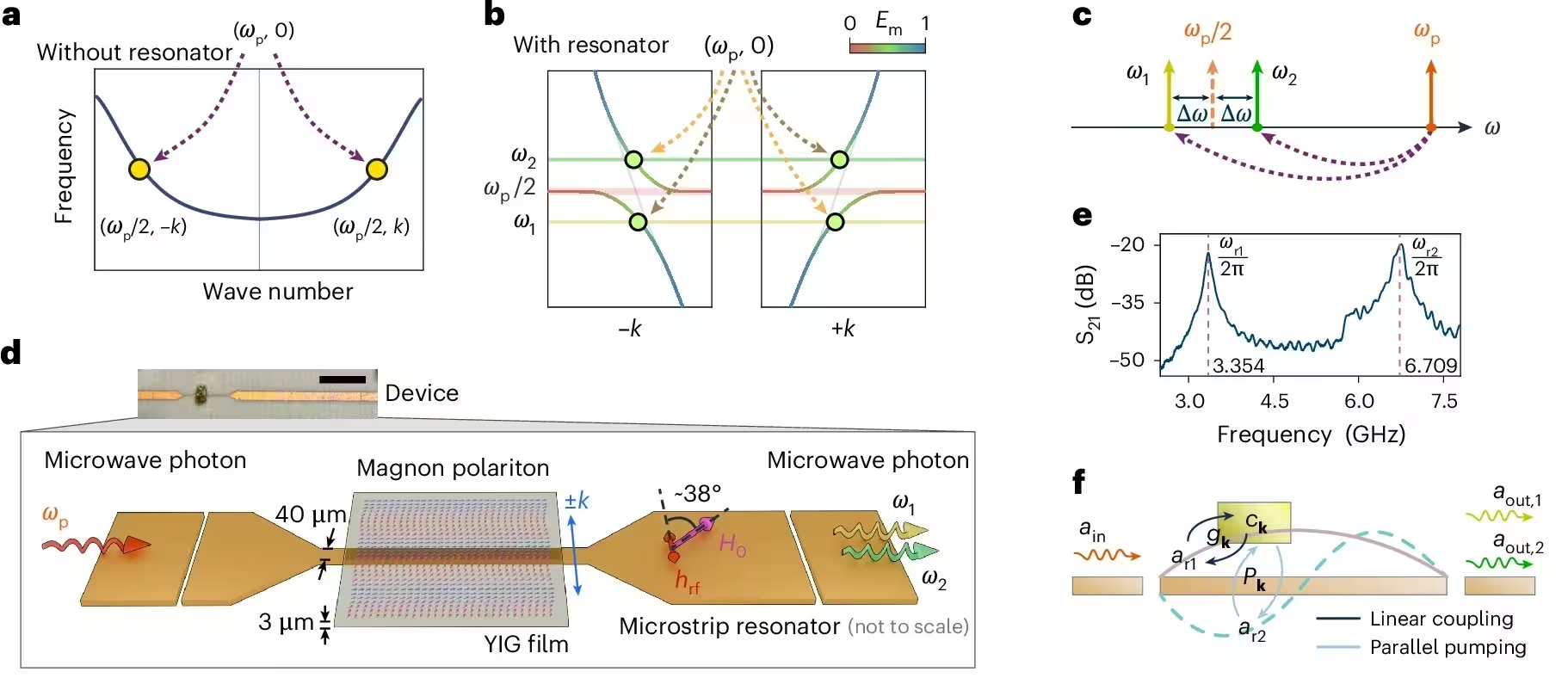
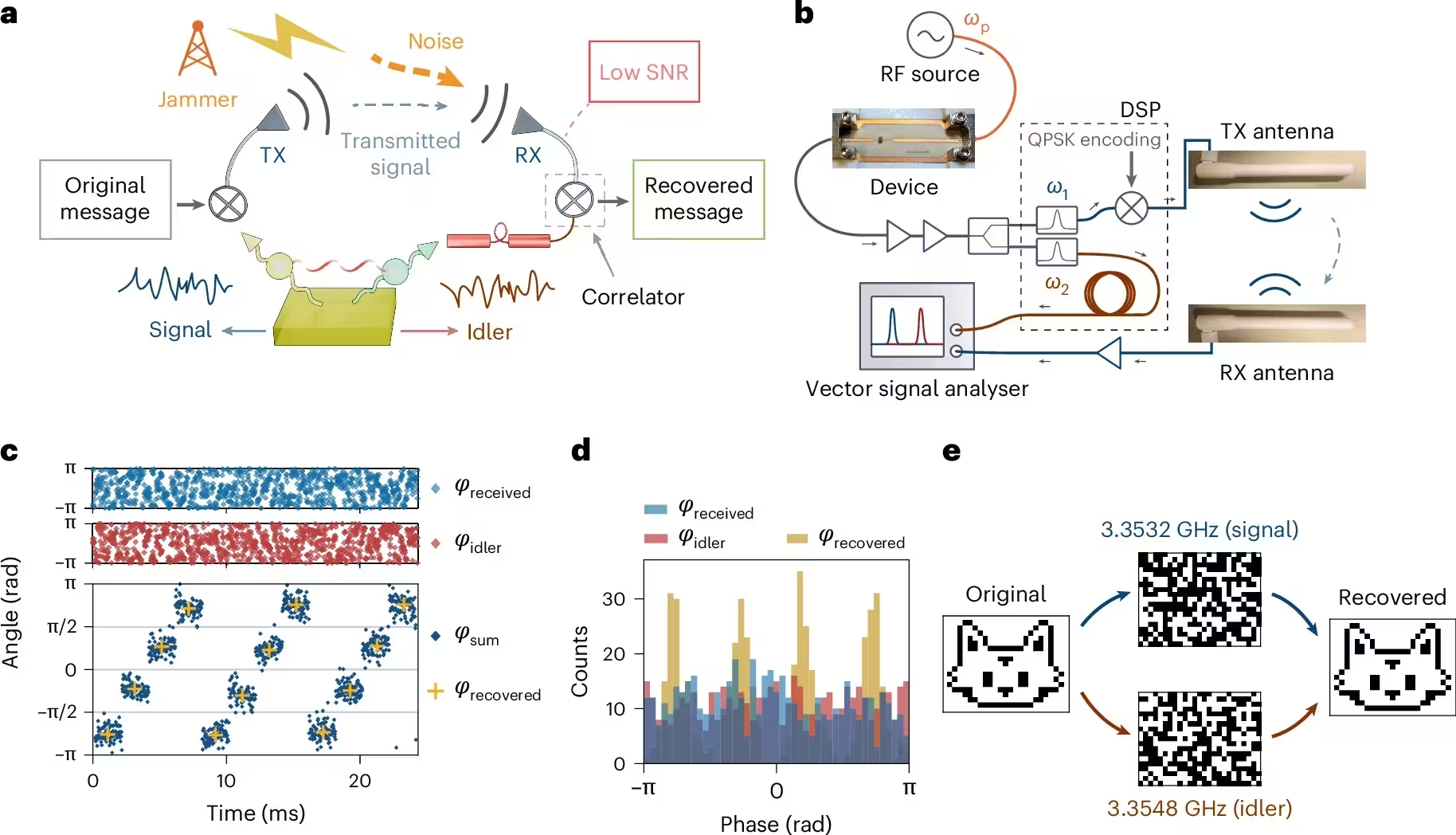
The device operates by placing a magnetic film inside a microwave resonator—a specialized metal cavity designed to trap electromagnetic energy. When microwave power is introduced, the system triggers an interaction with the magnetic film, effectively splitting a single incoming signal into two distinct, synchronized output signals. While each individual output may appear random, they remain tethered by a strong phase relationship.
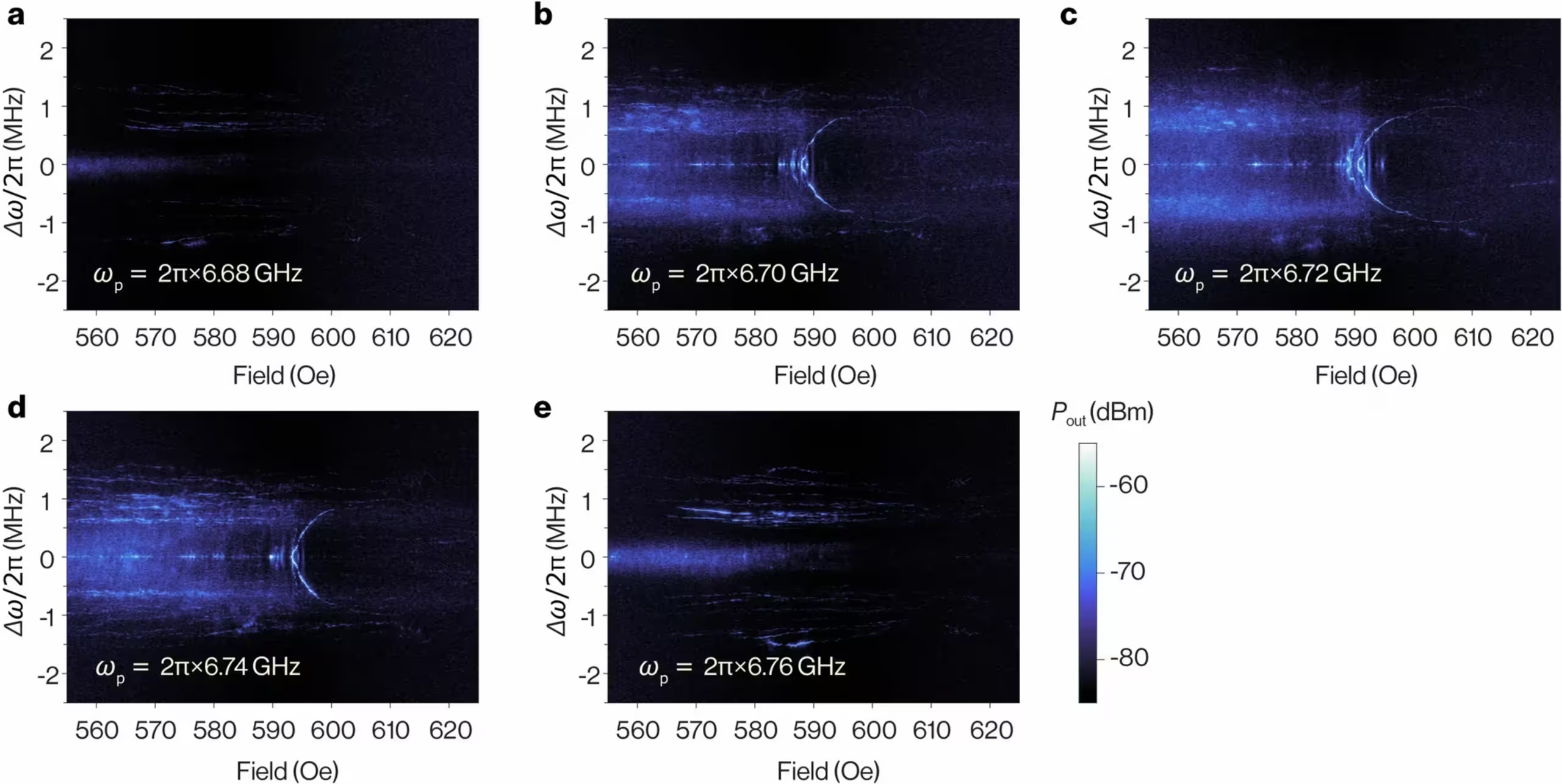
The system leverages magnons, which are quasiparticles representing packets of magnetic energy. In standard magnetic systems, incoming microwave photons often produce paired magnons of identical frequencies, making it difficult to isolate them for practical use. The MIT researchers addressed this by coupling the magnetic film with the microwave resonator, creating a hybrid magnon-photon architecture. This configuration allows for the generation of correlated signals at different frequencies, facilitating their practical application in information transmission.
Advancing Secure Communication and Sensing
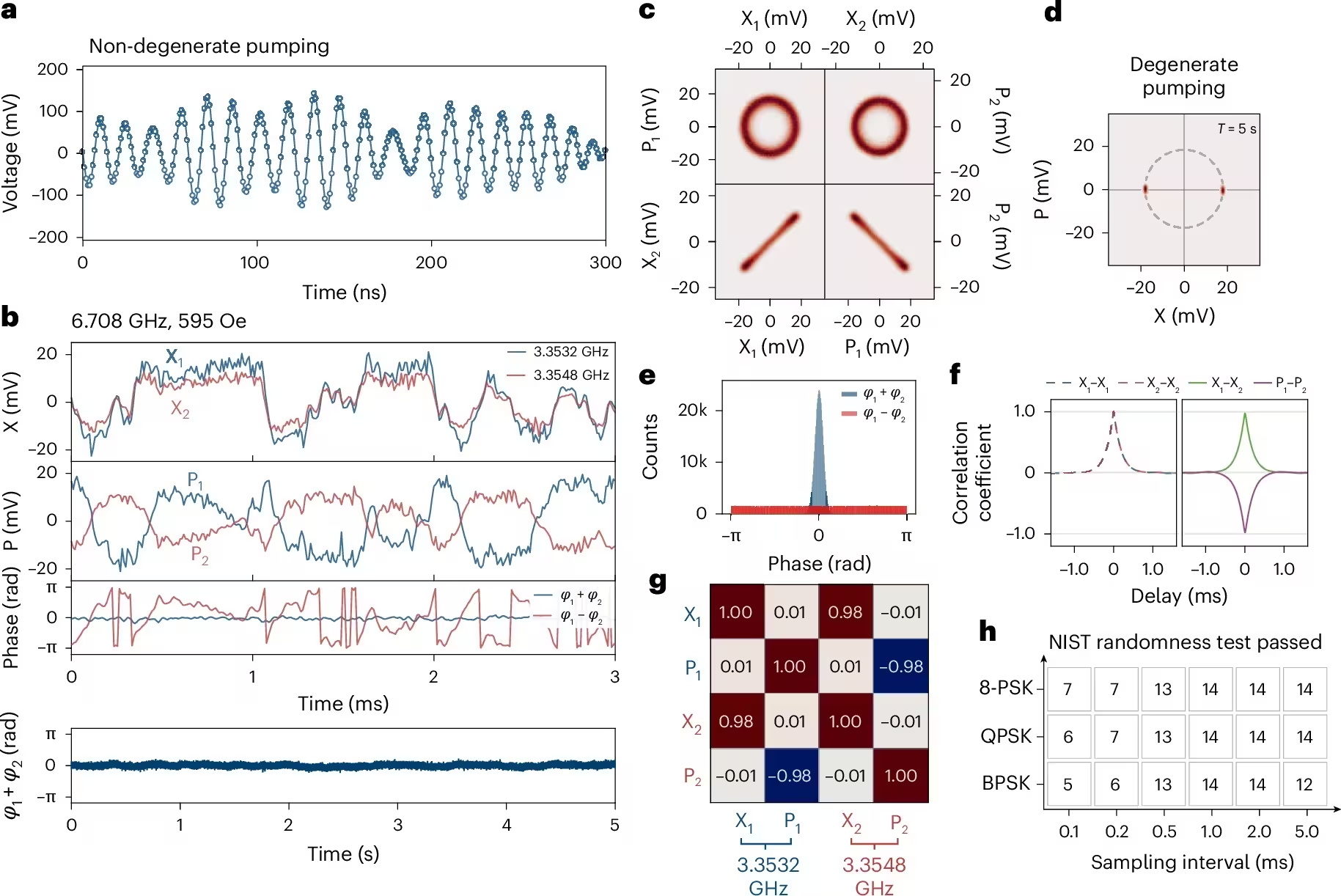
The ability to produce two distinct but linked frequencies offers a pathway to enhanced data security. By encoding information into one signal, the matching partner can serve as a key for recovery, making it significantly harder for unauthorized entities to intercept or reconstruct the data. The team successfully validated this concept by embedding a small image within the frequency of a signal and decoding it using its correlated partner.
Beyond secure data transfer, the platform holds promise for noise-resilient communication, where a receiver could potentially filter out ambient interference by relying on the correlated signal pair. Furthermore, the technology is expected to assist in the development of quantum simulators, which require precise control over particle interactions to model complex drug and material chemistry.
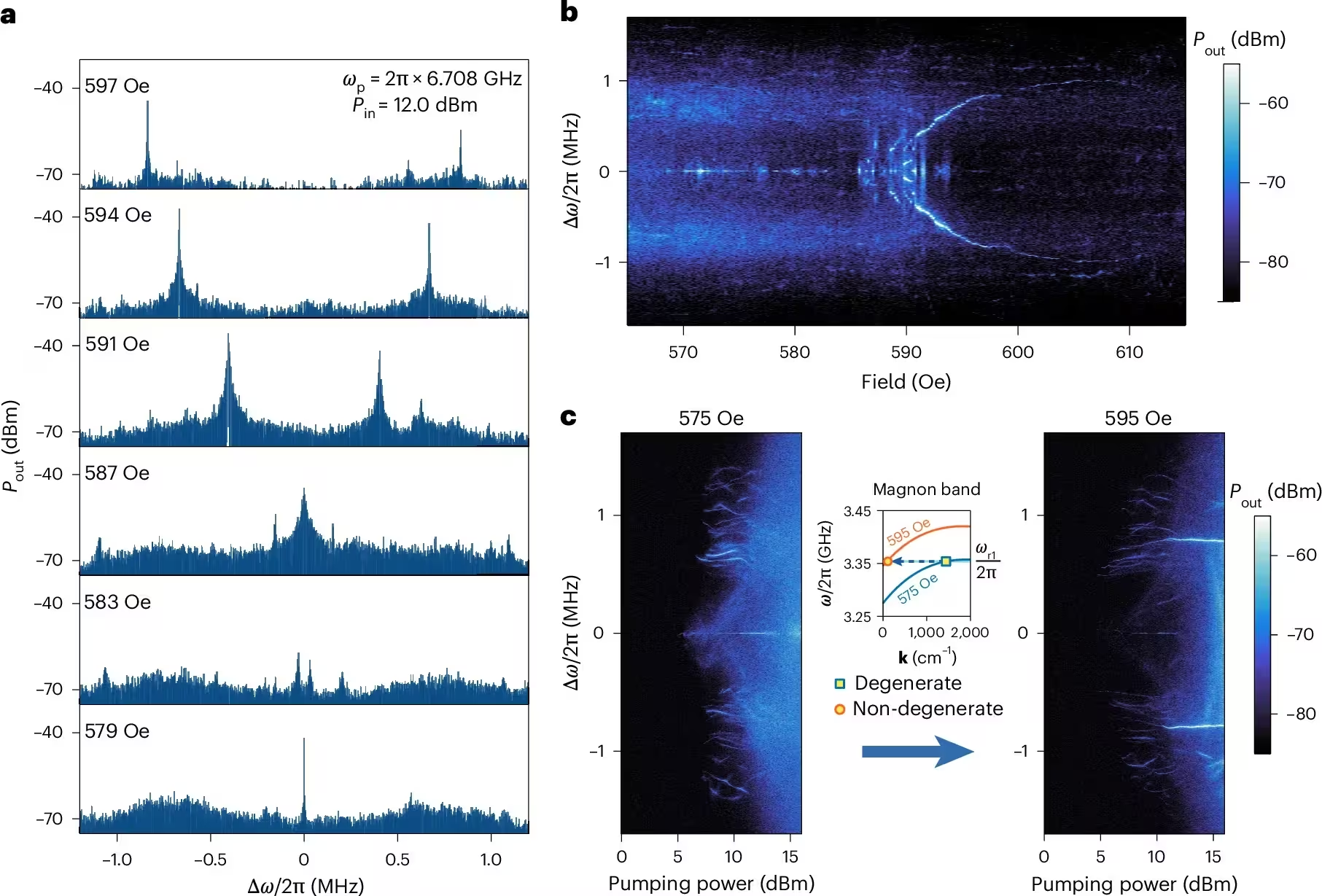
Senior author Luqiao Liu, an associate professor at MIT, emphasized that the work resolves a long-standing spectral overlap issue in magnonic systems. By utilizing level repulsion between magnons and microwave photons, the researchers successfully separated the “twin” magnons, enabling more flexible and practical signal management.
Can-Ming Hu, a professor of physics and astronomy at the University of Manitoba who was not involved in the study, described the development as a significant milestone for cavity magnonics. “Looking ahead, this platform could well be remembered as the starting point for realizing quantum-inspired microwave sensing and communication technologies based on nonlinear cavity magnonics,” Hu noted.
Pathways to Future Scalability
While the current demonstration is a critical proof-of-concept, the researchers are now focused on developing a scalable architecture. Future work will investigate broader applications of the platform and further explore the underlying physics of correlated microwave signals. As the team works to transition this technology from the benchtop to real-world deployment, they aim to refine the design to maintain its efficiency and compact form factor.
The research, led by graduate student Qiuyuan Wang, alongside colleagues from MIT and the University of Illinois at Urbana-Champaign, is detailed in the journal Nature Electronics.
Further Reading
- A map of cavity magnonics: concepts, developments, and recent advances(Journal of Physics: Condensed Matter, 2025)
- Enhancement of Microwave Entanglement via Coherent Quantum Feedback with Cavity Magnonics(Advanced Quantum Technologies, 2025)
- The role of excitation vector fields and all-polarisation state control in cavity magnonics(npj Spintronics, 2024)
- Quantum-enhanced metrology in cavity magnonics(Physical Review B, 2024)
- Quantum Illumination and Quantum Radar: A Brief Overview(Reports on Progress in Physics, 2024)
This article has been fact checked for accuracy, with information verified against reputable sources. Learn more about us and our editorial process.
Last reviewed on .
Article history
- Latest version
Reference(s)
- Wang, Qiuyuan. “A room-temperature cavity–magnonic source of correlated microwave magnon polariton pairs - Nature Electronics.”, August 19, 2026, pp. 1-9. Nature, doi: 10.1038/s41928-026-01689-y. <https://www.nature.com/articles/s41928-026-01689-y>.
- Macêdo, Rair., et al. “A map of cavity magnonics: concepts, developments, and recent advances.” Journal of Physics: Condensed Matter, vol. 37, no. 49, December 4, 2025, pp. 493003 IOP Publishing, doi: 10.1088/1361-648X/ae1ab9. <https://doi.org/10.1088/1361-648X/ae1ab9>.
- Lin, Yue‐Han., et al. “Enhancement of Microwave Entanglement via Coherent Quantum Feedback with Cavity Magnonics.” Advanced Quantum Technologies, vol. 8, no. 11, July 18, 2025 Wiley, doi: 10.1002/qute.202500296. <https://doi.org/10.1002/qute.202500296>.
- Joseph, Alban., et al. “The role of excitation vector fields and all-polarisation state control in cavity magnonics.” npj Spintronics, vol. 2, no. 1, December 4, 2024 Springer Science and Business Media LLC, doi: 10.1038/s44306-024-00062-z. <https://doi.org/10.1038/s44306-024-00062-z>.
- Wan, Qing-Kun., et al. “Quantum-enhanced metrology in cavity magnonics.” Physical Review B, vol. 109, no. 4, January 16, 2024 American Physical Society (APS), doi: 10.1103/PhysRevB.109.L041301. <https://doi.org/10.1103/PhysRevB.109.L041301>.
- Karsa, Athena., et al. “Quantum illumination and quantum radar: a brief overview.” Reports on Progress in Physics, vol. 87, no. 9, August 1, 2024, pp. 094001 IOP Publishing, doi: 10.1088/1361-6633/ad6279. <https://doi.org/10.1088/1361-6633/ad6279>.
Cite this page:
- Posted by Aisha Ahmed