Earth Is About To Host A Rare Cosmic Experiment As The Giant Asteroid Apophis Skims Our Planet
When asteroid Apophis zooms past Earth in 2029, scientists will use the rare 38,000 km flyby as a vital test for future planetary defense strategies.

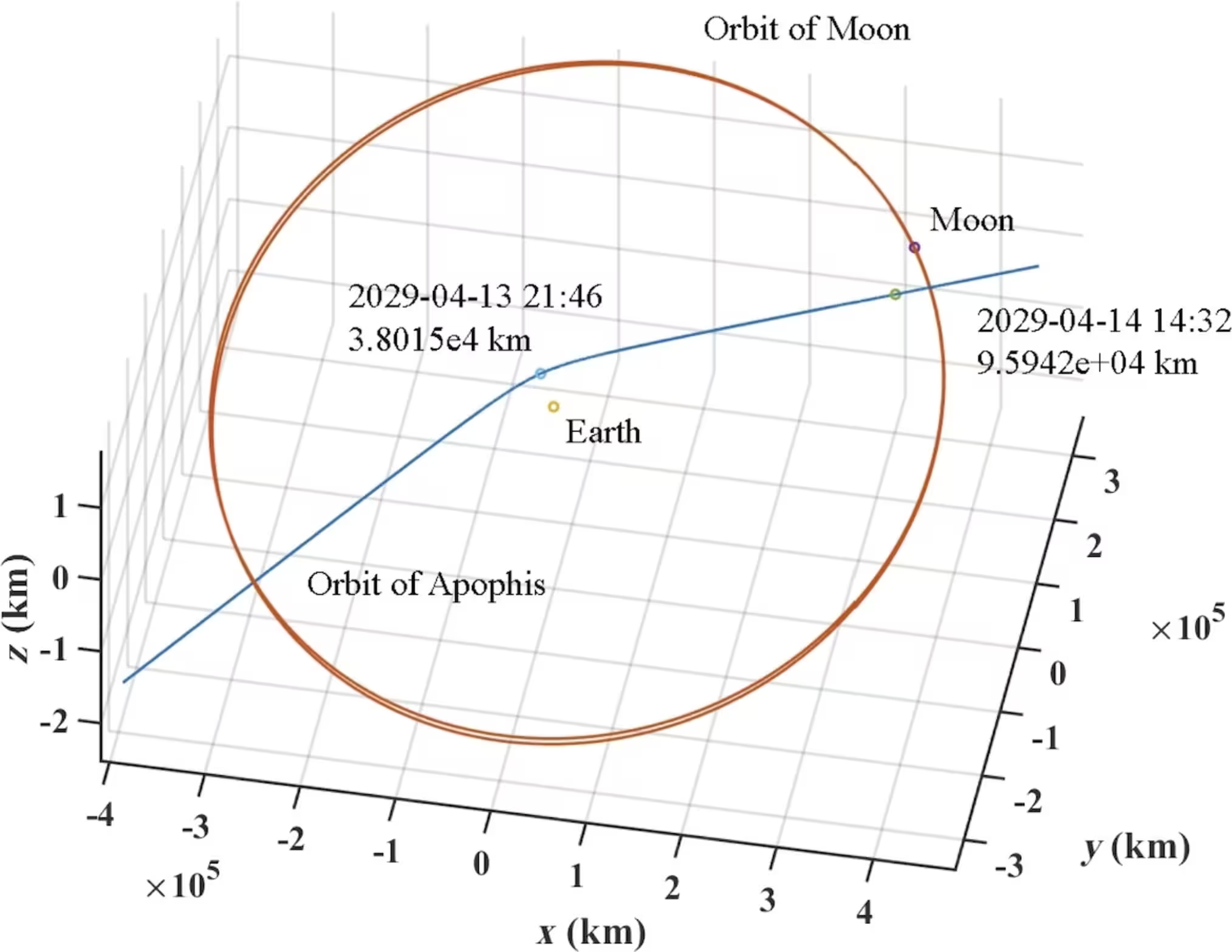
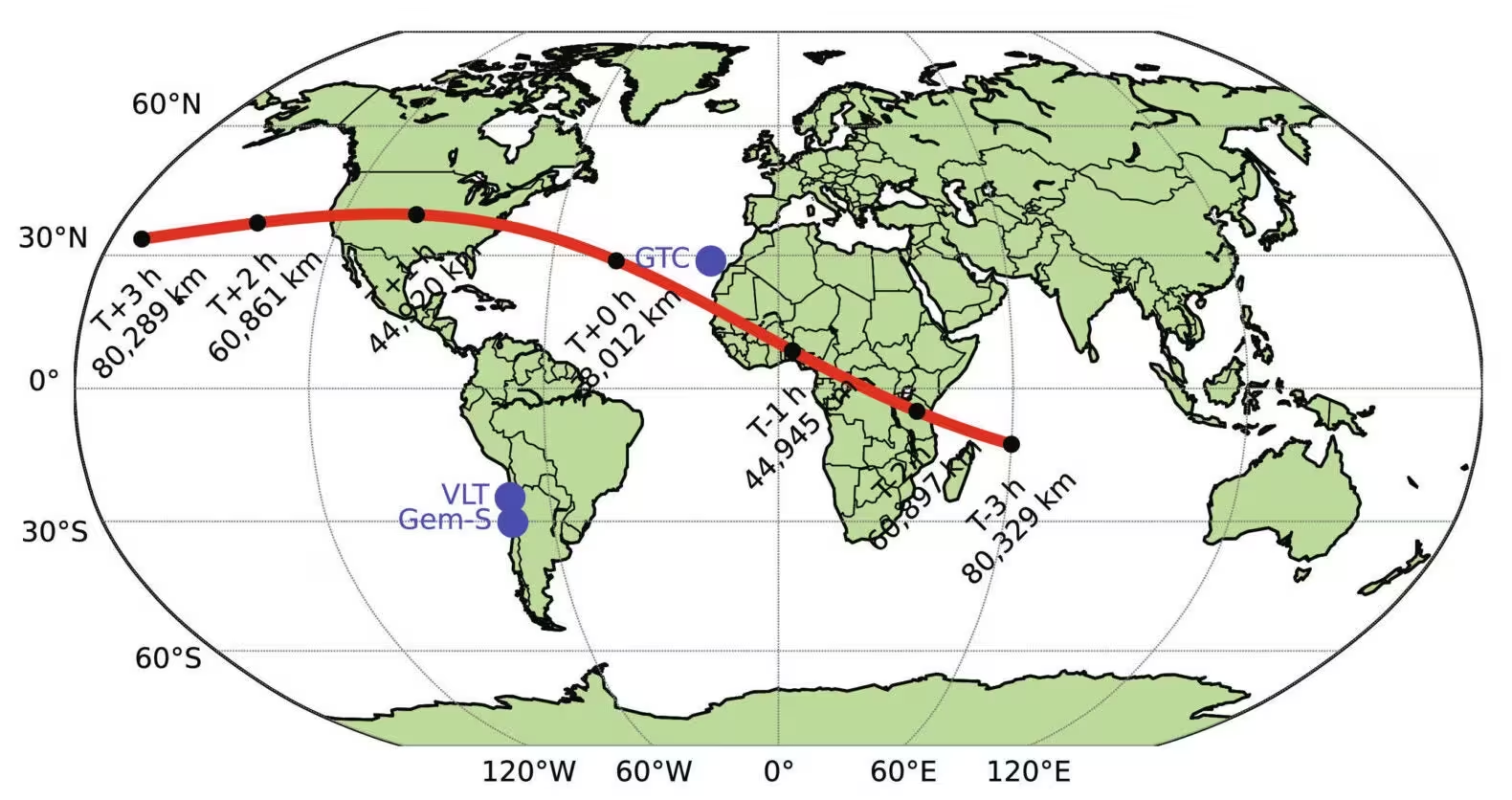
On April 13, 2029, the asteroid 99942 Apophis will make a remarkably close approach to Earth, skimming by at a distance of approximately 38,000 kilometers. This flyby, which brings the 340-meter-wide object within one-tenth of the distance between our planet and the Moon, presents a once-in-a-millennium opportunity for researchers to observe the gravitational interaction between a large asteroid and a planet in real time.
- Apophis will pass roughly 38,000 kilometers from Earth in 2029, offering a unique window to observe how planetary gravity affects a large space rock.
- While the asteroid is expected to experience minor surface shifts and changes to its rotation, it is unlikely to suffer significant structural damage.
- The event will serve as a global benchmark for asteroid science, testing our planetary defense capabilities through a coordinated effort involving radar, telescopes, and visiting spacecraft.
A comprehensive study published in the journal Space: Science & Technology, led by Li Jianyang of Sun Yat-sen University, synthesizes current data and mission planning regarding this upcoming encounter. Although initial discovery in 2004 sparked fears of a potential collision, subsequent tracking has ruled out any impact risk for at least the next century. Instead, the asteroid has become a prime subject for studying the fundamental properties of near-Earth objects.
Insights into the Asteroid’s Composition and Behavior
Observations indicate that Apophis is an elongated, asymmetric body that exhibits a complex tumbling motion rather than a stable rotation. With a rotation period of approximately 30.6 hours and a density of 1.95 grams per cubic centimeter, experts suspect the object is a “rubble pile”—a loosely held collection of boulders and dust—rather than a solid, monolithic rock. During the 2029 pass, Earth’s gravitational field is expected to pull on this fragile structure, potentially shifting its orbit from an Aten-type to an Apollo-type trajectory and inducing a measurable change in its spin.
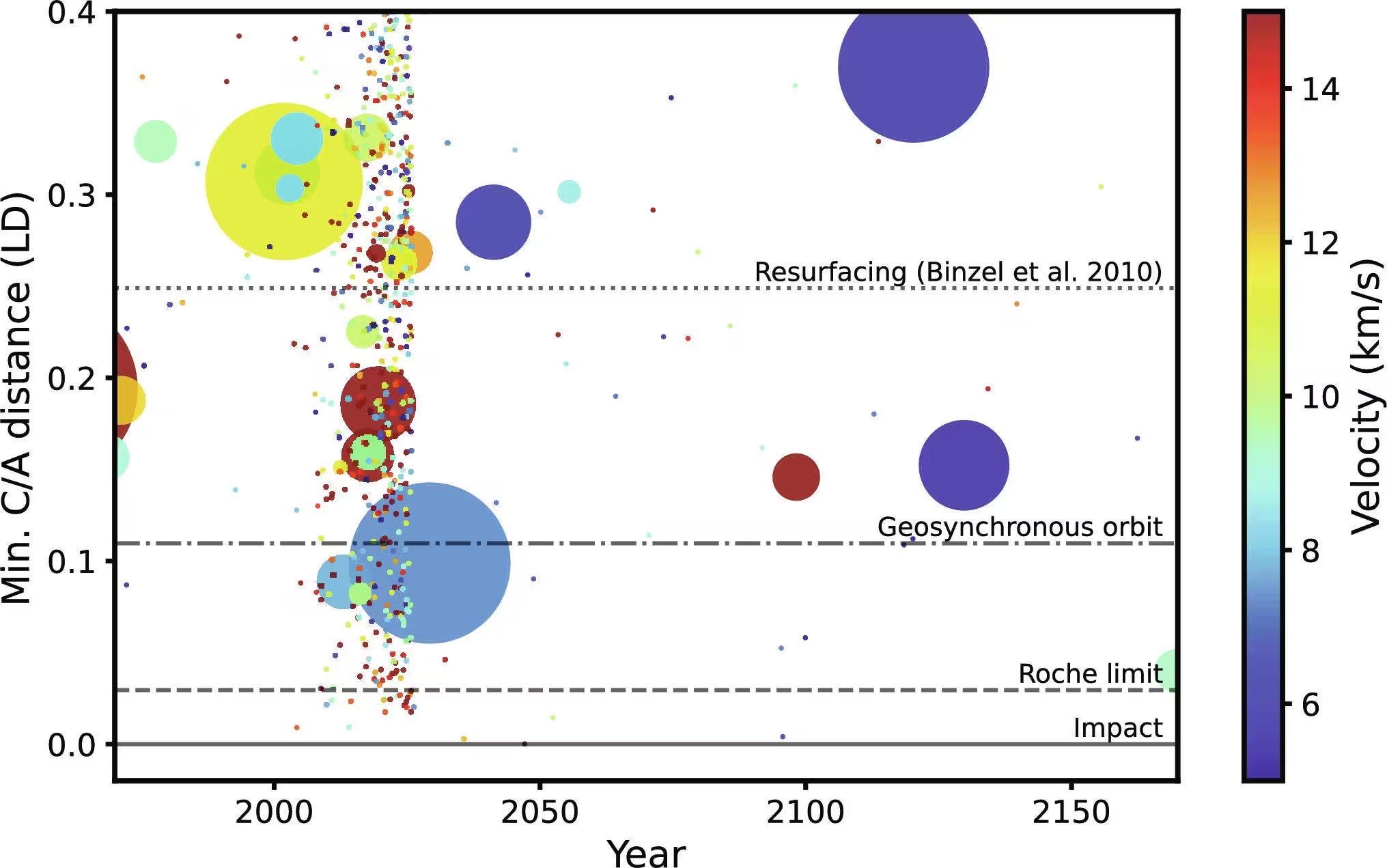
While the asteroid will remain safely outside Earth’s Roche limit, preventing total structural disintegration, researchers anticipate subtle surface changes. Simulations predict that up to one percent of the surface could experience minor landslides or shifting of surface grains. Such activity could expose fresh material, helping scientists understand how planetary encounters contribute to the physical weathering of asteroids over time. Additionally, the weak gravitational pull of the asteroid might allow loose dust particles to rise hundreds of meters above the surface, potentially interacting with Earth’s magnetosphere.
Global Scientific Coordination
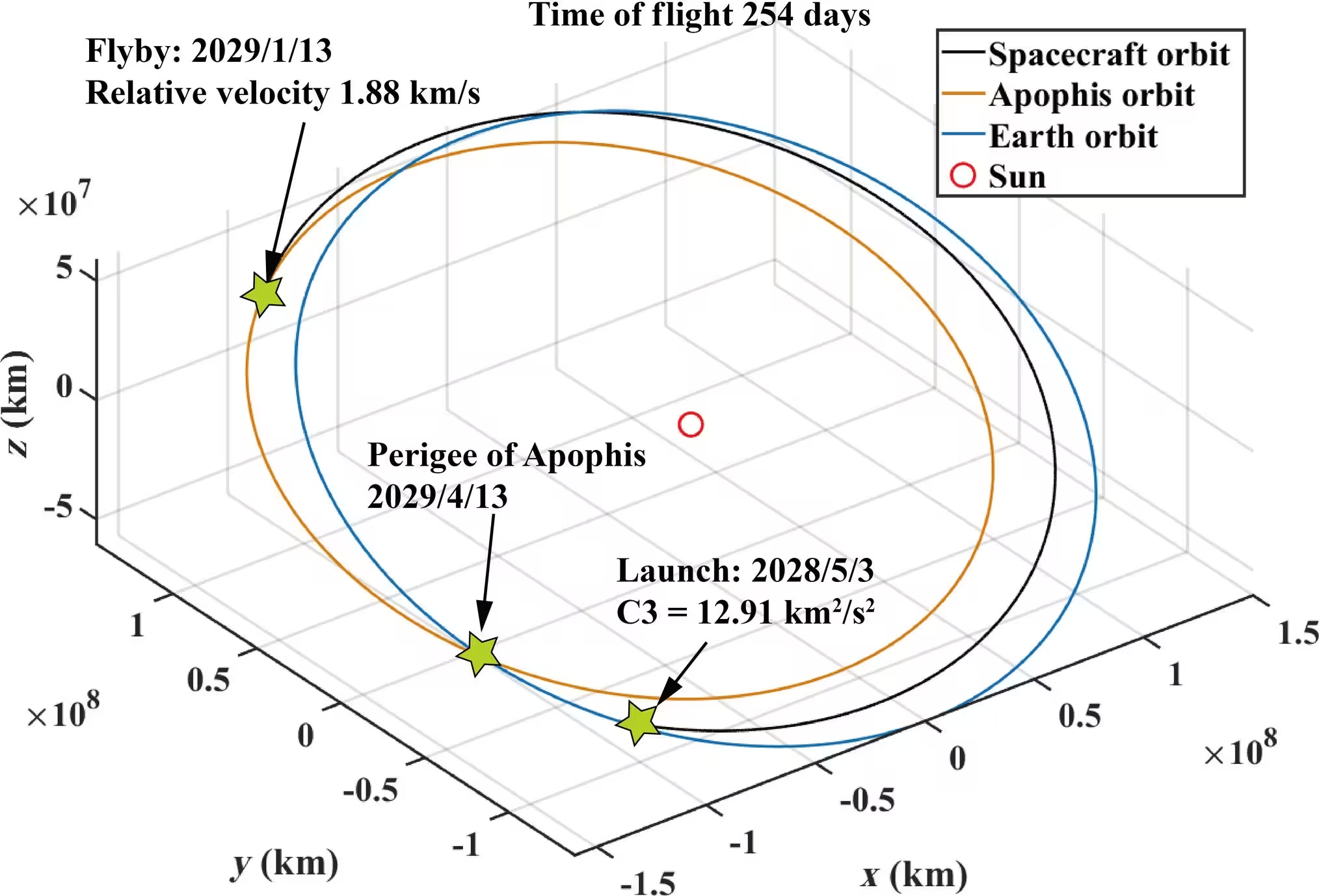
The flyby has galvanized the international space community, with several missions currently in development to study the event. NASA’s OSIRIS-APEX spacecraft is slated to arrive shortly after the encounter to map the surface and investigate the internal structure. Meanwhile, the European Space Agency’s RAMSES mission aims to arrive earlier, providing a front-row seat to the gravitational interaction as it happens.
Beyond spacecraft, the event will rely on ground-based observation. China’s Compound Eye radar system is expected to track the asteroid with unprecedented precision, and the object will be bright enough to be visible to the naked eye for millions of people across Europe, Africa, and the Americas. This creates an unparalleled opportunity for the International Asteroid Warning Network to stress-test global communication, tracking, and planetary defense protocols.
![Shape and spin state of Apophis. (A to C) Nonconvex shape model based on radar [10]. (D) Short-axis tumbling period convention for Apophis.](https://www.bioscience.com.pk/images/50148da16c.avif)
By studying how a rubble-pile asteroid reacts to the tidal forces of a planet, scientists hope to refine their models for future kinetic-impact defense missions. Whether it is improving the accuracy of long-term trajectory predictions or understanding how asteroids are affected by thermal forces like the Yarkovsky effect, the Apophis flyby represents a landmark test for our ability to secure the planet against future cosmic threats.
This article has been fact checked for accuracy, with information verified against reputable sources. Learn more about us and our editorial process.
Last reviewed on .
Article history
- Latest version
Reference(s)
- Wu, Jin-Ze., et al. “Preliminary Hot-Fire Test of Ammonium Dinitramide-Based Thrusters Based on Electrical Ignition.” Space: Science & Technology, vol. 6, July 2, 2026 American Association for the Advancement of Science (AAAS), doi: 10.34133/space.0493. <https://spj.science.org/doi/10.34133/space.0493>.
- Adkins, Jamie. “OSIRIS-APEX - NASA Science.”, October 31, 2023 NASA <https://science.nasa.gov/mission/osiris-apex/>.
- “iawn: IAWN Home.” <https://iawn.net/>.
Cite this page:
- Posted by Aisha Ahmed