Astronomers Just Discovered A Rare Four Star System With A Bizarre Triple Eclipse Pattern
Astronomers have confirmed the discovery of a rare four-star system featuring a unique eclipse pattern, as captured by NASA’s TESS mission.

Astronomers have identified a unique quadruple star system, known as TIC 433545934, which displays an unprecedented level of orbital synchronization. In this rare 2+2 configuration, two distinct binary pairs orbit a common center of gravity, with the system exhibiting not only individual stellar eclipses but also a rare event where one binary pair passes in front of the other.
Understanding the Mechanics of a 2+2 Quadruple System
In a 2+2 quadruple system, four stars are divided into two independent binary pairs. Each pair consists of two stars in a tight mutual orbit, and these two sets then circulate around one another at a significantly greater distance. Distinguishing these true gravitationally bound systems from mere line-of-sight alignments—where stars appear close together but are physically unrelated—is a major hurdle for researchers.
To confirm the structure of TIC 433545934, a team led by Tamás Borkovits of the Baja Astronomical Observatory in Hungary analyzed subtle variations in eclipse timing. The gravitational influence exerted by each binary pair on the other creates predictable, synchronized shifts in their orbital motion, which served as a cosmic signature confirming the four stars are indeed a single, cohesive entity.
NASA’s TESS Captures a Rare Triple-Dip Eclipse
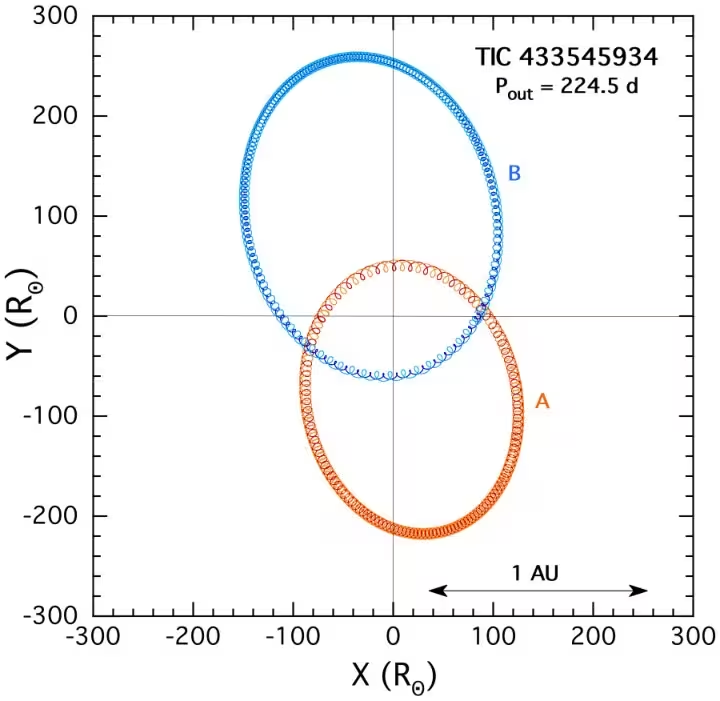
The most striking observation of the system involves a “triple-dip” eclipse event, documented by NASA’s TESS satellite. This phenomenon occurs when one binary system traverses the path of the other, resulting in a series of brightness fluctuations that reveal the interaction between the two pairs. Researchers noted that this alignment is highly specific, occurring in only one direction due to the elongated, eccentric nature of the outer orbit, which prevents a reciprocal eclipse.
Precise Alignment Within a Complex Architecture
According to the findings, which have been accepted for publication in Astronomy & Astrophysics and are available via arXiv, the system is remarkably well-ordered. The two inner binaries orbit every 1.4 and 2.1 days, respectively, while the entire complex completes a full outer rotation every 224.5 days. Remarkably, the orbital planes of these four stars are aligned to within approximately two degrees of one another, a level of geometric precision rarely seen in such complex stellar arrangements.
The system also highlights the diversity of stellar evolution. The first binary pair consists of stars with similar, slightly evolved characteristics, while the second pair features a striking imbalance, with one massive, dominant star paired with a much smaller companion. By providing a rare look at how such distinct stellar pairs remain stable within a single gravitational influence, TIC 433545934 offers a vital natural laboratory for astronomers studying the formation and long-term survival of multiple-star systems.
This article has been fact checked for accuracy, with information verified against reputable sources. Learn more about us and our editorial process.
Last reviewed on .
Article history
- Latest version
Reference(s)
- Borkovits, Tamás. “TIC 433545934: The first 2+2 type doubly eclipsing binary with extra, mutual eclipses.” arXiv.org <https://arxiv.org/abs/2608.13034v1>.
Cite this page:
- Posted by Aisha Ahmed