Webb Telescope Finds Surprisingly Familiar Ingredients on an Interstellar Comet
Webb telescope observations of interstellar comet 3I/ATLAS reveal unique dusty ice, suggesting shared planet-building blocks across distant solar systems.
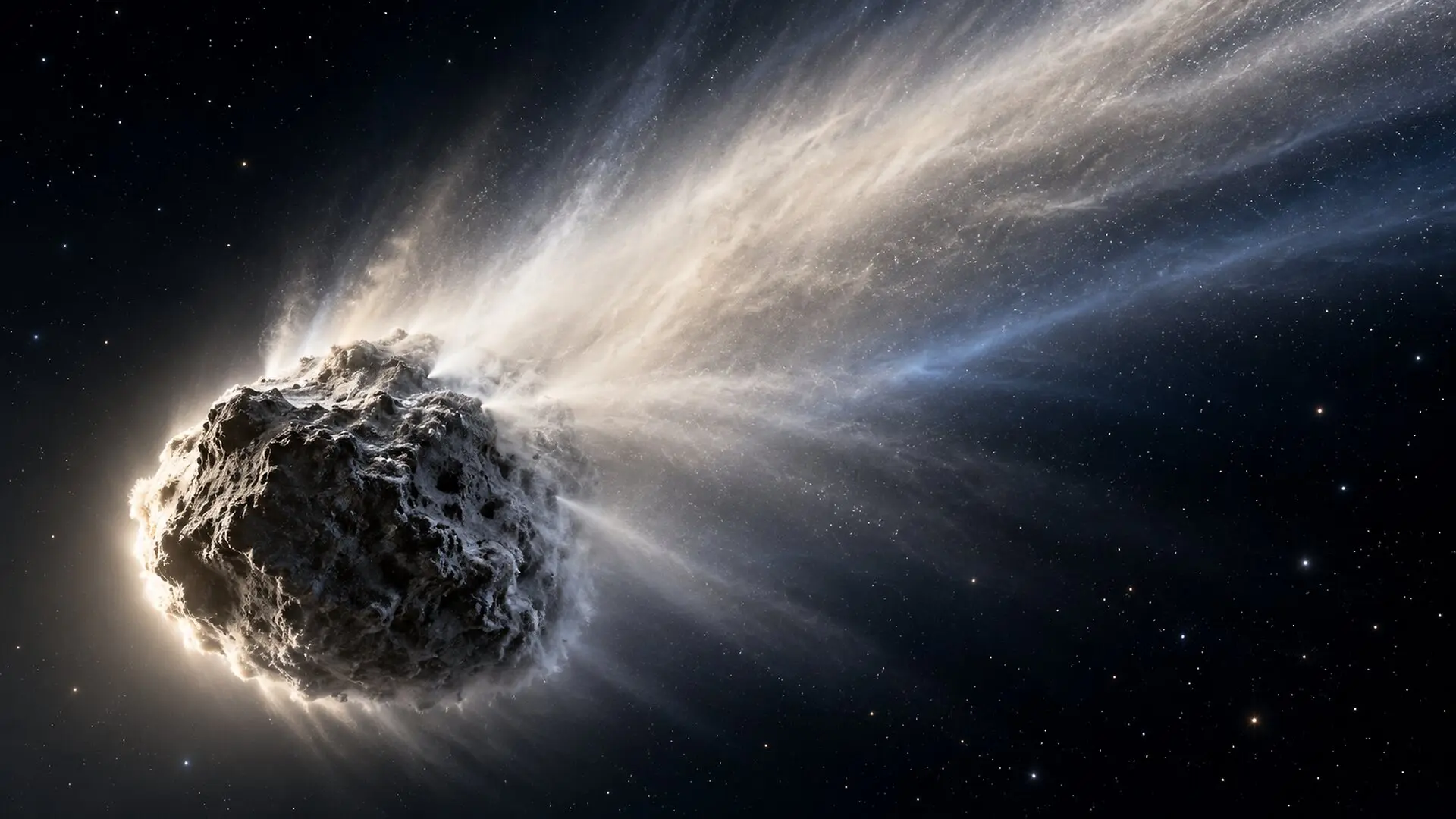
Data captured by the James Webb Space Telescope (JWST) has unveiled a curious composition within the interstellar comet 3I/ATLAS, suggesting it carries a heavy load of dust tightly bound with water ice. This discovery provides a rare, high-resolution glimpse into the building blocks of planetary systems far beyond our own, revealing a surprisingly familiar profile that mirrors certain icy bodies lurking at the fringes of our solar system.
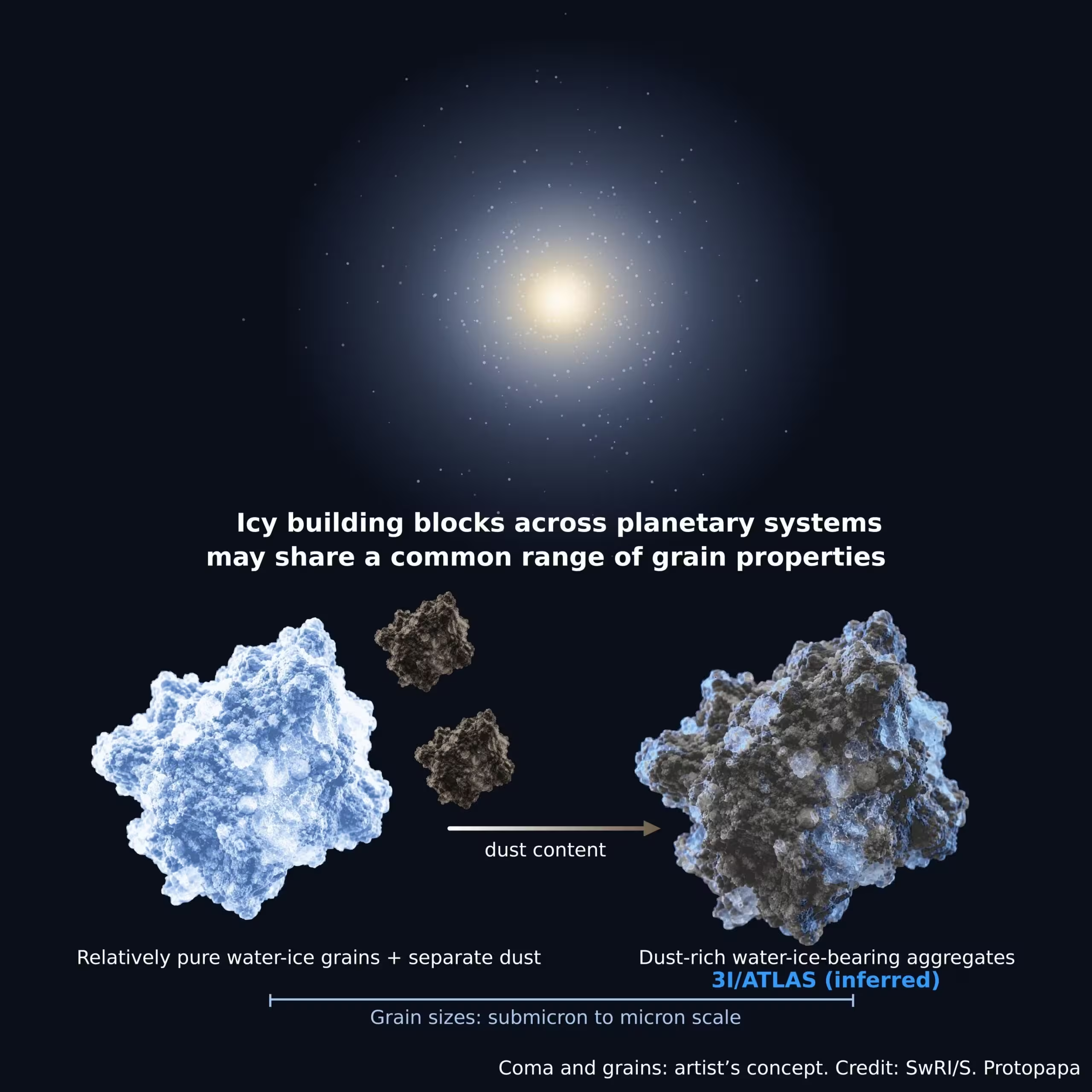
A research team led by the Southwest Research Institute detailed these findings in The Astrophysical Journal Letters. By examining the light spectrum emitted by the comet’s coma—the cloud of gas and dust surrounding its nucleus—scientists identified micron-sized particles that appear to be complex aggregates of water ice and rocky debris.
An Interstellar Messenger from Afar
As the third interstellar object ever detected, following the notable 1I/‘Oumuamua and 2I/Borisov, 3I/ATLAS represents a pristine sample of material originating from a foreign star system. While earlier visitors like ‘Oumuamua remained enigmatic due to a lack of cometary activity, 3I/ATLAS has been actively venting gas and solids as it warms in the heat of our Sun, allowing astronomers to analyze its chemical “fingerprint” from afar.
“As 3I/ATLAS warms up, gas escaping from its interior carries ice and dust grains into the surrounding cloud,” explained lead author Silvia Protopapa. “Those grains hold clues to the conditions where the comet was born.”
The observational campaign, spearheaded by Martin Cordiner of NASA’s Goddard Space Flight Center and the Catholic University of America, utilized the JWST’s Near-Infrared Spectrograph to track the object’s evolution across several months, spanning its closest approach to the Sun in late 2025.
Deciphering the Spectral Puzzle
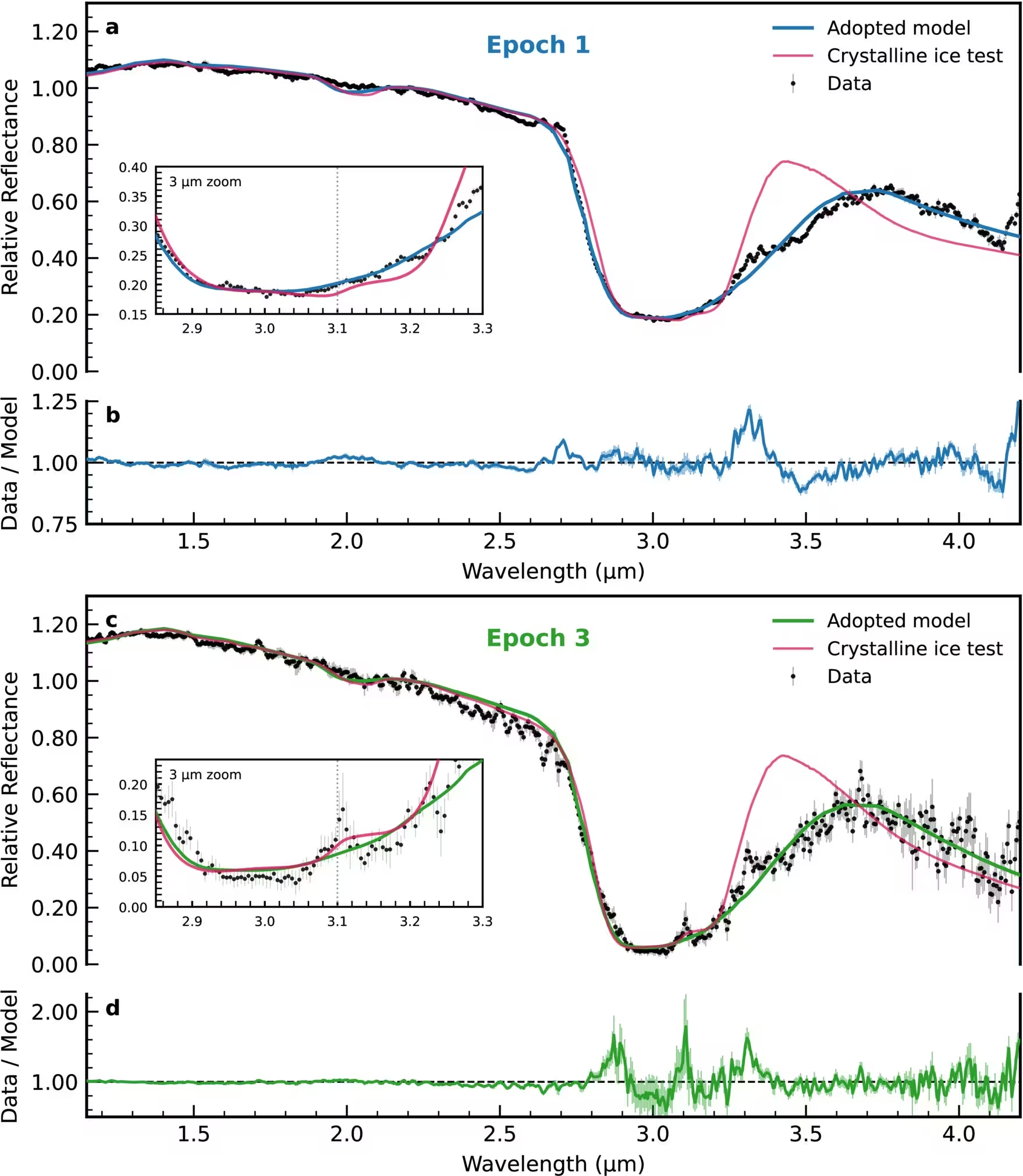
The JWST data presented a paradox for the researchers. While water ice is typically identified by a strong absorption feature at 3 microns accompanied by two distinct, weaker bands at 1.5 and 2.0 microns, the comet showed a clear 3-micron signal while the shorter-wavelength bands were inexplicably faint or entirely missing.
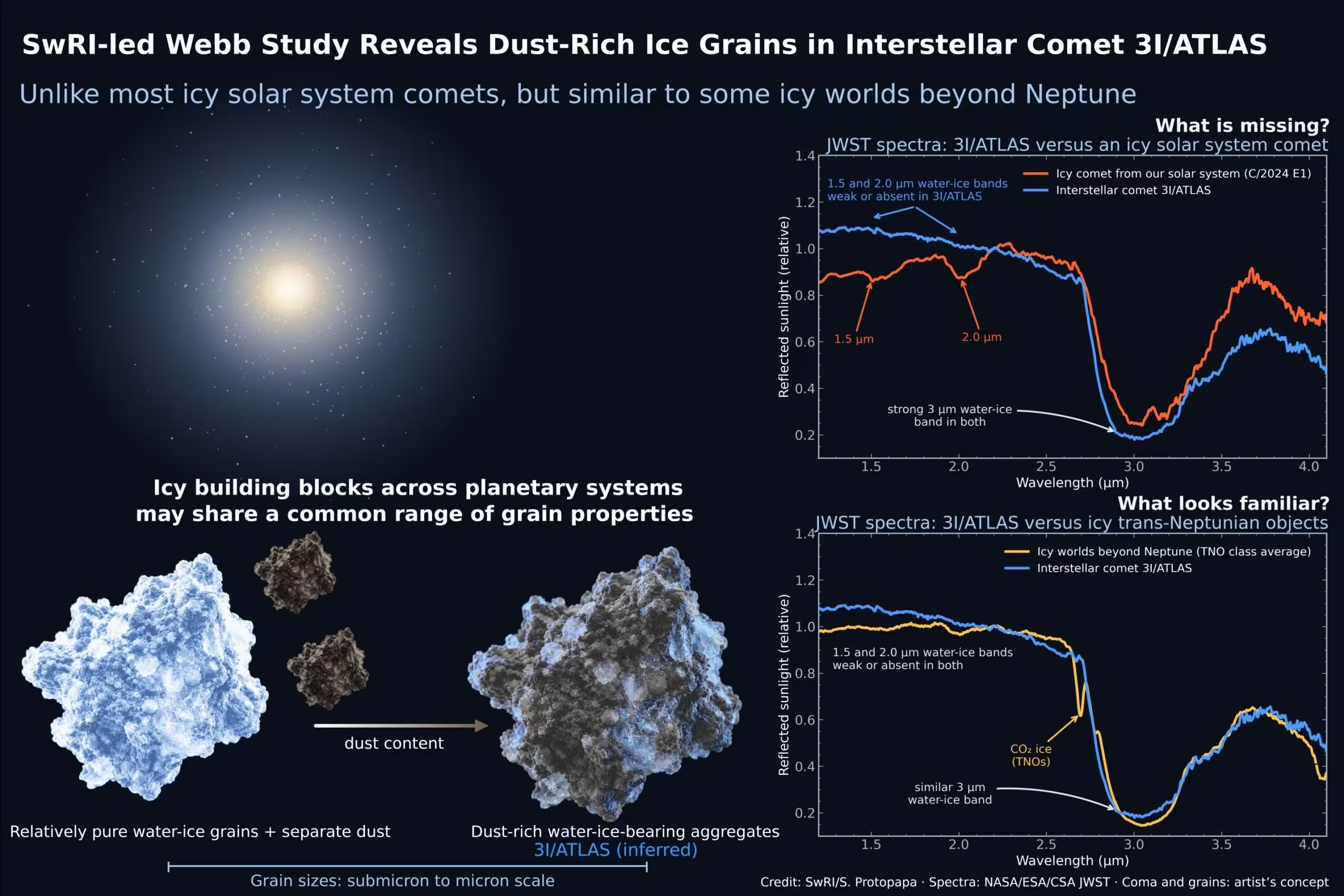
Through sophisticated light-scattering modeling, the team determined that this spectral “mismatch” is likely caused by the unique physical structure of the grains. When ice is intimately mixed with significant amounts of dust in sub-micron-sized particles, the internal path of light through the ice is shortened, effectively masking the weaker spectral signatures while retaining the stronger, more robust 3-micron feature. This suggests that the interstellar comet is not merely a collection of pure ice, but a complex, dust-rich composite.
Shared Origins in the Cosmic Neighborhood
Perhaps most intriguingly, this spectral signature bears a striking resemblance to those observed in various trans-Neptunian objects—the frozen, ancient remnants residing in the outer reaches of our own solar system. This alignment does not necessarily prove that 3I/ATLAS shares a common heritage with our local icy neighbors, but it does indicate that the fundamental processes governing the assembly of planetesimals may be universal.
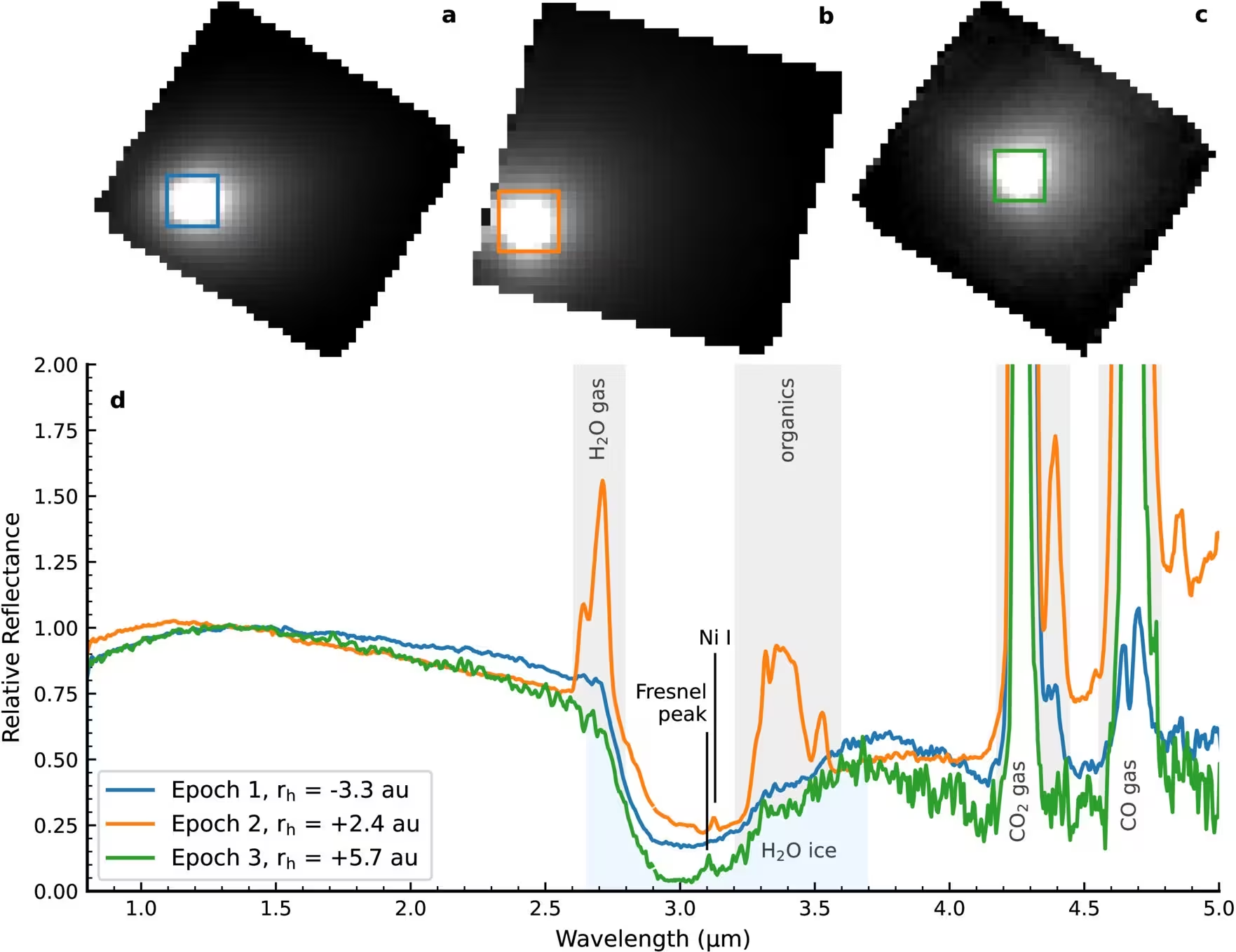
As the comet moved further from the Sun, its spectral profile shifted slightly, hinting at a potential change in the size or composition of the released grains. Whether these changes are the result of thermal degradation, the shedding of outer surface layers, or inherent variations in the comet’s nucleus remains a topic for further investigation.
The findings emphasize the importance of future interstellar arrivals as essential laboratories for planetary science. By comparing these external visitors to the diverse array of icy worlds found within our own system, astronomers hope to refine our understanding of how star systems build planets and whether the dusty, icy “ingredients” found here are standard throughout the galaxy.
Further Reading and Resources
- Isotopic evidence for a cold and distant origin of 3I/ATLAS (Nature, 2026)
- Water ice in the debris disk around HD 181327 (Nature, 2025)
- NASA’s Webb Reveals the Ancient Surfaces of Trans-Neptunian Objects (NASA, 2025)
This article has been fact checked for accuracy, with information verified against reputable sources. Learn more about us and our editorial process.
Last reviewed on .
Article history
- Latest version
Reference(s)
- “Southwest Research Institute | R&D From Deep Sea to Deep Space.” <https://www.swri.org/>.
- Protopapa, Silvia., et al. “JWST Reveals Refractory-rich Water Ice in Interstellar Comet 3I/ATLAS: Evidence for a Continuum of Grain Properties across Protoplanetary Disks.” The Astrophysical Journal Letters, vol. 1011, no. 1, October 26, 2026, pp. L11 American Astronomical Society, doi: 10.3847/2041-8213/aea60d. <https://iopscience.iop.org/article/10.3847/2041-8213/aea60d>.
- <https://www.catholic.edu/>.
- Cordiner, Martin. “Isotopic evidence for a cold and distant origin of 3I/ATLAS - Nature.”, vol. 655, no. 8124, pp. 870-874. Nature, doi: 10.1038/s41586-026-10771-6. <https://www.nature.com/articles/s41586-026-10771-6>.
- Xie, Chen. “Water ice in the debris disk around HD 181327 - Nature.”, vol. 641, no. 8063, pp. 608-611. Nature, doi: 10.1038/s41586-025-08920-4. <https://www.nature.com/articles/s41586-025-08920-4>.
- Sabia, Stephen. “NASA’s Webb Reveals the Ancient Surfaces of Trans-Neptunian Objects - NASA Science.”, February 12, 2025 NASA <https://science.nasa.gov/blogs/webb/2025/02/12/nasas-webb-reveals-the-ancient-surfaces-of-trans-neptunian-objects/>.
Cite this page:
- Posted by Aisha Ahmed