Solar Storm Tonight May Light Up Northern US Sky: See Which States Could See Aurora
A solar eruption may spark visible northern lights in the northern US, giving millions the chance to see this spectacular nighttime display.
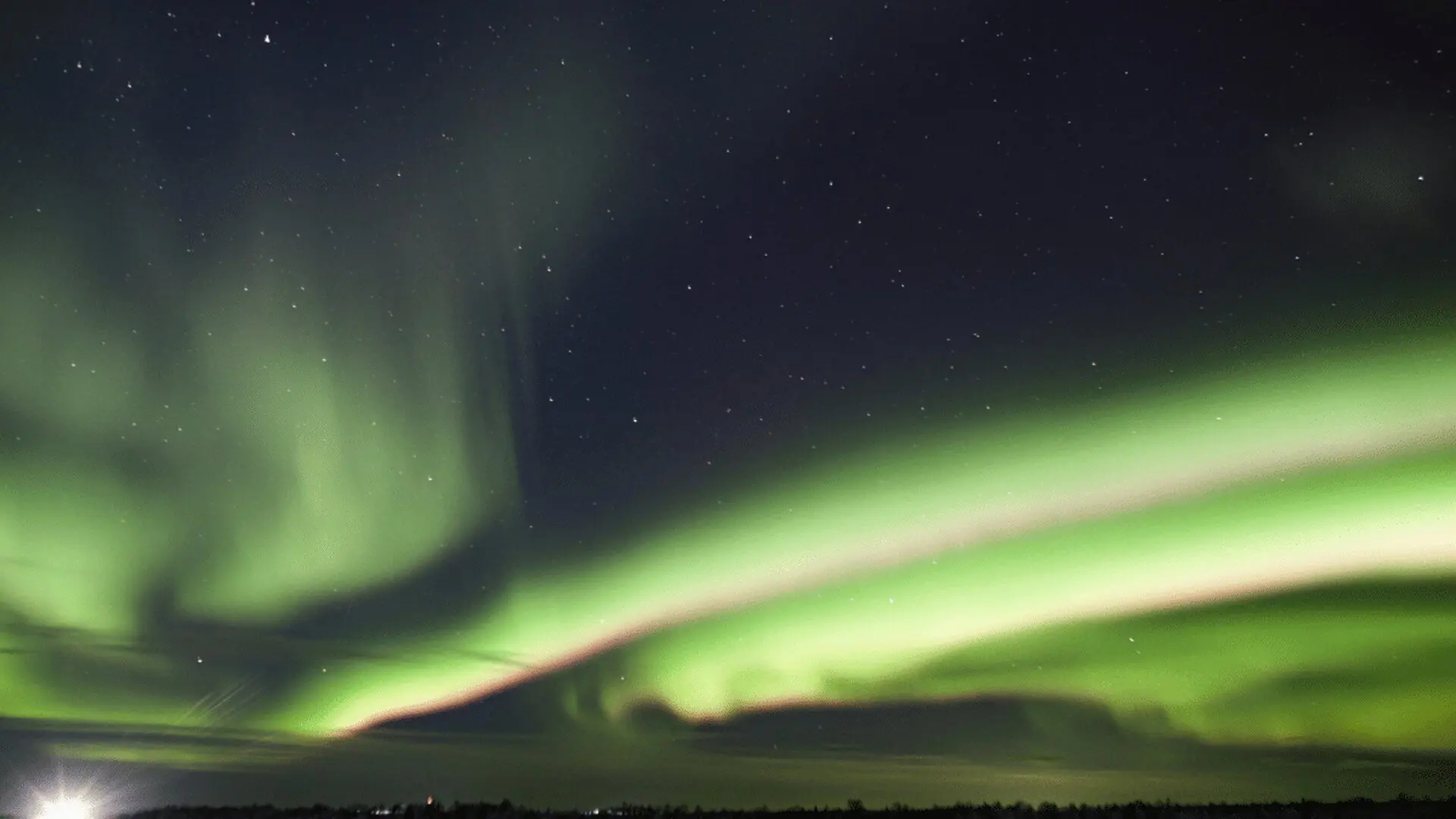
A burst of solar‑driven charged particles is set to strike Earth tonight, offering a window for aurora enthusiasts in the northern United States to see the Northern Lights, provided clouds and light pollution cooperate. NOAA predicts the influx could spark a geomagnetic disturbance ranging from minor (G1) to moderate (G2), enough to make the aurora visible in up to 19 states.
Solar Eruption Propels Charged Cloud Toward Earth
Days ago the Sun expelled a coronal mass ejection (CME), a massive plume of magnetized plasma that travels through space at high speed. Unlike a flash‑like solar flare, a CME carries billions of tons of ionized material that takes several days to arrive. When this plasma collides with Earth’s magnetic shield, it can disturb the magnetosphere and set off a geomagnetic storm.
Current models suggest the incoming CME may trigger a G1 (minor) or G2 (moderate) storm. Although these levels fall short of the most intense storms that light up the entire continent, they are often sufficient to produce auroral curtains along the northern border of the United States. The ultimate brightness will hinge on factors such as cloud cover, ambient light pollution, and the orientation of the interplanetary magnetic field at the moment of impact.
Where the Night Sky Might Glow
The greatest likelihood of a visible display lies near the U.S.–Canada frontier, where geomagnetic activity is naturally stronger. Residents of northern Washington, Idaho, Montana, North Dakota, South Dakota, Minnesota, Wisconsin, Michigan and Maine stand the best chance of spotting the lights.
If the storm briefly intensifies, observers further south in Oregon, Wyoming, Nebraska, Iowa, Illinois, Indiana, Ohio, New York, Vermont and New Hampshire could also catch a faint glow along the northern horizon.
Even modest auroras can be enhanced by modern smartphones, whose camera sensors often reveal colors and structures invisible to the naked eye. Long‑exposure photography remains the most reliable method for documenting moderate geomagnetic events, though clear skies are essential for a memorable experience.
Natural lighting conditions may limit visibility. The lingering twilight after the recent summer solstice keeps the northern sky brighter later into the night, while the bright Full Strawberry Moon could wash out weaker auroral features.
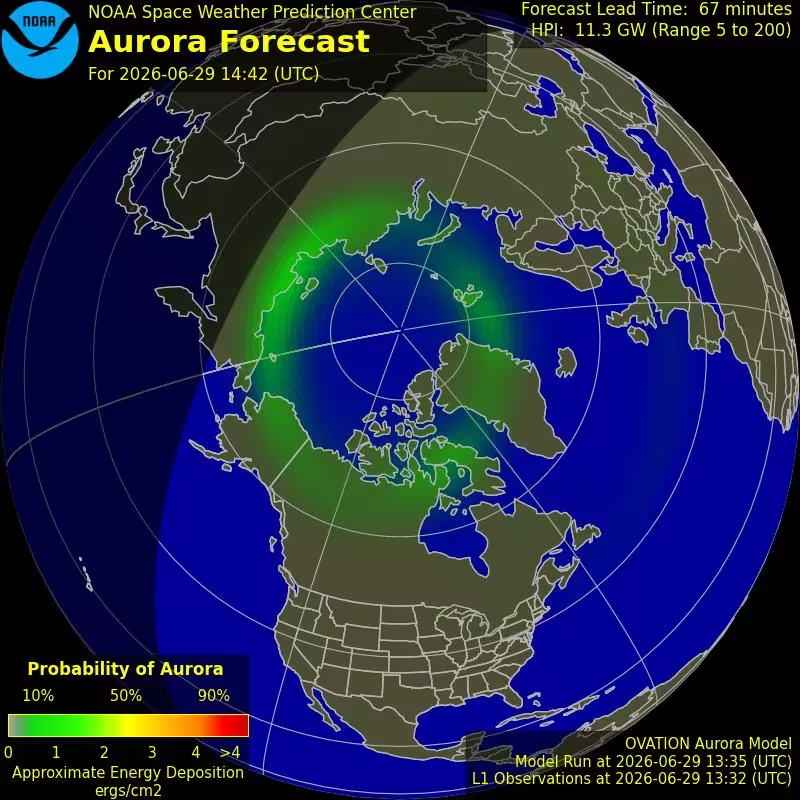
NOAA Forecasts Heightened Geomagnetic Activity Tonight
The Space Weather Prediction Center warns that geomagnetic conditions are likely to intensify as the CME merges with Earth’s magnetic field during the early morning hours. Predicting the exact storm strength remains challenging until the solar wind reaches the planet, because the critical factor is the Bz component of the interplanetary magnetic field. A southward‑oriented Bz links more efficiently with Earth’s field, allowing greater solar energy to pour into the magnetosphere and fueling brighter auroras.
Because magnetic orientation can shift rapidly, NOAA updates its forecasts throughout the event. An initially modest storm can amplify quickly if conditions become favorable, while a stronger forecast may weaken if the incoming plasma arrives with a different magnetic alignment. Scientists are closely monitoring real‑time solar wind data to refine their predictions as the situation unfolds.
This article has been fact checked for accuracy, with information verified against reputable sources. Learn more about us and our editorial process.
Last reviewed on .
Article history
- Latest version
Reference(s)
- “Aurora - 30 Minute Forecast | NOAA / NWS Space Weather Prediction Center.” <https://www.spaceweather.gov/products/aurora-30-minute-forecast>.
Cite this page:
- Posted by Karan Das