Hubble Spots a Stunning Cosmic Illusion That Could Expose Hidden Dark Matter
A distant galaxy distorted by gravity is helping NASA calibrate its next space telescope to map the universe’s mysterious invisible dark matter.
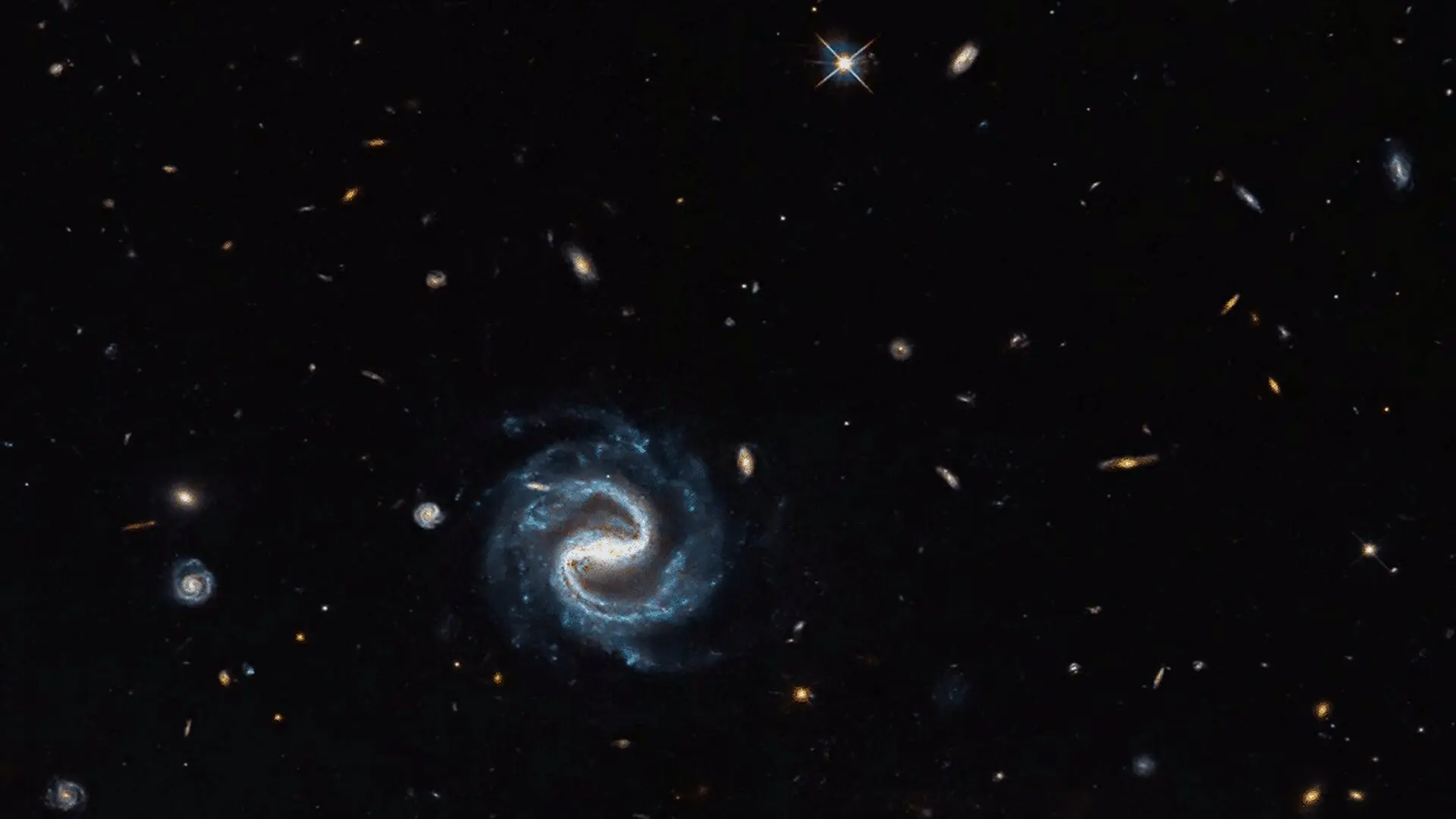
A striking new image from the Hubble Space Telescope captures a cosmic distortion where a distant, background galaxy is stretched into two distinct, curved arcs. This visual anomaly is not merely a celestial curiosity but a classic demonstration of gravitational lensing, a phenomenon where the intense gravity of a foreground object bends light from more remote sources across billions of light-years.
Mapping the Universe’s Invisible Framework
The scene features a prominent elliptical galaxy situated approximately 4.5 billion light-years from Earth. Positioned directly behind this massive structure, a second galaxy located roughly 8 billion light-years away serves as the light source. As this light travels toward our telescopes, the foreground galaxy acts as a cosmic magnifying glass, warping the background object into an arc-counterarc pair.
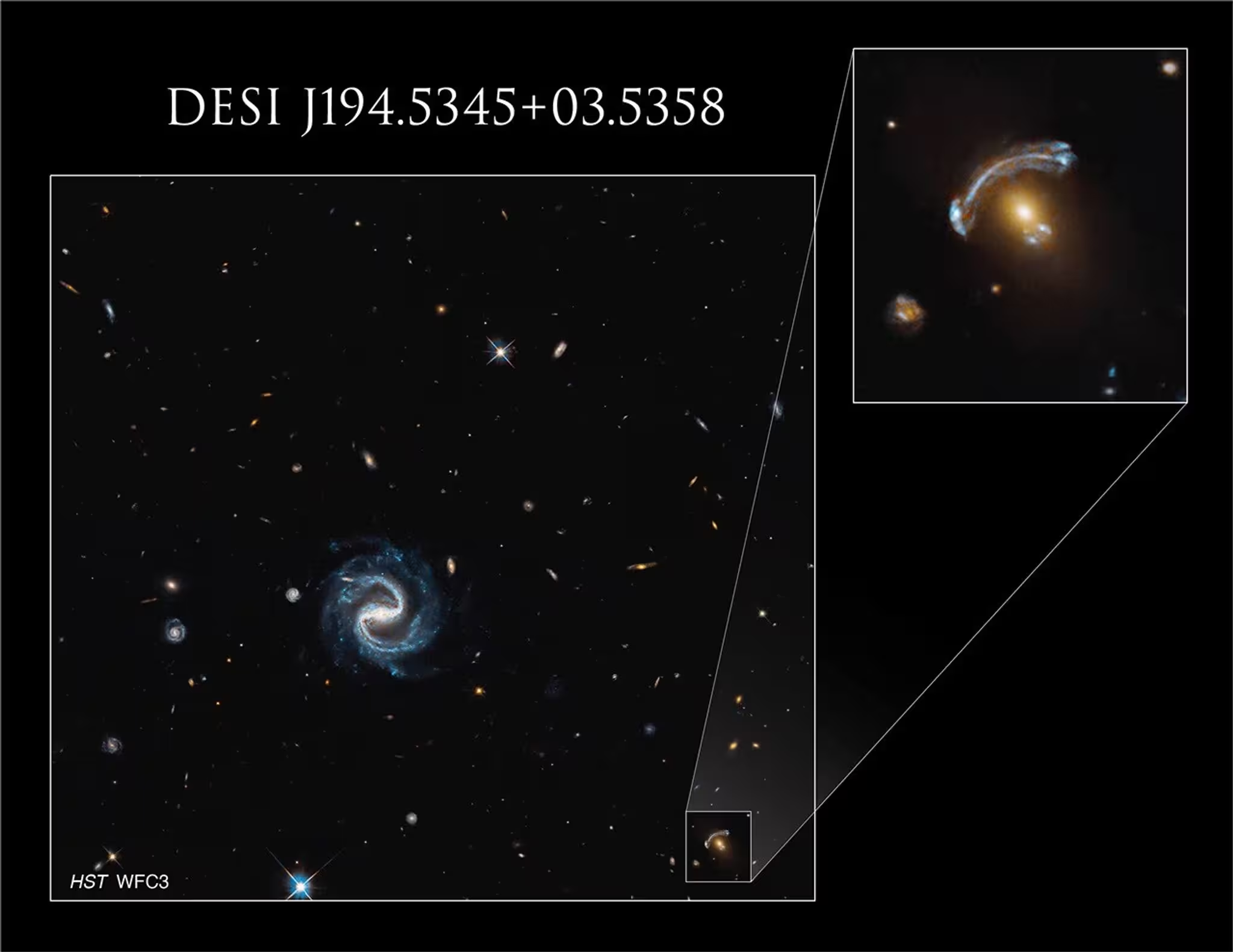
Beyond the aesthetic appeal of the image, the geometry of these arcs provides a crucial diagnostic tool for astrophysicists. Because the degree of light-bending is directly tied to the total mass of the lens, these distortions allow scientists to “weigh” the foreground galaxy. This is a vital approach for probing dark matter, the elusive, invisible substance that makes up the bulk of the universe’s mass but does not interact with electromagnetic radiation. By analyzing how these arcs deviate from models based on visible stars and gas, researchers can map the distribution of invisible dark matter halos that extend far beyond the reach of conventional detection.
Bridging Hubble and the Roman Space Telescope
While Hubble’s legacy is defined by its unparalleled spatial resolution and depth, it operates with a relatively narrow field of view. To gain a truly comprehensive understanding of dark matter on a galactic scale, NASA is preparing the Nancy Grace Roman Space Telescope. Designed for wide-field surveys, the Roman mission will scan vast swaths of the sky, identifying thousands of gravitational lenses that would be impossible to target one-by-one with existing instruments.
The current Hubble observations act as a high-resolution pilot program for this upcoming era of survey astronomy. Astronomers are using the sharp, detailed data from Hubble to refine the computer algorithms and analytical techniques required to process the massive influx of data expected from Roman. These models must be robust enough to interpret complex distortions across a diverse array of galactic structures and distances.
Ultimately, the two observatories are set to form a powerful tandem. Hubble will remain the primary tool for detailed, high-resolution follow-up studies, while Roman will provide the statistical breadth needed to draw large-scale conclusions about the cosmic web. By combining Hubble’s precision with Roman’s broad observational reach, scientists hope to bridge the gap between our current snapshot of the universe and a more unified understanding of how dark matter shapes the evolution of galaxies.
The official NASA documentation highlights that these foundational efforts are essential to preparing for the next generation of space-based exploration, ensuring that when the Roman Space Telescope begins its mission, researchers will have the frameworks in place to decode the gravitational fingerprints of the invisible universe.
This article has been fact checked for accuracy, with information verified against reputable sources. Learn more about us and our editorial process.
Last reviewed on .
Article history
- Latest version
Reference(s)
- Vogel, Tracy. “NASA’s Hubble Charts Path for Roman with Gravitational Lenses - NASA Science.”, October 22, 2026 NASA <https://science.nasa.gov/missions/hubble/nasas-hubble-charts-path-for-roman-with-gravitational-lenses/>.
Cite this page:
- Posted by Karan Das