Astronomers Just Found A Cosmic Giant That Challenges Our Understanding Of Dark Matter
A colossal galaxy cluster found in a massive cosmic collision is challenging our understanding of dark matter, suggesting the universe may be more complex.
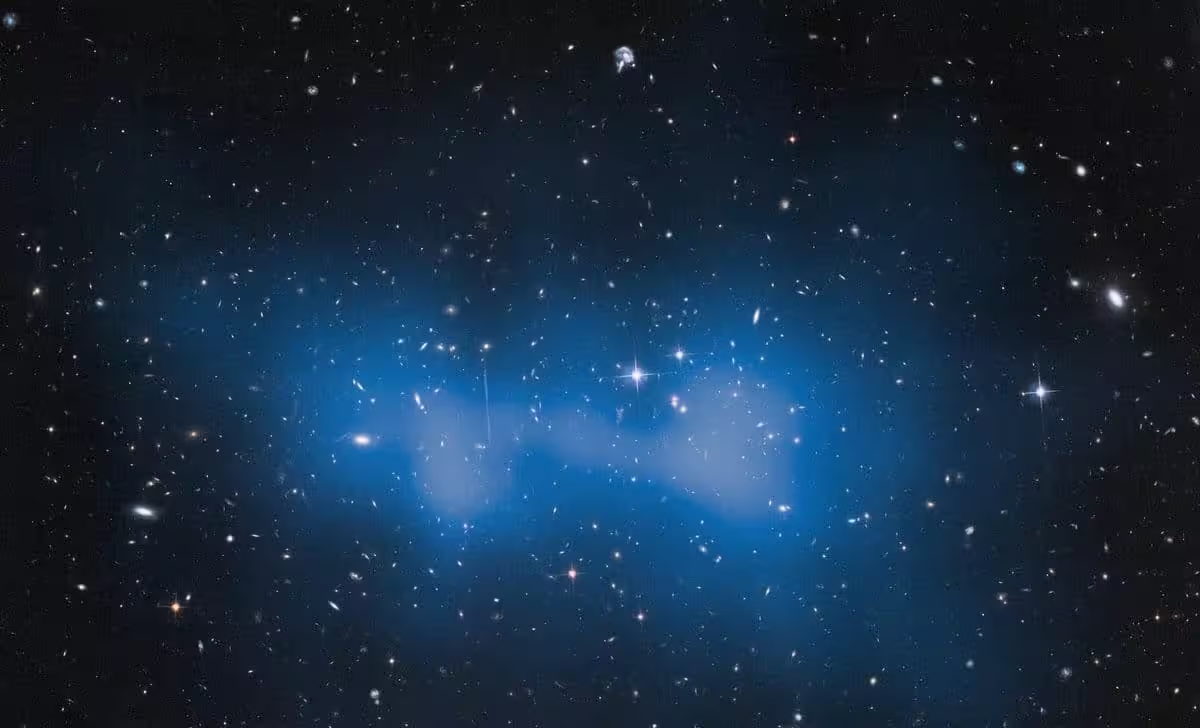
Located approximately 7 billion light-years from Earth, the massive galaxy cluster known as El Gordo—Spanish for “the Fat One”—has long defied standard cosmological expectations. Weighing in at over two quadrillion times the mass of our Sun, this colossal structure is composed of two gargantuan galaxy groups locked in a violent, high-speed collision. The mystery lies in its sheer scale: El Gordo appears far more developed and massive than current models suggest it should be for its age in the early universe.
The existence of such a behemoth challenges the standard cosmological model, which posits that cold dark matter drives the assembly of galaxies and clusters through gravity. Because dark matter is “cold,” its particles possess minimal kinetic energy, meaning the construction of structures as vast as El Gordo should theoretically require more time than the universe had afforded at that stage of its development. As Brian Koberlein has noted, this structural anomaly forces researchers to re-examine the fundamental nature of the dark matter that anchors the cosmos.
Rethinking Particle Dynamics in the Dark Sector
Traditional theories treat dark matter as largely non-interacting, but scientists are increasingly investigating “self-interacting” models to explain the cluster’s evolution. A new study featured in The Astrophysical Journal proposes a departure from the conventional view of monolithic dark matter. Instead, researchers suggest that dark matter particles may exist in two distinct states: a ground state and an excited state.
In this framework, collisions between dark matter particles are not merely elastic bounces that preserve total kinetic energy. When these particles collide with sufficient energy, one may shift into an excited state, effectively siphoning kinetic energy away from the interaction. This energy exchange provides a mechanism for modifying the internal dynamics of the cluster without violating the requirement that dark matter remains predominantly “cold.”
Simulating Cosmic Collisions
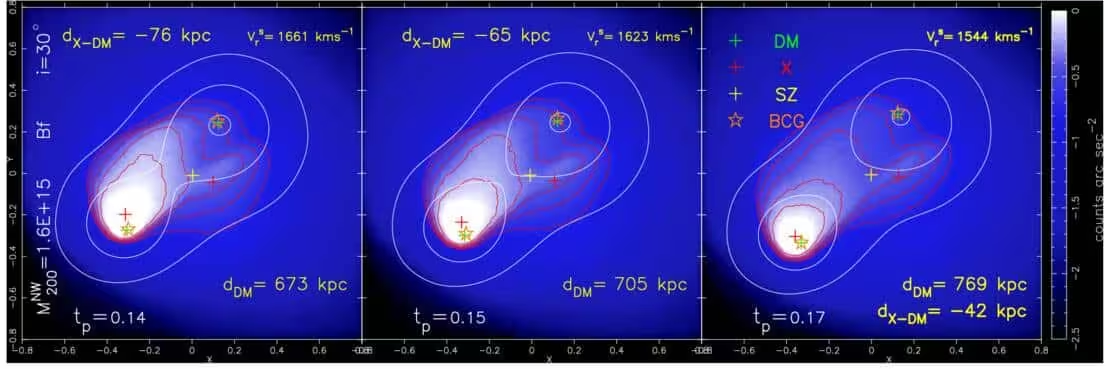
To validate this hypothesis, the research team utilized N-body simulations to model the ongoing merger within El Gordo. They contrasted three scenarios: one featuring non-interacting dark matter, another with standard elastic self-interactions, and the proposed two-state inelastic model. The findings, as detailed in the study, suggest that the two-state model aligns more closely with the observed structural characteristics of the cluster than existing paradigms.
However, the researchers remain cautious. Significant uncertainties persist regarding the exact total mass of El Gordo and the relative velocities of its colliding components. Because the model’s viability is sensitive to these variables, the team acknowledges that if the cluster’s mass sits at the lower end of current estimates, the advantage of the two-state model diminishes. While these results offer a compelling new direction for understanding how dark matter shapes the universe, they remain an intriguing theoretical possibility rather than a confirmed discovery.
This article has been fact checked for accuracy, with information verified against reputable sources. Learn more about us and our editorial process.
Last reviewed on .
Article history
- Latest version
Reference(s)
- “Brian Koberlein.” <https://briankoberlein.com/>.
- Valdarnini, R.. “Hydrodynamical Simulations of the Merging Cluster El Gordo in a Two-state Self-interacting Dark Matter Scenario.” The Astrophysical Journal, vol. 1008, no. 1, August 27, 2026, pp. 105 American Astronomical Society, doi: 10.3847/1538-4357/ae9300. <https://iopscience.iop.org/article/10.3847/1538-4357/ae9300>.
- McCoy, Marty. “Tour of El Gordo Galaxy Cluster - NASA Science.”, August 2, 2023 NASA <https://science.nasa.gov/asset/webb/tour-of-el-gordo-galaxy-cluster/>.
- Cermak, Alicia. “NASA Hubble Team Finds Monster "El Gordo" Galaxy Cluster Bigger Than Thought - NASA Science.”, April 2, 2014 NASA <https://science.nasa.gov/missions/hubble/nasa-hubble-team-finds-monster-el-gordo-galaxy-cluster-bigger-than-thought/>.
Cite this page:
- Posted by Karan Das