Astronomers Unveil the Secret Engine Behind a Red Giant’s Explosive Superflares
Violent eruptions on a distant red giant reveal how a stellar companion and magnetic forces combine to trigger extraordinary, powerful superflares.
Astronomers have finally pinpointed the physical processes responsible for some of the most intense stellar explosions ever recorded in the NASA Kepler field. The research clarifies how the gravitational influence of a companion star, combined with a potent internal magnetic dynamo, can transform an aging red giant into a powerhouse of extreme stellar activity.
The Star That Defies Evolutionary Norms
The subject of this study, KIC 2852961, has long baffled researchers. Typically, as stars transition into the red giant phase, their outer layers expand significantly and their rotational speed decreases, which usually results in a dramatic decline in magnetic flaring. KIC 2852961, however, ignores this trend, exhibiting superflares that dwarf even the most energetic solar events.
A team based at the Konkoly Observatory of the HUN-REN Research Centre for Astronomy and Earth Sciences in Budapest has scrutinized this star for years. Their 2020 analysis of data from NASA’s Kepler space telescope uncovered 59 separate flares and superflares, marking it as the most volatile object in the Kepler sample. The new study, recently accepted for publication in Astronomy & Astrophysics, synthesizes Kepler’s long-term observations with ground-based spectroscopy and astrometric data from the European Space Agency’s Gaia mission to solve the mystery.
“We wanted to find out what makes this particular star so extreme,” said lead author Zsolt Kővári, of HUN-REN CSFK. “Is it the nearby companion star pulling on it? Or something happening deep inside? The answer turned out to be more nuanced than either option alone.”
Gravitational Tides and Rotational Maintenance
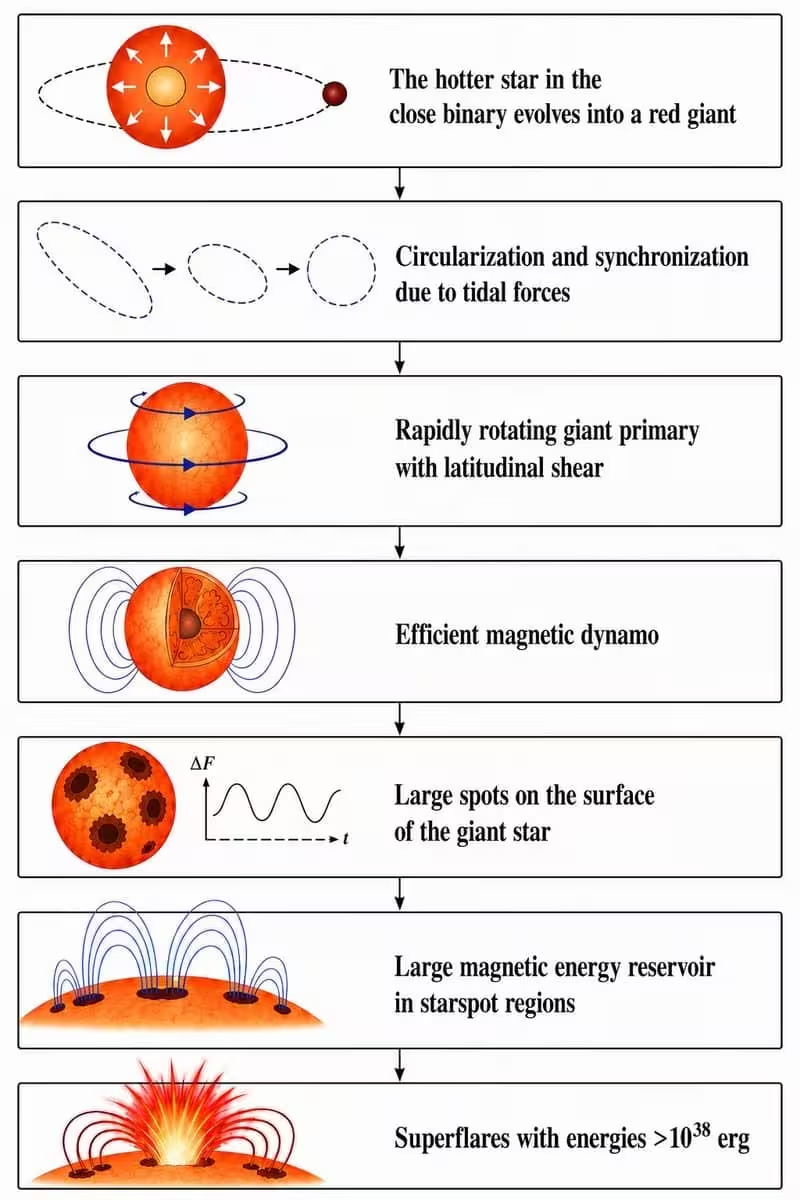
The research reveals that KIC 2852961 is part of a close binary system, orbited by a faint dwarf star. While the companion does not directly spark the flares, its gravitational presence is critical to the giant’s extreme behavior. As the giant star expanded to reach roughly 12 times the Sun’s radius, tidal forces between the two objects began to play a major role in the giant’s internal dynamics.
These tidal interactions work to synchronize the giant’s rotation with its orbit and circularize its path. Because these effects scale dramatically with the ratio of the stellar radius to the orbital separation, they have intensified significantly as the giant has evolved. The system is currently in a state of near-synchronization, a delicate balance that preserves the rotation needed to power high-level magnetic activity while allowing for the persistent rotational differences necessary for generating major flares.
The Dynamo Powering Stellar Outbursts
At the heart of the flare production is differential rotation—the process where different parts of a star rotate at varying speeds. While tidal forces have tempered these differences, they have not fully erased them. This remaining discrepancy is key to fueling an efficient stellar dynamo that amplifies magnetic fields.
“Differential rotation plays a dual role,” explained Kővári. “On one hand, it helps generate and sustain huge starspots on the surface. On the other, it twists and shears the coronal magnetic field lines above those spots—and when these tangled, highly stressed magnetic field lines reconnect, the result is a superflare.”
Kepler data show that the star’s brightness fluctuations are linked to massive, dark starspots that cover significant swaths of its surface. These spots serve as anchors for the magnetic fields. As the star rotates, the differential movement twists these magnetic lines, storing immense energy that is eventually released through magnetic reconnection—an explosive process that manifests as a superflare.
Clarifying the Mechanism of Action
To determine if the companion star was a direct trigger, the researchers looked for a correlation between the binary orbit and the timing of the flares. They found no such pattern, suggesting that the companion is not “flicking a switch” on the giant. Instead, the companion’s role is structural; it maintains the rotational and magnetic conditions within the giant that allow these massive eruptions to occur in the first place. This distinction is vital for researchers studying stellar binary systems, as it proves that intense flaring can be an internal, rather than interaction-driven, phenomenon.
Ultimately, this finding provides a new perspective on how red giants age. It suggests that if the orbital environment is right, a star can maintain the magnetic intensity of its youth long into its twilight years. This discovery adds a crucial layer to our understanding of stellar evolution and the unpredictable nature of space weather in systems far beyond our own solar neighborhood.
This article has been fact checked for accuracy, with information verified against reputable sources. Learn more about us and our editorial process.
Last reviewed on .
Article history
- Latest version
Reference(s)
- Kővári, Zs.. “What powers the most energetic flares in the Kepler field? Revisiting the superflaring star KIC 2852961.” arXiv.org <https://arxiv.org/abs/2610.11799>.
Cite this page:
- Posted by Aisha Ahmed