Hubble Reveals Hidden Dwarf Galaxy Illuminating Cosmic Flows
Revolutionäre Hubble-Aufnahme von ESO 490-017 enthüllt verborgene Strömungen in einer blassen Zwerggalaxie
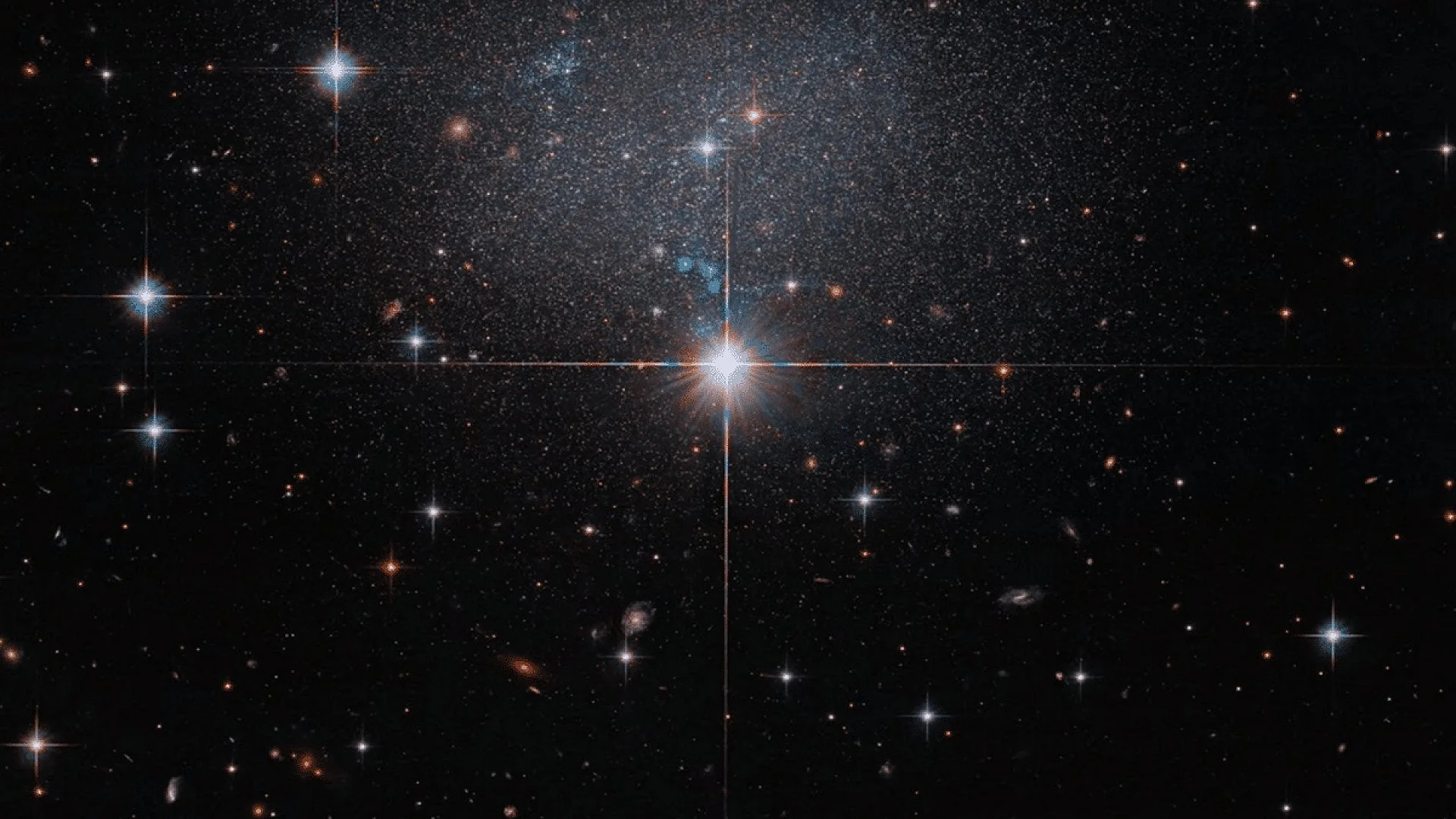
Hubble’s latest snapshot captures the elusive glow of dwarf irregular galaxy ESO 490‑017, situated more than 23 million light‑years from Earth, and provides astronomers with a fresh window onto the forces that steer galaxies through space.
The image, released by NASA, showcases the galaxy’s fragile stellar pattern while also exposing the unseen gravitational currents that govern large‑scale cosmic motion, a key piece in the puzzle of local galaxy behavior and universal dynamics.
Revealing the Faint Dwarf Galaxy ESO 490‑017
Classified as a low‑surface‑brightness system, ESO 490‑017 barely registers against the night sky’s backdrop. Spanning roughly 12 000 light‑years, it resides in the Canis Major constellation, nestled among brighter foreground stars that dominate the field.
Hubble’s sharp optics separate this tenuous star cluster from the glare of nearby stellar objects. The image not only displays the dwarf galaxy but also a scattering of distant galaxies painted in reds, oranges and beiges, many of which reveal faint spiral arms, creating a vivid portrait of the surrounding cosmic landscape.
Such detections are uncommon, as dwarf irregulars often evade surveys due to their dimness and dispersed star populations.
Tracing Galactic Motions with Hubble
The observation forms part of a Hubble initiative aimed at charting the movement of galaxies and clusters across the universe. Variations in matter distribution generate gravitational flows that drive the so‑called cosmic flow, propelling galaxies over vast distances.
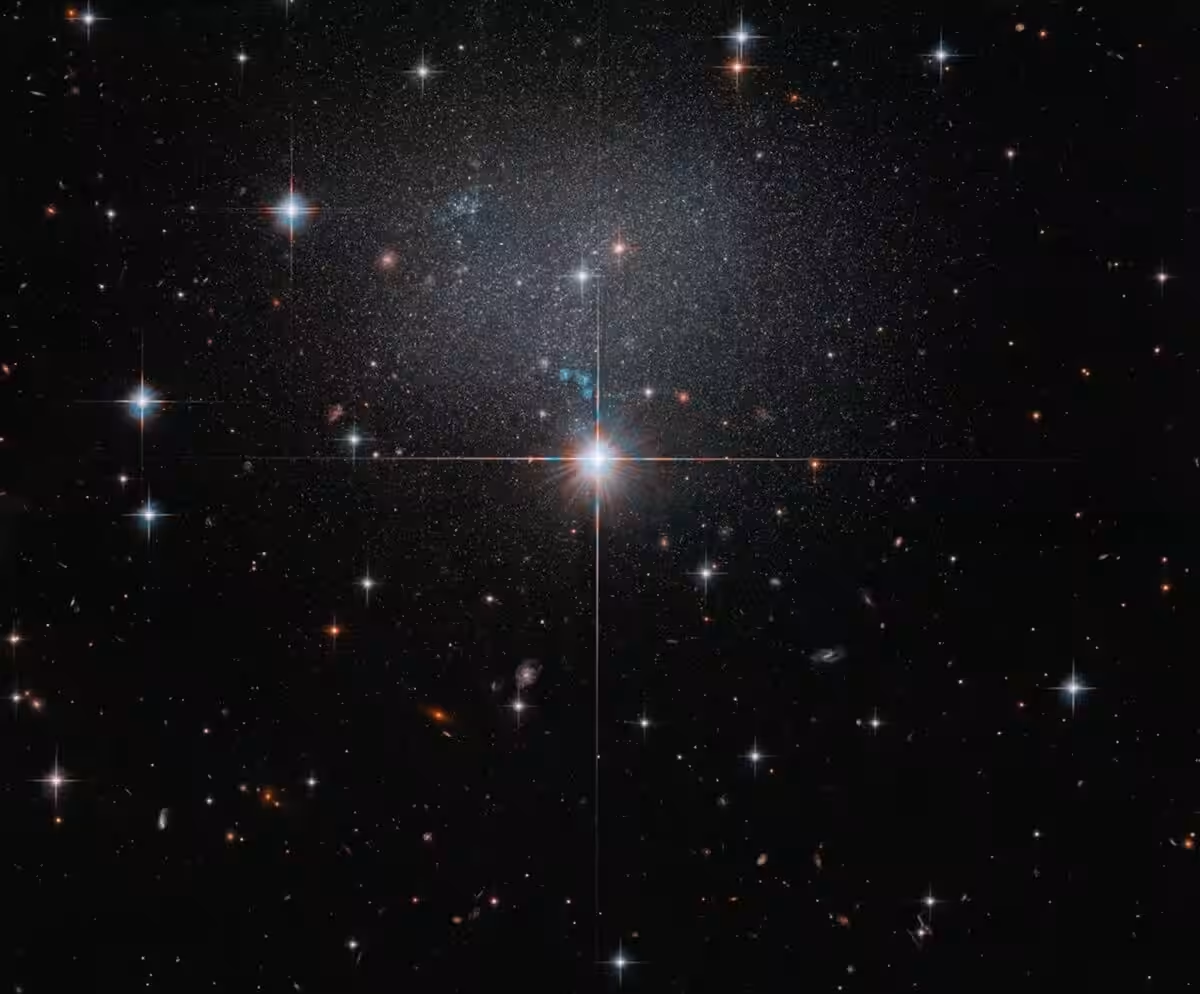
Credit: NASA, ESA, R. Tully (University of Hawaii); Image Processing: G. Kober (NASA/Catholic University of America)
Analyzing objects like ESO 490‑017 enables researchers to map these invisible streams, exposing the gravitational imprint of both ordinary and dark matter over millions of light‑years. The resulting data sharpen theoretical models of structure formation and clarify how galaxies have interacted throughout cosmic history.
Measuring Cosmic Distances via Red Giant Standard Candles
Hubble determines distances to nearby galaxies by employing low‑mass red giant stars as standard candles. By gauging the intrinsic brightness of these stars, astronomers derive precise separations for systems such as ESO 490‑017, thereby constructing a reliable three‑dimensional map of the local universe. This technique proves especially valuable for dwarf galaxies, whose individual stars are otherwise too faint for accurate assessment.
Accurate distance estimates anchor our perception of galactic locations and allow scientists to compare motion patterns on larger scales, shedding light on both the past trajectories and future evolution of the cosmos.
Enriching the Archive of Nearby Stellar Populations
Beyond distance work, the Hubble observation adds to a growing legacy archive of stellar demographics in proximal galaxies. Cataloguing the stellar types within ESO 490‑017 furnishes insights into star‑formation processes and evolutionary pathways in low‑mass environments. These records serve as benchmarks for upcoming surveys and help identify systematic trends across diverse galactic settings.
NASA’s Hubble mission continues to expand this repository, offering both professional researchers and the interested public a deeper appreciation of the universe’s smallest galactic constituents.
This article has been fact checked for accuracy, with information verified against reputable sources. Learn more about us and our editorial process.
Last reviewed on .
Article history
- Latest version
Reference(s)
- Gianopoulos, Andrea. “Hubble Spies Faint Irregular Galaxy - NASA Science.”, May 27, 2026 NASA <https://science.nasa.gov/missions/hubble/hubble-spies-faint-irregular-galaxy/>.
- Amazouz, Lydia. “NASA's Hubble Spots a Stellar Wake Inside Betelgeuse.”, January 6, 2026 The Daily Galaxy - Great Discoveries Channel <https://dailygalaxy.com/2026/01/nasas-hubble-spots-stellar-wake-betelgeuse/>.
Cite this page:
- Posted by Karan Das