China Captures Orbital Rocket Stage in Sea Net, Achieving World’s First Net Recovery
China recovers an orbital rocket’s first stage with a sea‑based net, achieving a key milestone in reusable launch technology.
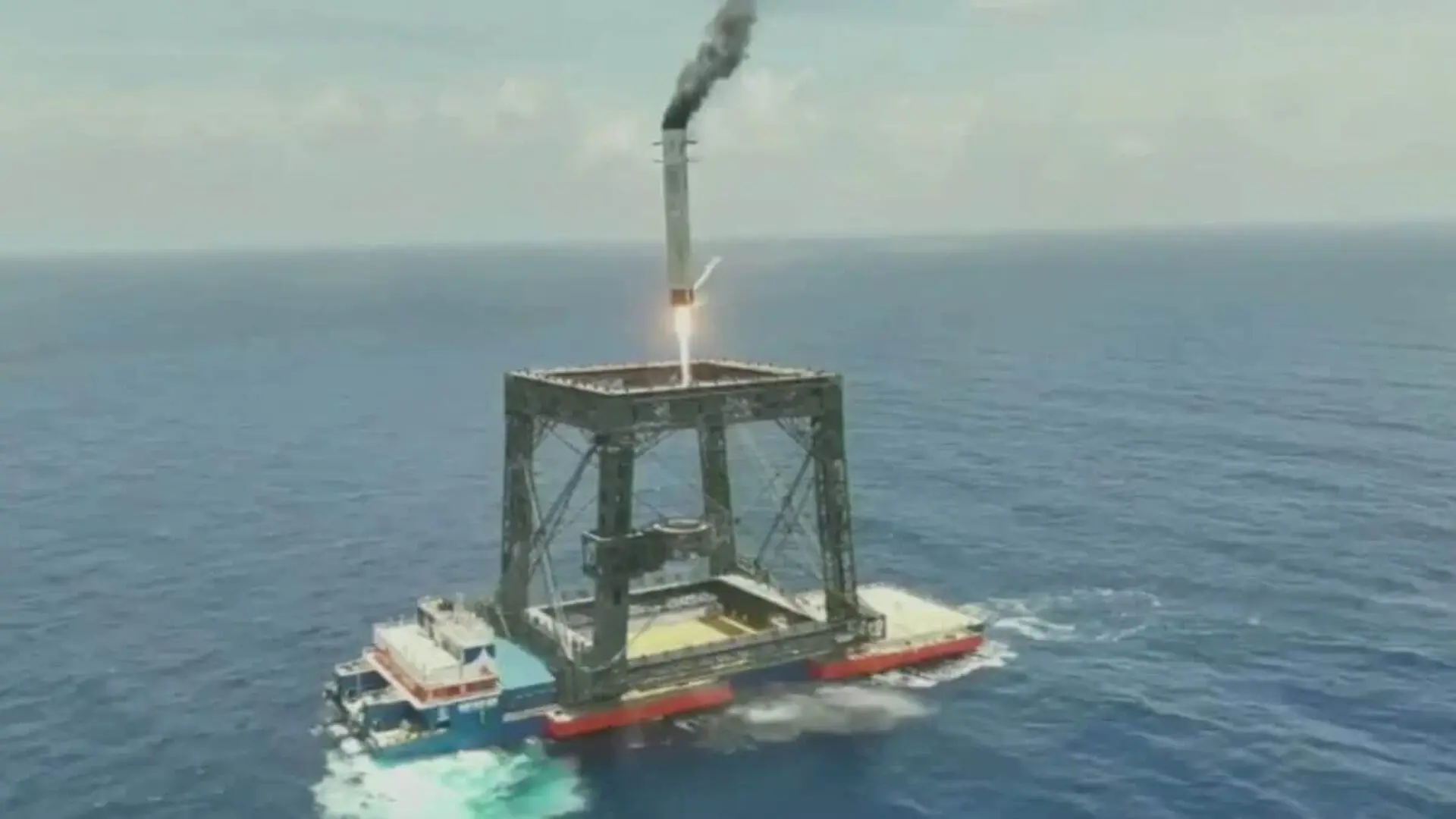
In a landmark test of reusable rocketry, China successfully retrieved the first stage of an orbital launch vehicle using a sea‑borne net system, a capability the China Aerospace Science and Technology Corporation (CASC) says has never been demonstrated before. The recovery took place after a launch from the Hainan Commercial Space Launch Site, underscoring Beijing’s drive to cut launch costs and increase flight cadence through reusable technology.
Sea‑Net Capture Demonstrated After Orbital Launch
The mission lifted off from Hainan on Friday at 12:15 a.m. EDT (0415 GMT; 12:15 p.m. Beijing time). Six minutes after liftoff, once the booster separated from the upper stage, it initiated a controlled descent toward a floating recovery platform equipped with a large net. Instead of the traditional ocean splashdown, the stage descended vertically into the net, which arrested its motion and secured the hardware.
CASC released a statement confirming the sequence: “Approximately 6 minutes after the first and second stages separated, the first stage returned vertically and was successfully recovered at a sea-based recovery platform using a net system,” the agency noted, adding that both launch and recovery were deemed complete successes.
As CASC stated: “This mission marks my country’s first successful controlled recovery of a launch vehicle and the world’s first network‑based recovery of a launch vehicle,” the China Aerospace Science and Technology Corporation (CASC) announced via social media shortly after the launch. (Translation by Google.) “It signifies a historic breakthrough for my country in the field of reusable rocket technology and will lay a solid foundation for accelerating the improvement of my country’s space access capabilities.”
The achievement adds a new chapter to the global push for reusable launch systems, where the ability to retrieve and refurbish hardware after orbit is a central objective for both established and emerging space agencies.
Strategic Impact on China’s Reusable Rocket Plans
Recovering a first stage is only part of the reusable equation; the hardware must also survive launch stresses, re‑entry heating, and landing impacts before it can be turned around for another flight. By guiding an orbital booster to a precise vertical capture on a sea platform, China has demonstrated growing confidence in the accuracy and durability of its recovery technology.
The China Aerospace Science and Technology Corporation (CASC) hailed the test as a milestone for the nation’s space sector, emphasizing its potential to streamline future launch operations and support an expanding roster of scientific, commercial, and governmental missions.
How This Net System Diverges From Existing Reusable Designs
Current reusable launch vehicles typically rely on vertical landings either on terrestrial pads or autonomous drone ships. China’s approach replaces a hard‑landing leg touchdown with a net‑based capture, offering a distinct recovery architecture. If refined, the method could lessen impact forces on the vehicle, simplify certain landing procedures, and broaden recovery options across varied mission profiles.
The test also highlights the sophistication of China’s guidance, navigation, and propulsion (GNC) suite. Steering a large booster into a confined maritime net demands precise engine burns, real‑time trajectory adjustments, and accurate atmospheric modeling, underscoring the high‑resolution control required for such operations.
While the net capture represents a promising addition to reusable technology, further flights will be needed to verify its reliability and operational benefits over a series of launches.
This article has been fact checked for accuracy, with information verified against reputable sources. Learn more about us and our editorial process.
Last reviewed on .
Article history
- Latest version
Reference(s)
- “长十乙火箭成功实现一子级可控回收_中国航天科技集团.” <https://www.spacechina.com/n25/n2014789/n2414549/c4646874/content.html>.
Cite this page:
- Posted by Karan Das