Blue Origin’s Blue Moon MK1 Clears Critical NASA Test, Marking a Turning Point for Lunar Missions
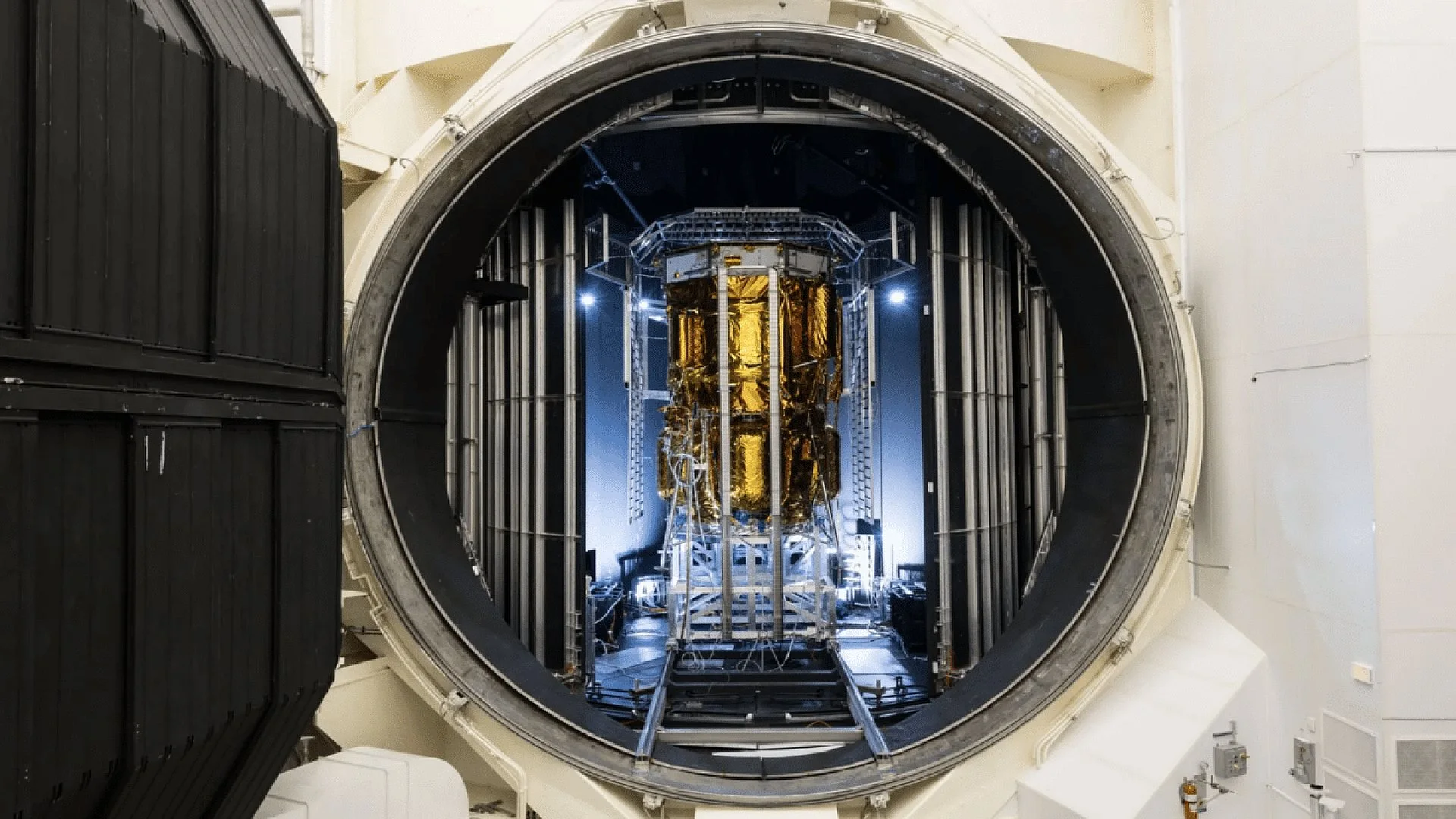
Blue Origin’s Blue Moon MK1 lunar lander has successfully passed a critical environmental evaluation within NASA’s Thermal Vacuum Chamber A, located in Houston.
The Blue Moon Mark 1 (MK1) lunar lander has successfully navigated the grueling environmental testing phase inside NASA’s Thermal Vacuum Chamber A, a significant milestone that underscores the growing momentum behind the agency’s Artemis campaign and the next wave of commercial lunar exploration.
A Crucial Test of Endurance in the Harsh Lunar Environment
At Johnson Space Center in Houston, engineers subjected the MK1 lander, also known as Endurance, to an unforgiving simulation that pushed its systems to the limit. Thermal Vacuum Chamber A, one of the largest facilities of its kind globally, replicates the extreme conditions of space, including the airless void and temperature swings experienced during a lunar mission. This phase represents a critical checkpoint that determines whether a spacecraft is ready to leave Earth, and the Blue Origin team has successfully cleared this hurdle.
The testing campaign focused on verifying the MK1 lander’s structural resilience, thermal stability, and the behavior of onboard systems when exposed to deep-space conditions. By recreating the Moon’s hostile environment on the ground, Blue Origin and NASA engineers were able to identify potential weaknesses early and refine system performance ahead of launch. This collaborative effort reflects a broader shift in how space exploration is conducted, with a hybrid model where public infrastructure accelerates private innovation.
The Space Act Agreement between NASA and Blue Origin has enabled the latter to access the former’s facilities, illustrating a reimbursable partnership that is rapidly becoming the backbone of modern lunar exploration strategies. This approach not only accelerates innovation but also reduces costs and increases efficiency, paving the way for a new era of space exploration.
Our second Blue Moon MK1 is taking shape at Lunar Plant 1 in Florida. The aft module and LOX/LH2 tanks are in assembly, with the aft module recently transitioning from a test fixture to a low-test stand for processing. Each lander is a step toward Lunar... pic.twitter.com/ToUaCpO9MZ
Precision Landing and Autonomous Control: The Key to Lunar Success
The Blue Moon MK1 is not designed to carry astronauts, but its role is far from secondary. As an uncrewed cargo lander, it serves as a technology pathfinder for future human missions. Its primary objectives include demonstrating precision landing, cryogenic propulsion, and advanced autonomous guidance, navigation, and control systems. Each of these capabilities is essential for landing safely in the Moon’s challenging south Pole region, where terrain is uneven and lighting conditions are extreme.
Precision landing, in particular, is a critical advancement. Future missions will require spacecraft to touch down within tightly constrained zones near valuable scientific targets or pre-deployed infrastructure. The MK1’s systems are designed to make real-time adjustments during descent, ensuring accuracy even in uncertain conditions.
Equally important is the validation of cryogenic propulsion technologies, which rely on supercooled propellants. Managing these fuels in space presents complex engineering challenges, including boil-off and storage stability. Demonstrating reliable performance in this area opens the door to longer missions and more capable landers.
Autonomy also plays a defining role. With communication delays between Earth and the Moon, the lander must make rapid decisions independently during descent. The MK1’s onboard systems are built to interpret terrain data and adjust trajectories without human intervention, a capability that will be indispensable for future crewed missions.
Future lunar landings are taking shape right here at Johnson Space Center.
Blue Origin’s Blue Moon Mark 1 cargo lander recently completed environmental testing at @NASA’s Johnson Space Center, preparing it to withstand the harsh, airless conditions modeling the vacuum of... pic.twitter.com/B4mHUg5cpr
— NASA’s Johnson Space Center (@NASA_Johnson) May 4, 2026
NASA Science Rides Along Through CLPS Initiative
Beyond its engineering objectives, the MK1 mission will carry scientific instruments to the lunar surface under NASA’s Commercial Lunar Payload Services (CLPS) program. This initiative partners with American companies to deliver payloads that expand understanding of the Moon while accelerating commercial capabilities.
Among the payloads is the Stereo Cameras for Lunar Plume-Surface Studies, a system designed to capture high-resolution imagery of how the lander’s engine plume interacts with the lunar surface during descent. These observations will provide valuable data on dust dynamics, a key factor in protecting future infrastructure and equipment on the Moon.
The second payload, the Laser Retroreflective Array, will enhance navigation accuracy by reflecting laser signals from orbiting spacecraft. This seemingly simple technology plays a major role in refining positional data, which is vital for both robotic and human missions operating on the lunar surface.
Fact Checked
This article has been fact checked for accuracy, with information verified against reputable sources. Learn more about us and our editorial process.
Das, Karan. “Blue Origin’s Blue Moon MK1 Clears Critical NASA Test, Marking a Turning Point for Lunar Missions.” BioScience. BioScience ISSN 2521-5760, 02 May 2026. <https://www.bioscience.com.pk/en/subject/space-science/blue-origins-blue-moon-mk1-clears-critical-nasa-test-marking-a-turning-point-for-lunar-missions>.
Das, K. (2026, May 02). “Blue Origin’s Blue Moon MK1 Clears Critical NASA Test, Marking a Turning Point for Lunar Missions.” BioScience. ISSN 2521-5760. Retrieved May 02, 2026 from https://www.bioscience.com.pk/en/subject/space-science/blue-origins-blue-moon-mk1-clears-critical-nasa-test-marking-a-turning-point-for-lunar-missions
Das, Karan. “Blue Origin’s Blue Moon MK1 Clears Critical NASA Test, Marking a Turning Point for Lunar Missions.” BioScience. ISSN 2521-5760. https://www.bioscience.com.pk/en/subject/space-science/blue-origins-blue-moon-mk1-clears-critical-nasa-test-marking-a-turning-point-for-lunar-missions (accessed May 02, 2026).