Betelgeuse Has Recovered From Its Great Dimming But Astronomers Found A Bizarre New Mystery
Betelgeuse is behaving strangely again. New observations reveal an unexpected twist in the giant star’s evolution, leaving astronomers reconsidering its fate.

Betelgeuse, the iconic red supergiant located roughly 724 light-years from Earth in the constellation Orion, has officially moved past the dramatic “Great Dimming” that captivated astronomers between 2019 and 2020. New radio-frequency observations confirm that the star’s outer atmosphere has returned to its baseline thermal state, though the massive celestial body now displays subtle structural shifts that may be linked to a hidden companion star.
As one of the most prominent stars in our galaxy, Betelgeuse is a cosmic titan, boasting a radius approximately 1,400 times that of our Sun and a luminosity exceeding 100,000 times that of our home star. Despite its immense size, the star is a relative infant, aged at only 8 million years, yet it has already reached the volatile final stages of its lifecycle.
Thermal Stability Returns
A research team led by Dr. Lynn Matthews of the MIT Haystack Observatory utilized the Karl G. Jansky Very Large Array (VLA) and the Atacama Large Millimeter/submillimeter Array (ALMA) to track the star’s recovery. Their findings, published in The Astronomical Journal, synthesize data collected across seven radio frequencies between 2021 and 2026 to map the temperature profiles of the star’s extended atmosphere.
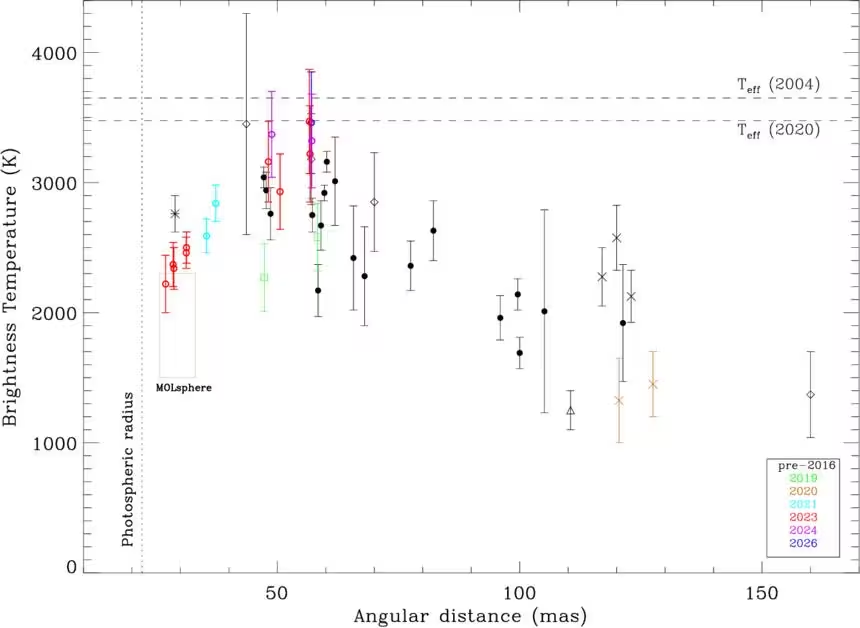
The analysis shows that brightness temperatures at 22 and 44 GHz have stabilized. Specifically, the 22 GHz data indicates a peak temperature of roughly 3,500 kelvin, effectively mirroring the star’s photospheric temperature. This represents a significant rebound from the conditions recorded in August 2019, which stood as the coldest atmospheric measurements for the star in over three decades.
“It was the combination of the incredible data from the VLA and ALMA that gave us a convincing result here,” Dr. Matthews noted.
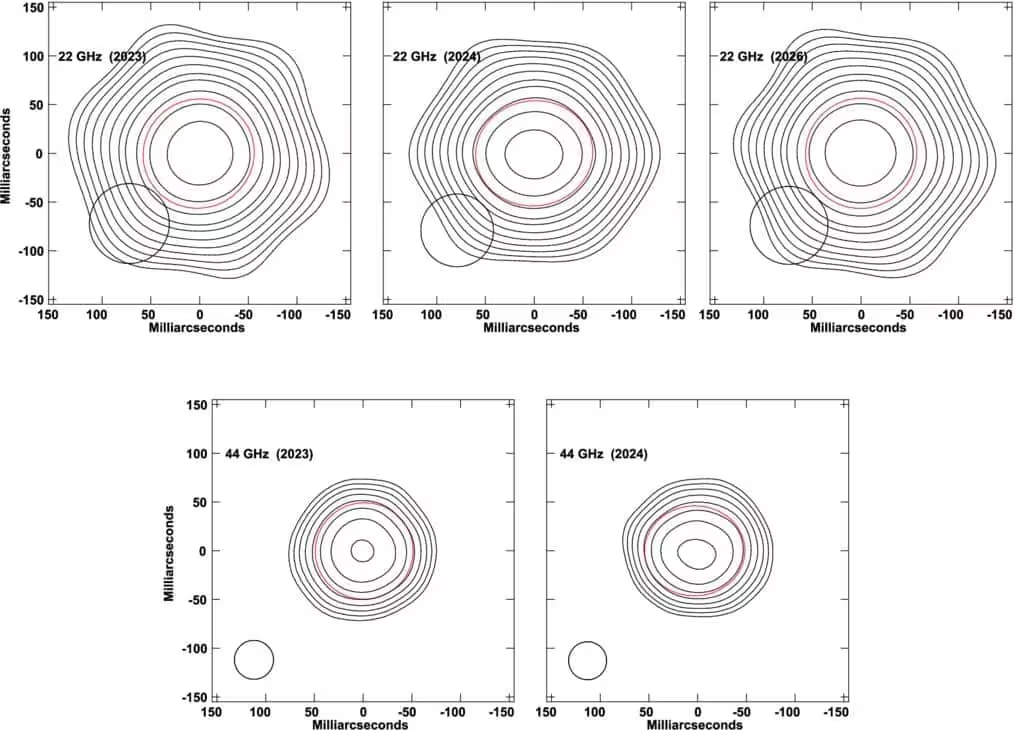
While the thermal equilibrium is restored, the star’s atmospheric geometry has shifted. Researchers observed the temperature peak occurring at approximately 2.7 stellar radii, an outward expansion compared to the 2.5 radii observed prior to 2016, suggesting potential shifts in atmospheric density.
Atmospheric Stratification
By sampling multiple radio frequencies, the team was able to probe the star’s atmosphere in depth, from the near-surface layers to the outer reaches. The data confirmed a distinct temperature gradient: brightness levels dip from 3,500 K at 2.7 stellar radii down to 2,220 K at 1.2 stellar radii, highlighting the well-documented existence of a temperature minimum situated between the star’s visible surface and its outer, hotter chromosphere.
“The fact that we can use these facilities to actually resolve the disks of nearby stars is amazing,” Matthews explained.
The Influence of Siwarha
Perhaps the most compelling aspect of the study involves Siwarha, a smaller companion star that has been theorized to influence Betelgeuse’s long-standing 2,100-day variability cycle. While direct visual confirmation of the companion remains elusive, the radio data reveals patterns consistent with its movement through the giant’s extended atmosphere.
Although Betelgeuse generally maintains a circular profile with an ellipticity of 10% or less, researchers identified periodic elongations that correlate with the predicted orbital path of Siwarha. When the companion is at its maximum apparent distance, the red supergiant appears slightly stretched, a distortion that diminishes as the companion passes behind or in front of the primary star.
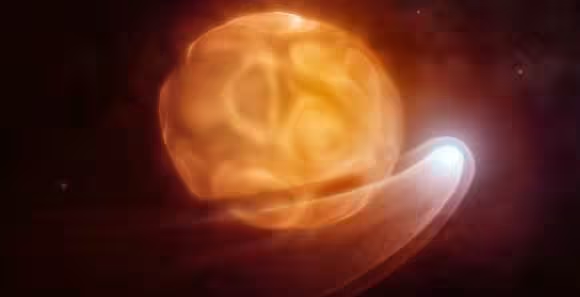
Matthews draws a vivid parallel to describe the interaction, likening the companion’s movement to a “jet boat tearing through a lake.” This gravitational and physical interaction likely generates a wake that ripples through the atmosphere of the red supergiant, creating localized disturbances near the source of its stellar winds.
This article has been fact checked for accuracy, with information verified against reputable sources. Learn more about us and our editorial process.
Last reviewed on .
Article history
- Latest version
Reference(s)
- “Lynn D. Matthews - MIT Haystack Observatory.”, June 17, 2020 MIT Haystack Observatory <https://www.haystack.mit.edu/researcher/lynn-matthews/>.
- Matthews, L. D.., et al. “New Spatially Resolved Observations of Betelgeuse from the VLA and ALMA: Evidence for Atmospheric Perturbations from a Close Companion.” The Astronomical Journal, vol. 172, no. 3, September 1, 2026, pp. 184 American Astronomical Society, doi: 10.3847/1538-3881/ae953d. <https://iopscience.iop.org/article/10.3847/1538-3881/ae953d>.
Cite this page:
- Posted by Karan Das