New Simulations Suggest the Moon May Have Formed in Just Five Hours After Giant Impact
New evidence suggests the Moon’s violent origin story is more complex than previously thought, potentially forcing a major rewrite of lunar history.
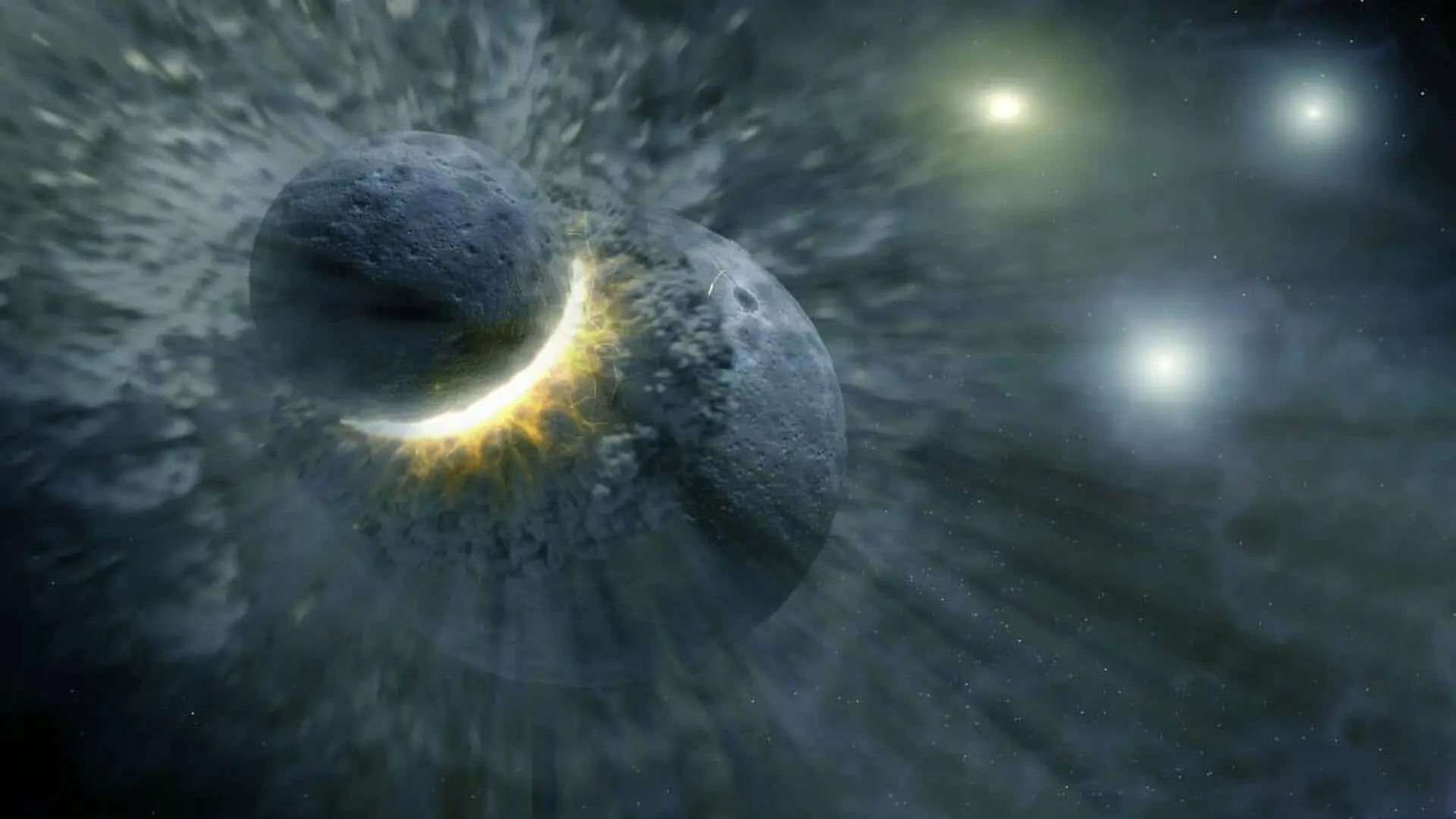
New computational modeling suggests the Moon may have formed with remarkable speed, potentially coalescing into a complete body within just five hours of the cataclysmic collision that birthed it. This finding challenges long-standing assumptions about the lunar origin story by highlighting how the structural integrity and thermal state of the early Earth and its impactor, Theia, fundamentally altered the mechanics of the event.
For decades, the leading theory—the giant impact hypothesis—has posited that a Mars-sized planet named Theia smashed into the proto-Earth roughly 4.5 billion years ago. Conventional simulations have typically depicted this collision as so violent that the resulting debris was effectively reduced to a fluid state, eventually forming a ring around the Earth from which the Moon gradually accreted. However, these older models often disregarded the physical strength and resistance of the planetary materials involved, assuming the intense energy of the impact rendered such properties irrelevant.
Revisiting the Physics of Planetary Impacts
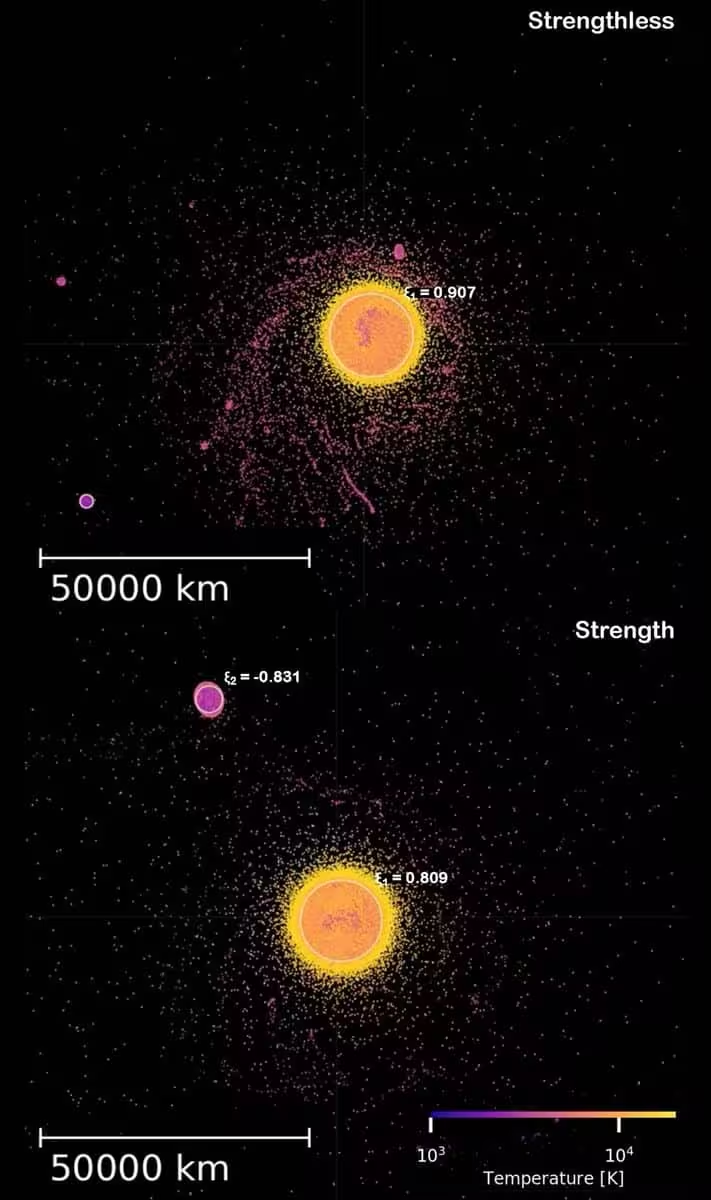
Researchers from the Southwest Research Institute and the University of Arizona are now challenging that fluid-based paradigm. By employing an advanced version of smoothed particle hydrodynamics (SPH), the team incorporated the geological strength of rocks and metals into their simulations. This allowed the scientists to account for how these materials resist deformation under the extreme pressures of a planetary strike.
“Because the collision was considered violent enough to melt and vaporize large portions of Earth and Theia, those previous papers assumed that it is okay to approximate them as fluids,” said Erik Asphaug, co-author of the research. “Based on our new results, however, we think that it is time to reconsider that.”
Evidence for a Rapid Lunar Genesis
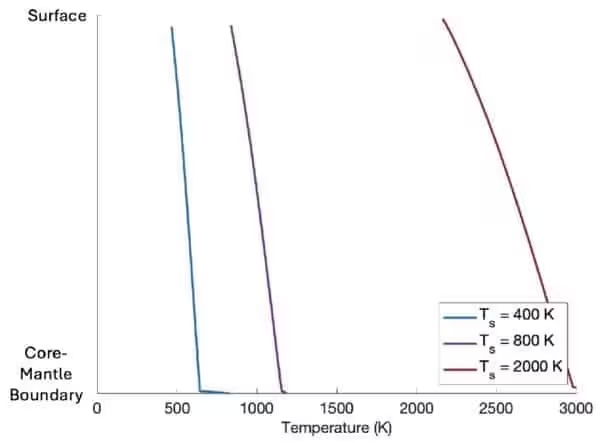
The team discovered that the internal temperature of the colliding bodies was a critical factor in the final outcome. In their models, colder planets maintained significant structural strength, while hotter bodies behaved with less resistance. When the simulation used temperature parameters similar to those in original models but added material strength, the results shifted dramatically: an intact moon formed in roughly five hours.
“When we used the same parameters as original impact modeling – down to the equal temperature structures inside both bodies – within around five hours, an intact moon emerged,” said Adeene Denton, the lead researcher and former postdoctoral researcher at the Lunar and Planetary Laboratory.
Unanswered Questions in the Lunar Narrative
While this rapid formation scenario provides a fresh perspective, researchers acknowledge that the mystery of the Moon’s composition remains. Scientists are still working to understand why the Earth and its satellite share such striking chemical similarities if the Moon was formed from the remains of a foreign object like Theia. Future research will likely focus on how these geophysical states influenced the volatile elements present on the Moon today.
“We now know that the geophysical state of Earth and Theia play a fundamental role in shaping the outcome of the collision. This gives us a new way to explore the conditions of the impact and what they might reveal about the Moon’s origin,” says doctoral student Namya Baijal.
Experts outside the study emphasize the implications of this work for dating the lunar origin. Robin Canup noted that these findings suggest a tangible link between the Moon’s current physical makeup and the thermal conditions present during that prehistoric collision, which could ultimately help refine our understanding of exactly when this transformative event occurred.
This article has been fact checked for accuracy, with information verified against reputable sources. Learn more about us and our editorial process.
Last reviewed on .
Article history
- Latest version
Reference(s)
- “Lecture23.” <http://www.astro.yale.edu/coppi/astro520/ricker_course/lecture23.pdf>.
- “Erik Asphaug | Lunar and Planetary Laboratory & Department of Planetary Sciences.”, June 9, 2025 Lunar and Planetary Laboratory & Department of Planetary Sciences <https://lpl.arizona.edu/faculty/erik-asphaug>.
- “About — Adeene Denton.” Adeene Denton <http://www.adeenedenton.com/about>.
- “Namya Baijal | Lunar and Planetary Laboratory & Department of Planetary Sciences.”, November 21, 2025 Lunar and Planetary Laboratory & Department of Planetary Sciences <https://lpl.arizona.edu/graduate/students/namya-baijal>.
- “Robin Canup - Boulder SWRI.” Boulder SWRI <https://www.boulder.swri.edu/team-members/robin-canup/>.
Cite this page:
- Posted by Karan Das