NASA Just Captured a Rare Purple Aurora From Space and Explained Why It Happened
NASA has captured a rare purple atmospheric glow, offering new insights into the complex and dynamic relationship between Earth and space weather.
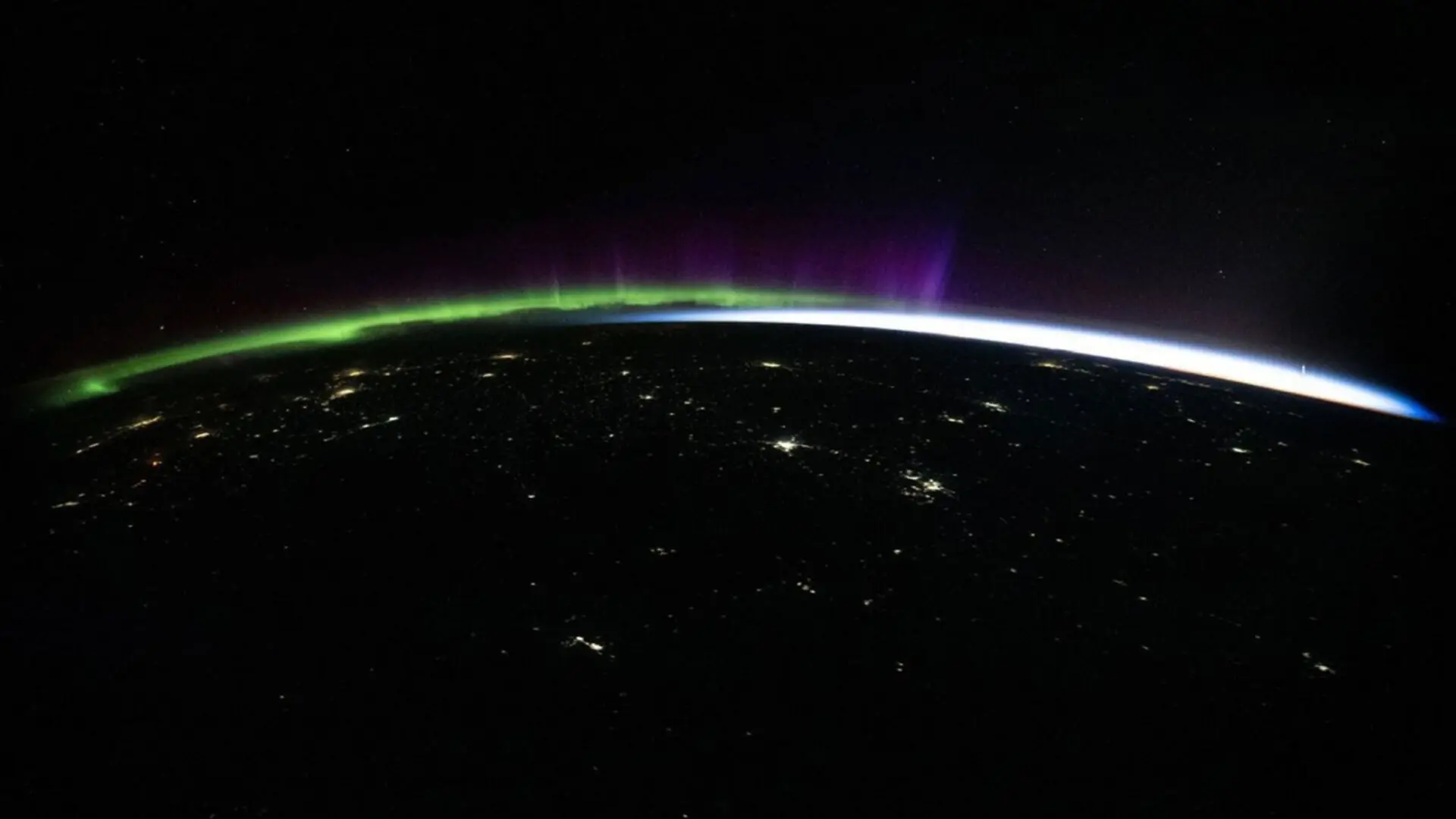
Rare Violet Aurora Caught by Astronauts Over Central Asia
A striking purple glow recently illuminated the upper atmosphere, providing researchers with a unique opportunity to study the complex interactions between solar energy and Earth’s protective magnetic shield. Documented by the NASA Earth Observatory, this rare chromatic event highlights the intricate chemical and physical processes that occur when solar-borne particles collide with our planet’s gases.
The observation was captured on September 7, 2026, by NASA astronaut Jessica Meir while aboard the International Space Station (ISS) during Expedition 75. Using a Nikon Z9 digital camera, Meir recorded the vivid violet light from an altitude of roughly 255 miles (411 kilometers) as the station passed over Kyrgyzstan. The resulting image offers a rare perspective on atmospheric phenomena that are frequently elusive to ground-based observers.
Purple Haze. Jimi Hendrix would have rejoiced at the site of the northern lights last night. I’ve never before seen such a brilliant purple wavelength in the aurora – certainly makes me want to kiss the sky. Photo taken with Nikon Z9, 15mm lens. pic.twitter.com/3A3v4GiZsS
— Jessica Meir (@Astro_Jessica) September 8, 2026
Decoding the Chemistry of Cosmic Light
Auroral displays are the visual manifestation of solar wind—streams of charged particles ejected by the Sun—interacting with Earth’s magnetosphere. As these particles are funneled toward the polar regions, they transfer kinetic energy to atmospheric atoms and molecules, such as oxygen and nitrogen. The resulting glow depends heavily on the altitude and the specific elements involved in the collision.
While the iconic green auroras are typically the product of oxygen emissions at specific heights, the appearance of purple and violet hues indicates a more complex set of conditions. These shades often emerge when excited nitrogen molecules contribute significantly to the emission spectrum, or when a specific combination of atmospheric wavelengths overlaps. Scientists view these rare color profiles as critical data points for mapping the chemical composition and energy states of the upper atmosphere.
Expanding Our Understanding of Space Weather
The study of such phenomena is central to the field of space weather, which monitors how solar activity impacts Earth’s environment. Because these displays are dynamic and reactive, they serve as natural laboratories for understanding how our planet responds to external solar influences.
By pairing high-resolution photography from the ISS with data from satellite instruments and ground-based observatories, researchers can build a comprehensive picture of energy flow through the magnetosphere. These insights are essential for predicting potential disruptions to global communications, power grids, and satellite infrastructure.
As the Sun continues its cycle, researchers expect to see a wider variety of these atmospheric displays. Each documented event provides new evidence that the atmosphere is not merely a static shroud, but a highly active system in constant dialogue with the Sun. Future missions and ongoing orbital monitoring aim to further unravel these colorful mysteries, refining our models of the environment that exists just beyond the reach of human habitation.
This article has been fact checked for accuracy, with information verified against reputable sources. Learn more about us and our editorial process.
Last reviewed on .
Article history
- Latest version
Reference(s)
- Dauphin, Lauren. “Purple Haze Aurora - NASA Science.”, September 16, 2026 NASA <https://science.nasa.gov/earth/earth-observatory/purple-haze-aurora/>.
- “https://twitter.com/Astro_Jessica/status/2097355530243072138/photo/1.” <https://t.co/3A3v4GiZsS>.
Cite this page:
- Posted by Karan Das