Astronomers Discover A Bizarre Giant Planet With A Clock Ticking Toward Invisibility
Astronomers have detected an unusual signal from a distant star, revealing a mysterious giant planet that opens a groundbreaking new line of investigation.

Astronomers have uncovered a curious celestial anomaly: a massive gas giant known as TOI-1355 b, which follows a strikingly elongated path around its host star. While many similar “hot Jupiters” settle into tight, circular orbits over time, this planet maintains a highly eccentric trajectory despite completing a full revolution every two days.
The discovery, led by researchers at the University of Tokyo, highlights a growing effort to understand planetary systems surrounding extremely hot stars. These stellar environments are significantly more intense than our own, with the host star of TOI-1355 b boasting a surface temperature of roughly 8,400 degrees Celsius (15,152 degrees Fahrenheit)—dwarfing the Sun’s 5,500 degrees Celsius (9,932 degrees Fahrenheit).
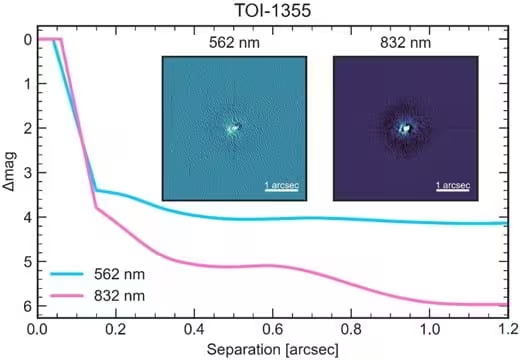
Detecting an Orbital Irregularity
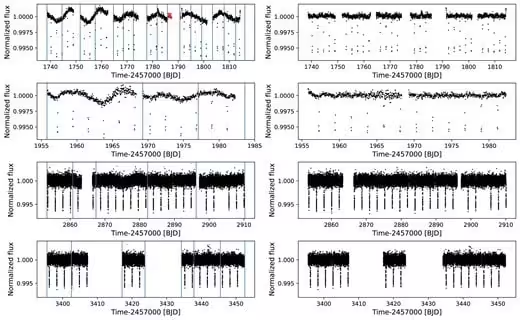
The unusual nature of the planet first emerged through data from NASA’s Transiting Exoplanet Survey Satellite (TESS). By monitoring dips in stellar brightness, scientists identified the planet’s rapid two-day orbital period. However, it was the timing of the secondary eclipse—the moment the planet passes behind its star—that revealed the system’s true complexity.
“When we investigated the change in brightness of TOI-1355 from prior data, we found that the secondary eclipse, a phenomenon in which a planet passes behind a star, occurred faster than the timing assumed for a circular orbit,” noted researcher Noriharu Watanabe. This timing discrepancy confirmed that the planet was not traveling in a perfect circle, but rather an elongated ellipse.
The Quest to Understand Planetary Migration
The team, which includes Professor Norio Narita, suspects that gravitational interactions with other massive objects may have pushed TOI-1355 b into this eccentric path. In many scenarios, tidal forces from the host star eventually pull such planets into closer, more circular orbits. It is possible that this planet is currently caught in the middle of this long-term evolutionary process.
While the team continues to investigate the orbital dynamics, they are racing against a ticking clock. Due to the shifting orientation of the planet’s orbit, transits will become undetectable from Earth’s vantage point after approximately 2033. Researchers are now prioritizing further study, including potential follow-up observations with the James Webb Space Telescope, to capture as much data as possible before the planet effectively disappears from our current observational reach.
This article has been fact checked for accuracy, with information verified against reputable sources. Learn more about us and our editorial process.
Last reviewed on .
Article history
- Latest version
Reference(s)
- <https://academic.oup.com/pasj/article/78/5/1992/8792826?login=false>.
- Kazmierczak, Jeanette. “TESS (Transiting Exoplanet Survey Satellite) - NASA Science.”, April 22, 2025 NASA <https://science.nasa.gov/mission/tess/>.
- “NARITA Norio | The University of Tokyo.” The University of Tokyo <https://www.u-tokyo.ac.jp/focus/en/people/k0001_00784.html>.
Cite this page:
- Posted by Karan Das