Physicists Smash Gold Nuclei at Near Light Speed and Find a Mysterious Dip in Matter
Physicists have detected a puzzling signal after colliding gold nuclei at extreme speeds, potentially revealing new insights into the early universe.

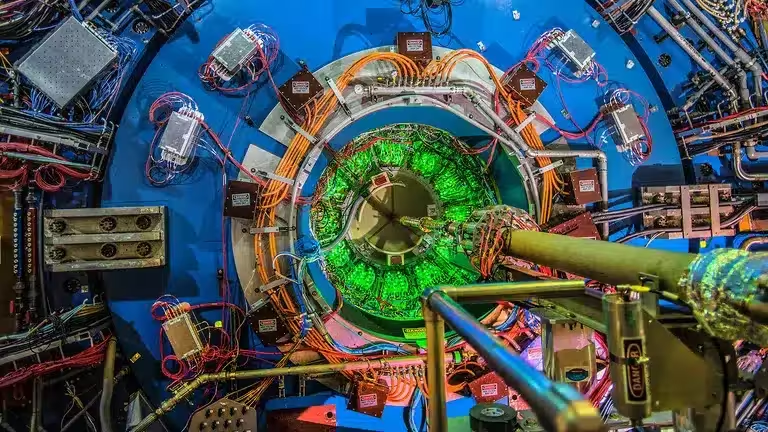
Physicists operating the STAR experiment at Brookhaven National Laboratory’s Relativistic Heavy Ion Collider (RHIC) have identified an anomalous pattern in subatomic debris that may offer a window into the earliest moments of the universe. By colliding gold nuclei at velocities approaching the speed of light, researchers briefly generated quark-gluon plasma, a primordial state of matter that characterized the cosmos just microseconds after the Big Bang.
The team is working to map the equation of state for nuclear matter—essentially a fundamental rulebook detailing how temperature, pressure, and density interact under extreme conditions. According to study co-author Rutik Manikandhan of The Ohio State University, understanding these transitions is critical to deciphering how the infant universe evolved as it cooled.
Seeking the Critical Point of Nuclear Matter
Quarks, the building blocks of protons and neutrons, are normally bound together by gluons via the strong force. However, when subjected to intense heat or density, they decouple to form the quark-gluon plasma. A central objective in high-energy physics is identifying a hypothetical “critical point” in this state of matter, where the transition between phases shifts from gradual to abrupt—a phenomenon akin to the way liquid water and steam become indistinguishable at specific pressures and temperatures.
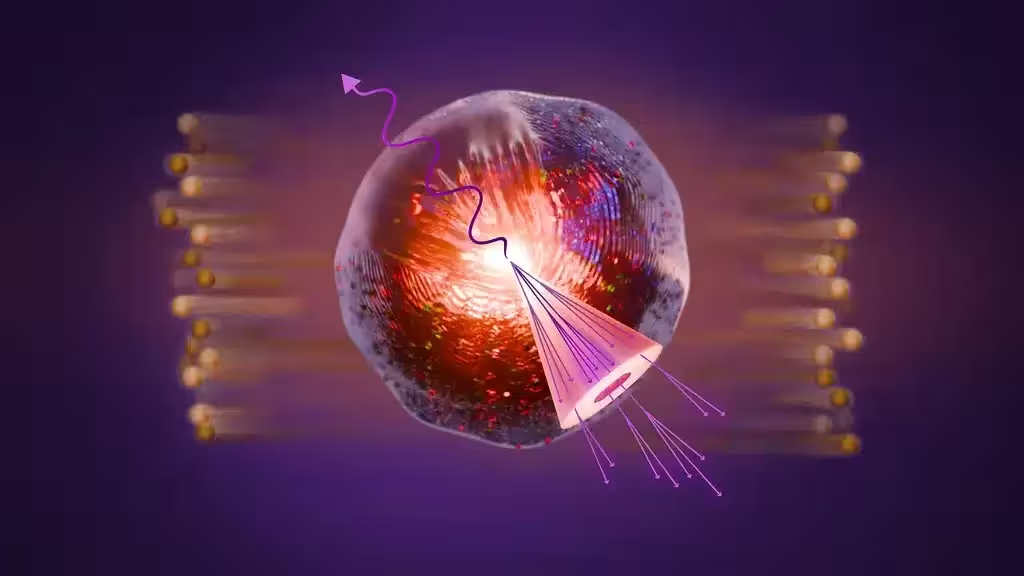
While theoretical models suggest this critical point may exist within the energy ranges accessible by RHIC, the evidence remains speculative. “All of this is still conjectured and there is nothing concrete yet, either from the experimentalists or theorists,” Manikandhan noted.
Data Analysis Reveals a Statistical Dip
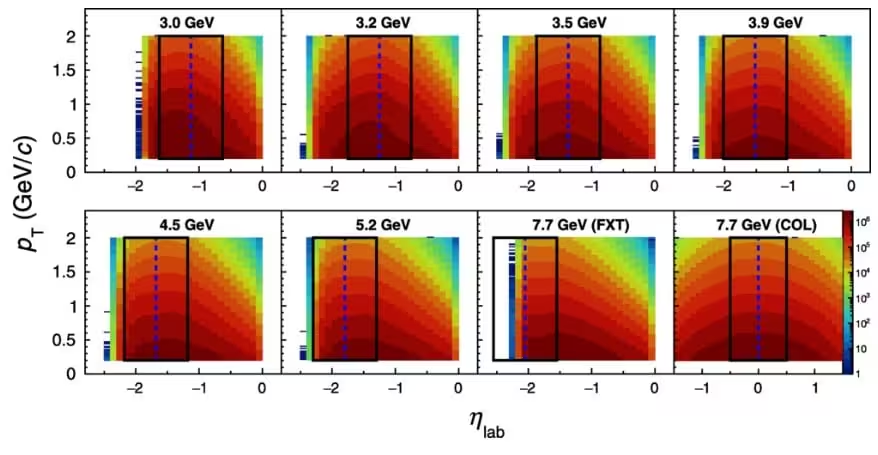
The research team examined data from roughly 1 billion gold-ion collisions, utilizing a fixed-target configuration where gold beams struck a stationary foil to reach peak densities. The study, published in Physical Review Letters, focused on the transverse momentum of charged particles, which serves as a proxy for the internal dynamics and temperature fluctuations of the expanding fireball.
As collision energies varied between 3 and 7.7 GeV, researchers observed an unexpected trend: rather than a smooth progression, the particle correlation data exhibited a distinct dip. This deviation reached a statistical significance of five sigma, implying that the likelihood of the pattern emerging from random fluctuation is approximately one in 3.5 million.
Cautious Interpretation of Preliminary Findings
Despite the high statistical significance, researchers caution against declaring the discovery of a critical point. Standard computer simulations that lack a phase-transition mechanism failed to replicate the dip, suggesting that the phenomenon is physically meaningful, yet other variables could be influencing the results. The feature appeared only weakly in off-center collisions, further necessitating a careful approach to interpretation.
“The result is suggestive, not proof of a critical point,” Manikandhan said, noting that external factors could still explain the fluctuations.
The next phase of research involves using these correlations to calculate the specific heat of the plasma and cross-referencing findings with data on proton production fluctuations. “Only when different measurements agree can we say confidently whether a critical point exists,” Manikandhan added.
This article has been fact checked for accuracy, with information verified against reputable sources. Learn more about us and our editorial process.
Last reviewed on .
Article history
- Latest version
Reference(s)
- Aboona, B. E.., et al. “Nonmonotonicity of Transverse Momentum Correlations in
Cite this page:
- Posted by Zara Tariq