Plant Evidence Pinpoints Llullaillaco Sacrifice to 1489, Revealing Inca Political Strategy
Plant remains near the Llullaillaco Maiden reveal Inca sacrifices may have served political aims as well as religious rites.
Archaeologists have long been captivated by the three remarkably intact children found atop the Llullaillaco Volcano. A recent paper in Archaeometry narrows the window of their burial to a few decades and suggests that the celebrated Inca ritual of Capacocha may have served political purposes as well as religious ones, helping to cement cohesion across the empire.
Plant Remains Pinpoint Inca Sacrifice to Late 15th Century
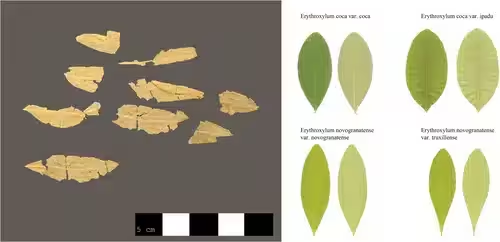
Previous attempts to date the Llullaillaco ceremony relied on methods that spanned nearly a hundred years, leaving scholars uncertain about its precise historical backdrop. The new study, appearing in Archaeometry, turned to botanical evidence—coca leaves, manioc seeds and maize kernels recovered with the 14‑year‑old known as the Llullaillaco Maiden. Because these crops complete a single growth cycle, they capture a narrow slice of atmospheric carbon, allowing for far more exact radiocarbon dating.
By pairing radiocarbon measurements with stable‑isotope analysis of carbon, nitrogen and oxygen, researchers reconstructed the environmental conditions of the plants’ growth season. Statistical modeling places the sacrificial event between 1462 and 1507 CE, with a peak probability around 1489 CE.
High‑Altitude Find Reveals Well‑Preserved Children
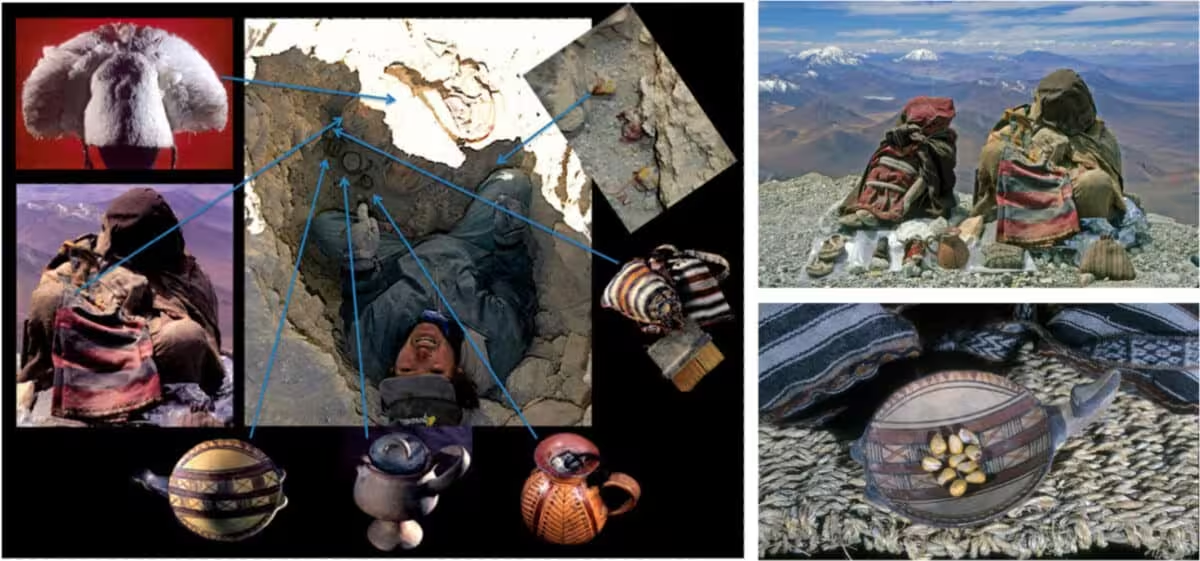
The story began in 1999 when a team of archaeologists scaled the 6,715‑meter summit straddling Argentina and Chile. There, they uncovered the naturally mummified remains of a teenage girl, a six‑year‑old girl and a seven‑year‑old boy—remarkably preserved by the mountain’s frigid, arid climate. Alongside the bodies, a wealth of offerings—textiles, figurines, foodstuffs and sacred plants—provided a vivid snapshot of Inca ceremonial practice.
Political Motives Behind the Llullaillaco Offering
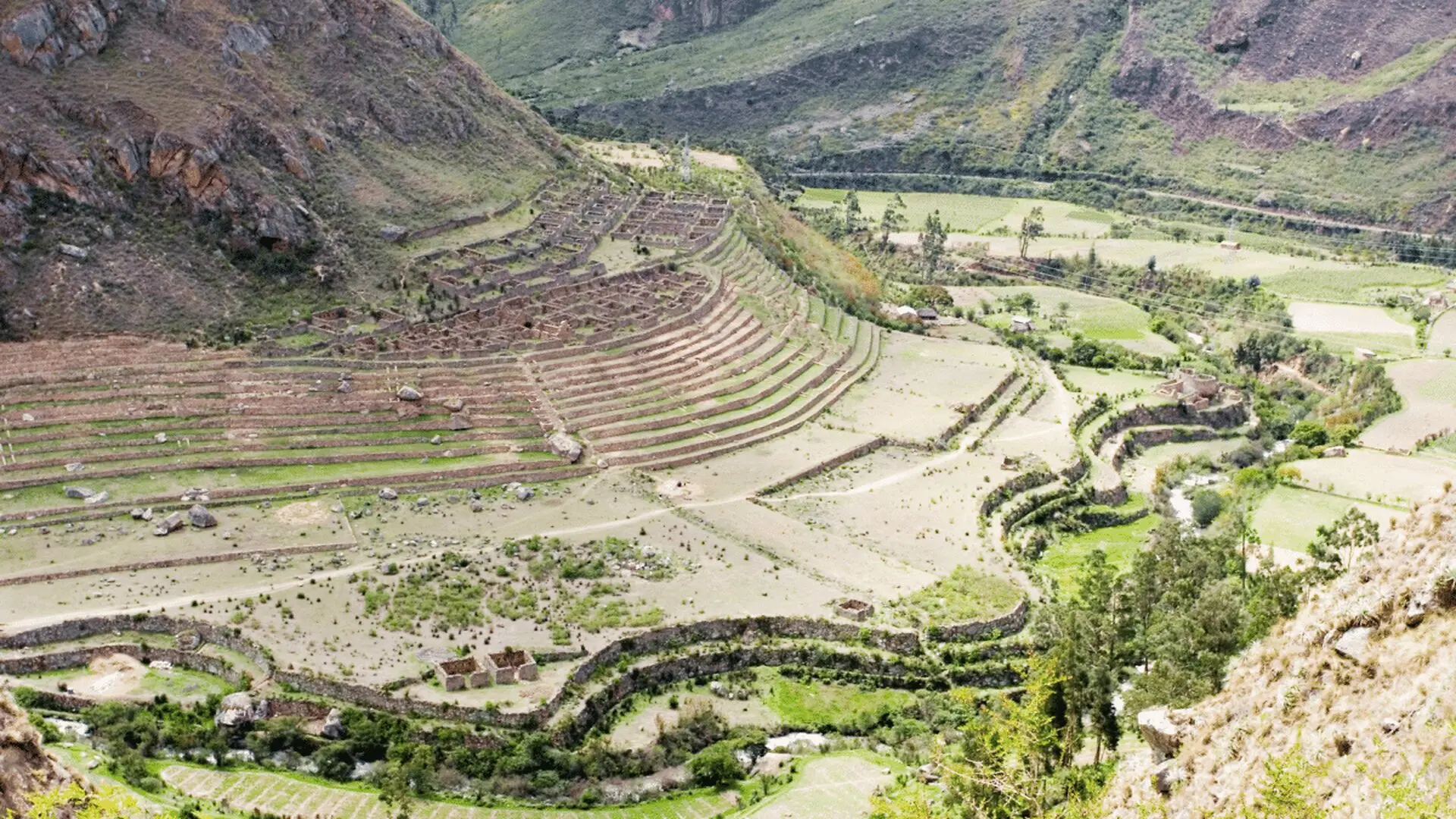
Pinpointing the ceremony to the reign of either Topa Inca or his successor Huayna Capac reshapes its interpretation. By the late fifteenth century, Inca control over the high‑Andean region had already been established for generations, weakening the notion that the rite marked a fresh conquest or celebrated a recent military triumph.
The study thus blurs the line between religion and politics, suggesting that ceremonial offerings simultaneously honored mountain deities, cemented social bonds, and bolstered the legitimacy of Inca rule.
New Data Undermines Disaster‑Driven Theories
Equally notable is what the chronology does not coincide with: no major volcanic eruption or climatic crisis aligns with the 1462‑1507 window. Earlier scholars had posited that such sacrifices might be pleas for divine intervention during environmental emergencies. The absence of a clear natural trigger for the Llullaillaco burial diminishes that explanation, though it does not preclude similar motivations in other contexts.
The research highlights the growing impact of scientific techniques on long‑standing historical questions. By focusing on short‑lived botanical materials that were previously overlooked, the team achieved a sharper chronological framework, illustrating how archaeology can revise narratives even for sites examined for decades.
Scientific Insights Redefine Inca Imperial Narrative
Reliance on colonial chronicles has long shaped Inca historiography, yet those sources carry the biases of outsiders. The botanical and isotopic evidence from Llullaillaco offers an independent line of inquiry that can confirm, challenge or refine those accounts.
The findings suggest that Capacocha was woven into a sophisticated system of governance that blended spiritual symbolism with statecraft. Sacrificing select children emerged as a potent instrument for projecting authority across vast distances.
As scholars continue to reassess the Llullaillaco discovery, the narrative grows richer. What once appeared chiefly as a religious act now emerges as a multifaceted strategy that helped the Inca Empire manage one of the largest and most diverse pre‑Columbian societies in the Americas. Modern scientific analysis is allowing the frozen children of Llullaillaco to speak with unprecedented clarity.
This article has been fact checked for accuracy, with information verified against reputable sources. Learn more about us and our editorial process.
Last reviewed on .
Article history
- Latest version
Reference(s)
- Sieczkowska‐Jacyna, Dominika., et al. “Timing the Sacred: A Multi‐Step Chronological Framework for the Llullaillaco Inca Burial.” Archaeometry, June 5, 2026 Wiley, doi: 10.1111/arcm.70172. <https://onlinelibrary.wiley.com/doi/10.1111/arcm.70172>.
Cite this page:
- Posted by Zara Tariq