Half-Earth-Sized White Dwarf Packs Sun’s Mass, May Hide Rare Oxygen-Neon Core
Astronomers uncover clues that a massive white dwarf’s concealed core could be composed of oxygen and neon, reshaping stellar evolution theories.
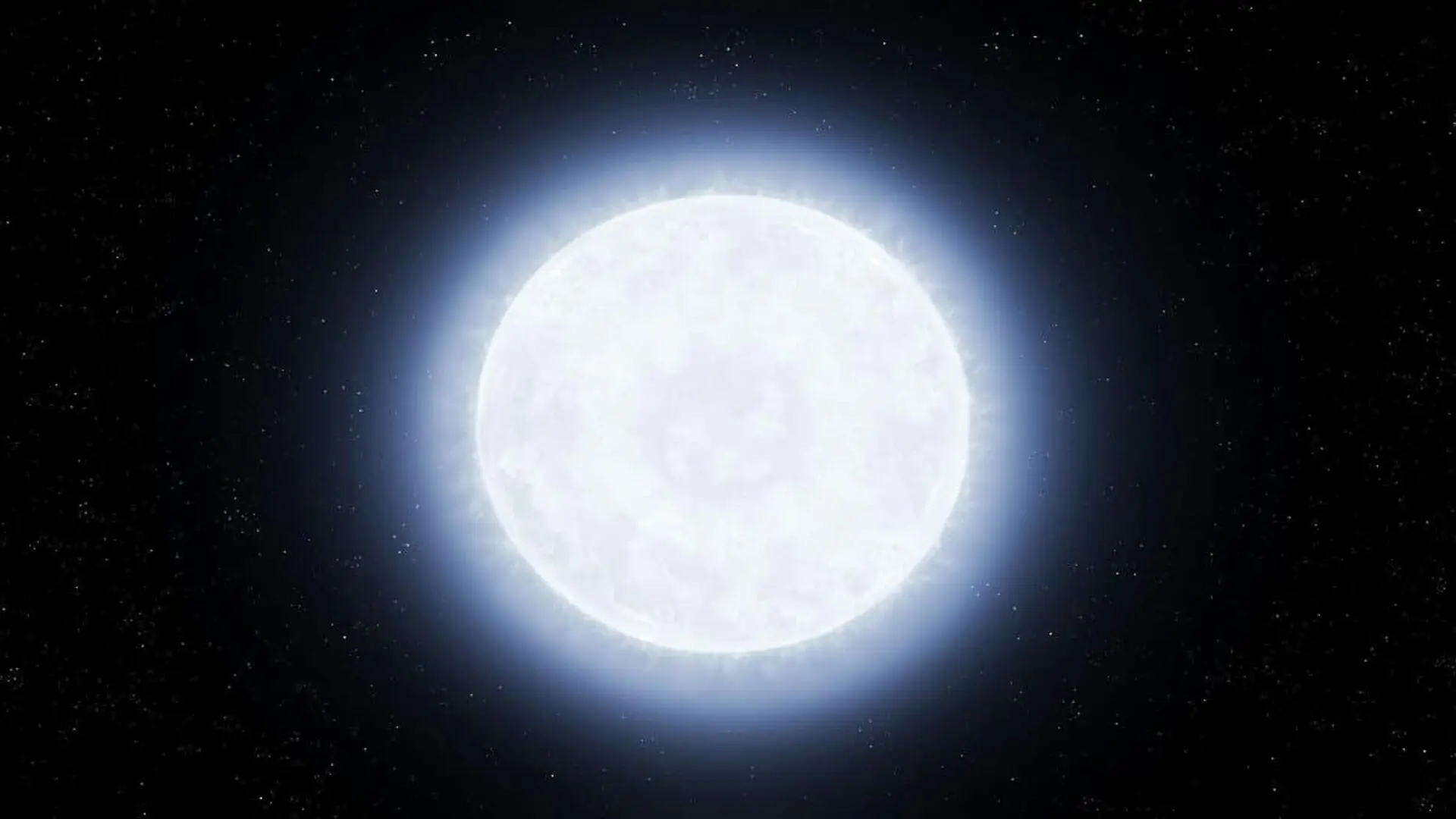
Astronomers have identified a compact stellar remnant roughly half the diameter of Earth that carries a mass exceeding the Sun’s by more than twenty percent. The object, catalogued as SDSS J0608−0059, appears to host a rare oxygen‑neon (O/Ne) core, a composition typically linked to the most massive white dwarfs.
While ordinary white dwarfs usually contain carbon‑oxygen interiors and weigh between 0.5 and 0.7 solar masses, the extreme density of SDSS J0608−0059 places it in the ultramassive regime—above roughly 1.05 M☉. Such high masses arise from progenitor stars of about 8–10 M☉, which achieve core temperatures sufficient to fuse carbon into oxygen and neon before shedding their outer layers.
Binary Companion Provides a Critical Velocity Baseline
Direct probing of a white dwarf’s interior is impossible; observers can only examine the thin photospheric layer that emits the detectable light. To infer the unseen core, the research team led by Stefan M. Arseneau turned to gravitational redshift—the wavelength stretch experienced by photons escaping a strong gravitational field.
SDSS J0608−0059 resides in a wide binary with a main‑sequence star located roughly 2,684 AU from the white dwarf. The companion’s radial velocity, measured independently, serves as a proxy for the system’s systemic motion. By subtracting this value from the white dwarf’s observed velocity, the researchers isolated the contribution attributable to gravitational redshift.
Multi‑Survey Photometry Constrains Mass and Radius
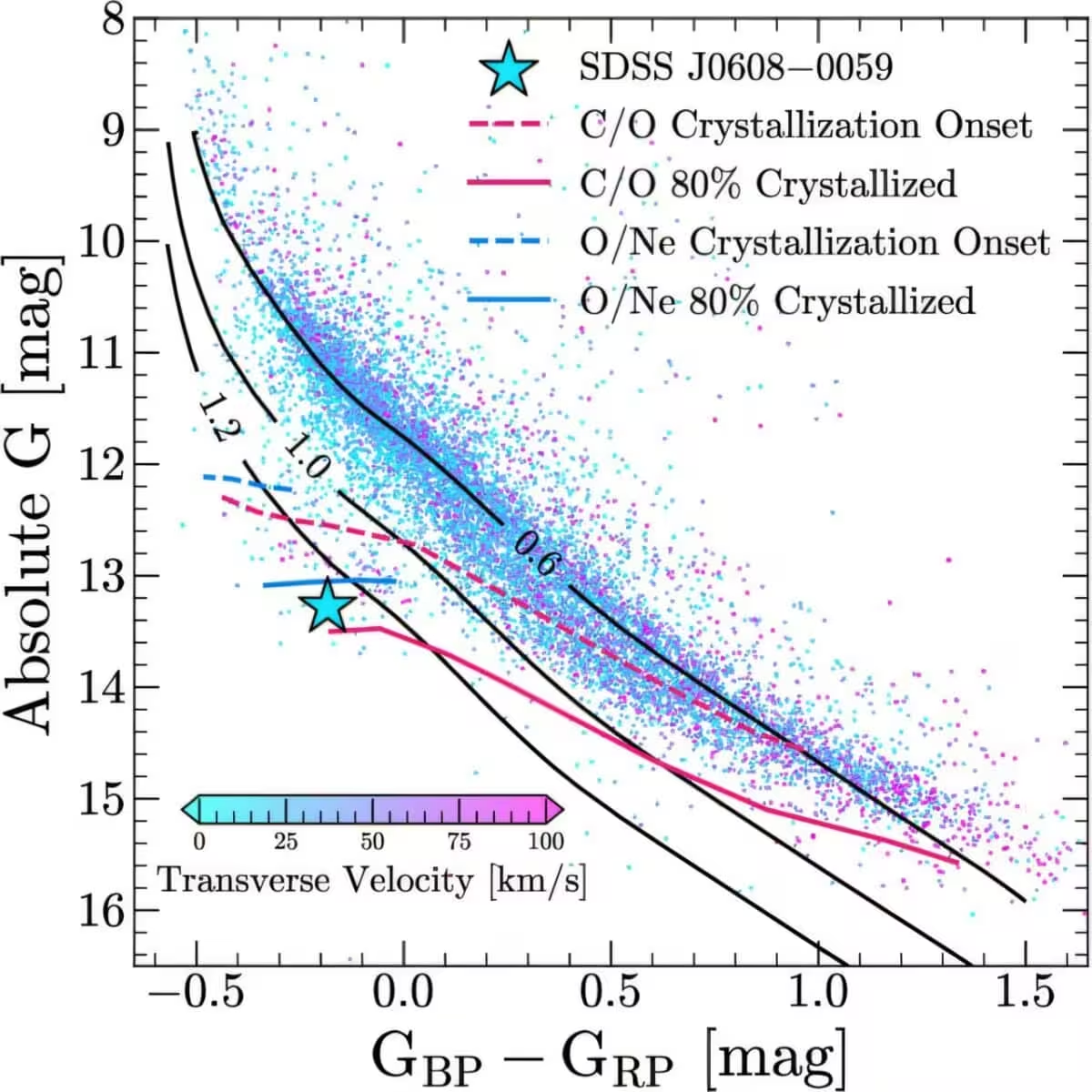
Gravitational redshift alone yields only a relationship between mass and radius. To break this degeneracy, the team incorporated photometric data from four large sky surveys—Gaia, SDSS, Pan‑STARRS and SkyMapper. A Bayesian simulation explored combinations of mass, radius, distance, interstellar extinction and effective temperature that best matched the full data set.
The analysis converged on a mass of about 1.226 M☉ confined within a radius roughly half that of Earth, confirming the object’s ultramassive status.
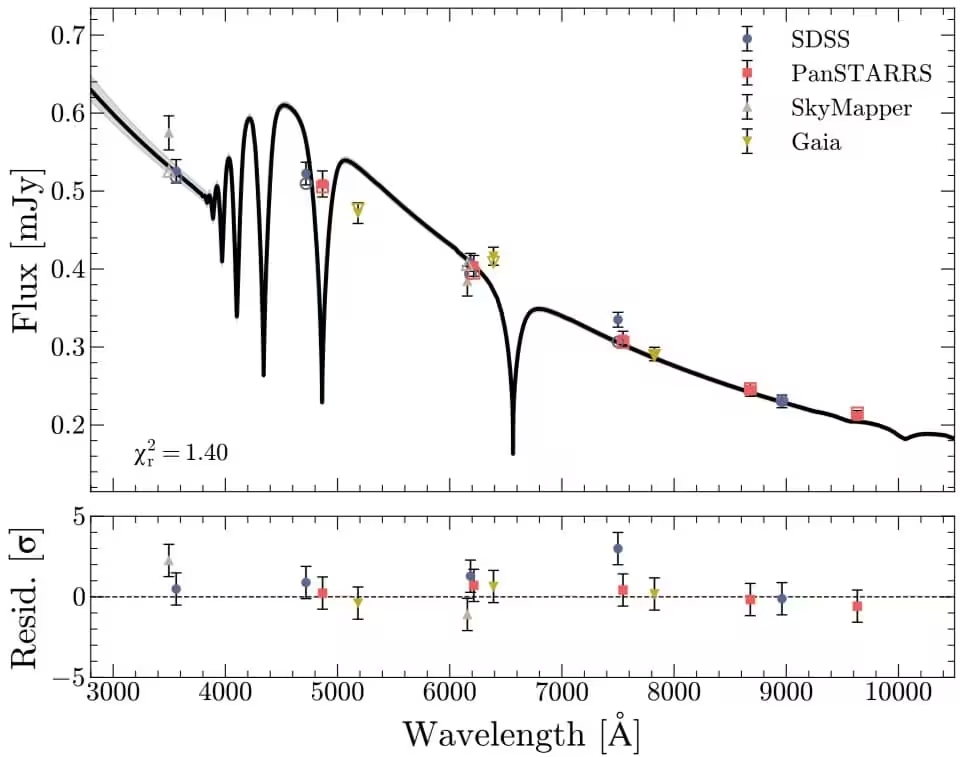
Placement on the brightness‑color diagram further confirms that SDSS J0608−0059 belongs to the cohort of ultramassive white dwarfs, sitting well beneath the standard cooling track for average-mass objects.
Evidence Favors an Oxygen‑Neon Interior
With reliable mass and radius estimates, the researchers compared the observations against theoretical mass‑radius curves for both carbon‑oxygen and oxygen‑neon compositions. The statistical preference leaned toward an O/Ne core, with a Bayes factor of 2.7 supporting the heavier-element scenario.
“By comparing to state-of-the-art mass‑radius relations for ultramassive white dwarfs, we find preference for an O/Ne core over a C/O core, with a Bayes factor of 2.7,” the team wrote
The authors also evaluated a possible origin via the merger of two less‑massive white dwarfs. However, the system’s modest galactic velocity, absence of detectable magnetism, and stability in a wide binary configuration argue against a merger history.

Although the current data strongly indicate an oxygen‑neon composition, the authors acknowledge that forthcoming Gaia releases or targeted ultraviolet spectroscopy could provide decisive confirmation, as noted by Phys.org.
This article has been fact checked for accuracy, with information verified against reputable sources. Learn more about us and our editorial process.
Last reviewed on .
Article history
- Latest version
Cite this page:
- Posted by Zara Tariq