Scientists Discover How These Unique Metals Stay Tough Near Absolute Zero
Scientists have identified a unique crystal structure mechanism that allows new metal alloys to resist brittle failure at extreme cryogenic temperatures.
In the extreme environment of near-absolute zero, most metals undergo a transformation that makes them notoriously brittle. While cooling typically increases a metal’s strength, it often strips away the flexibility needed to prevent catastrophic failure. A new study, published October 14 in Nature, has uncovered how specific alloys defy this rule, maintaining structural integrity and plasticity even when pushed to 20 kelvin, or approximately -253°C.
The research, conducted by an international team from the University of California, Berkeley, Lawrence Berkeley National Laboratory, and the University of Oxford, focused on why certain body-centered cubic alloys avoid the common ductile-to-brittle transition. In conventional metals, this transition occurs because the cold temperatures effectively lock the internal defects known as dislocations, preventing the atomic shifting required for the material to deform under stress rather than snapping.
Innovative Mechanisms at the Nanoscale
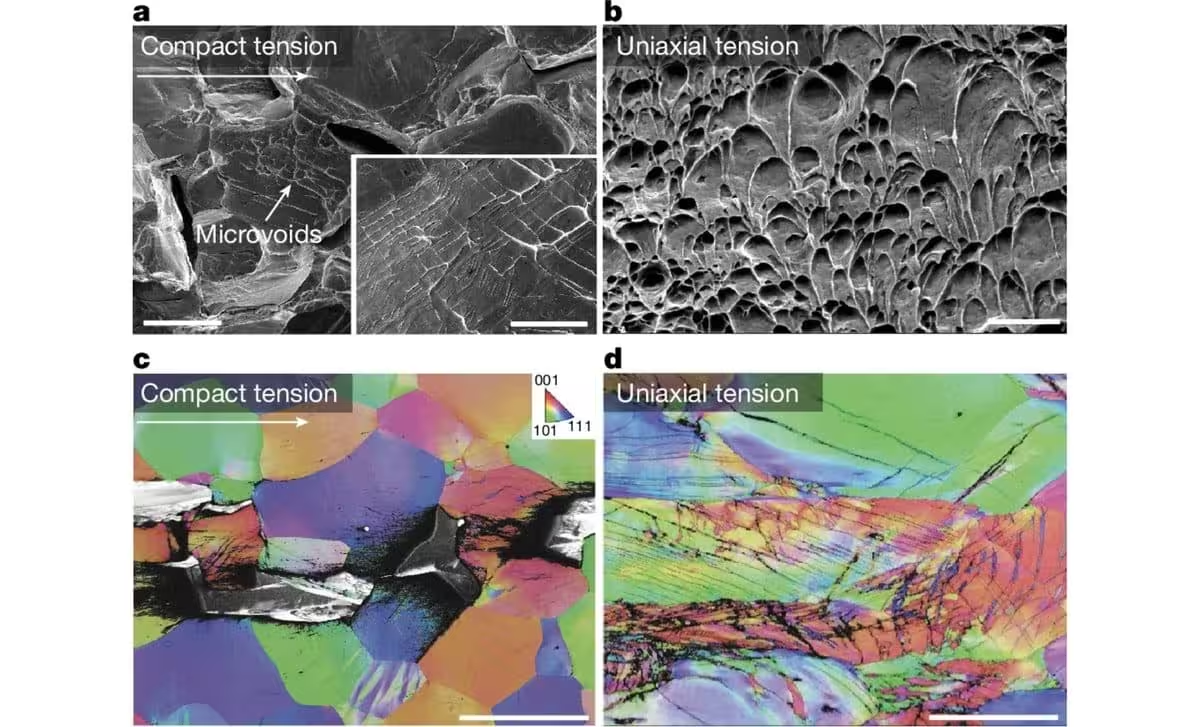
To determine if this brittleness could be bypassed, the researchers tested two specific alloys: Nb45Ta25Ti15Hf15 and the simpler Nb70Ti30. The results were striking. Neither alloy showed a measurable ductile-to-brittle transition at 20 kelvin. The four-element alloy retained impressive yield strength and crack-growth toughness, while the niobium-titanium alloy achieved a crack-initiation toughness of 170 MPa√m at the same temperature.
The team discovered that these materials rely on a unique, two-pronged strategy to manage stress. Instead of solely relying on the movement of pre-existing dislocations, the alloys undergo a process called nanoscale twinning, where segments of the crystal structure mirror one another. This occurs simultaneously with a localized phase transformation, known as the omega phase. When these evolving structures intersect with crystal boundaries, they force the creation of new dislocations, allowing the metal to continue deforming safely.
Advanced Testing Reveals New Insights
The investigation involved rigorous testing at the ENGIN-X instrument at the ISIS Neutron and Muon Source in Oxfordshire, England. By combining mechanical stress tests with neutron diffraction and electron microscopy, the scientists observed that these protective transformations occur prior to the typical dislocation movement seen in other metals. This fundamental shift in how the material handles stress explains its remarkable performance in cryogenic conditions.
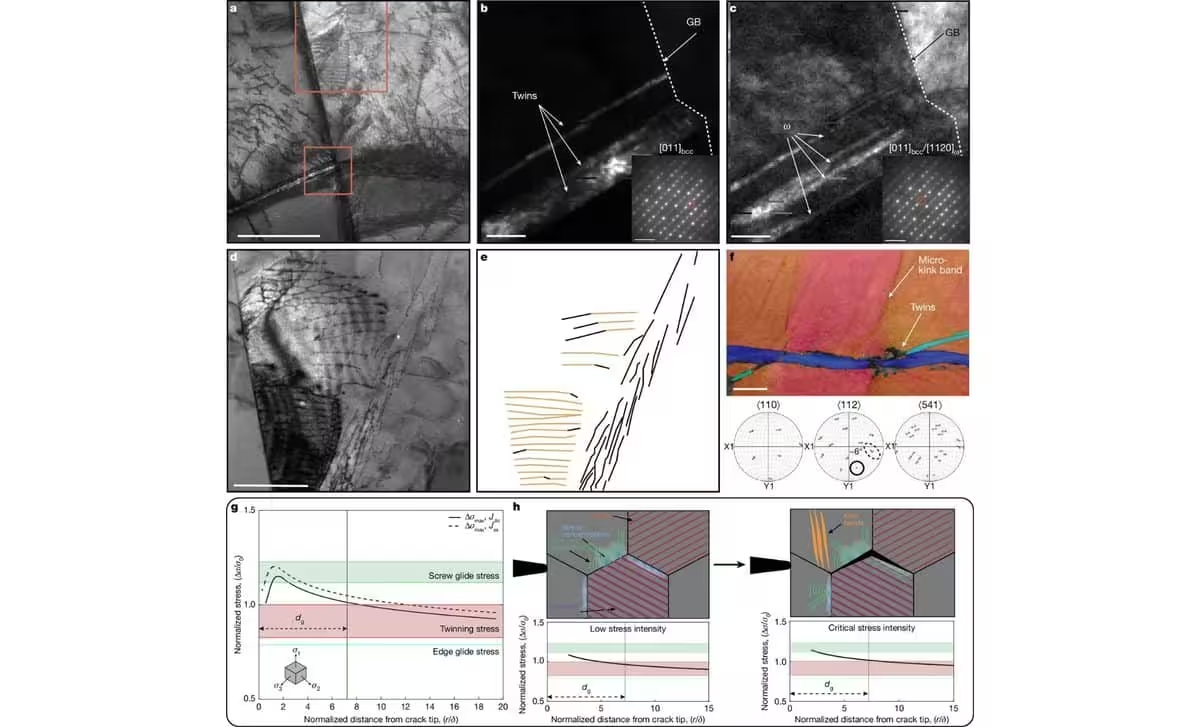
According to Professor Dong Liu of the University of Oxford, these findings force a reconsideration of the established models regarding the ductile-to-brittle transition. The capacity to generate new dislocations at internal boundaries is proving to be as critical to structural resilience as the mobility of existing ones.
Lead author Dr. David Cook, now at the University of Cambridge, noted that this discovery provides a new blueprint for engineers working in aerospace, energy, and transportation—sectors that frequently demand materials capable of surviving extreme thermal fluctuations. By understanding these competing microscopic processes, designers may be better equipped to engineer next-generation alloys that remain tough in the coldest corners of our universe.
This article has been fact checked for accuracy, with information verified against reputable sources. Learn more about us and our editorial process.
Last reviewed on .
Article history
- Latest version
Reference(s)
- “Dong (Lilly) Liu.” <https://eng.ox.ac.uk/people/dong-lilly-liu>.
- “Cambridge University Engineering Department.” <https://www.eng.cam.ac.uk/profiles/dhc40?page=9&utm_medium-referral=&utm_source=for-businesses>.
Cite this page:
- Posted by Zara Tariq