Why Gen Z Is Scoring Lower Than Their Parents Despite Billions Spent On Classroom Tech
Despite growing up with unprecedented classroom technology, Gen Z is facing a decline in academic performance. Explore what the data reveals about this trend.

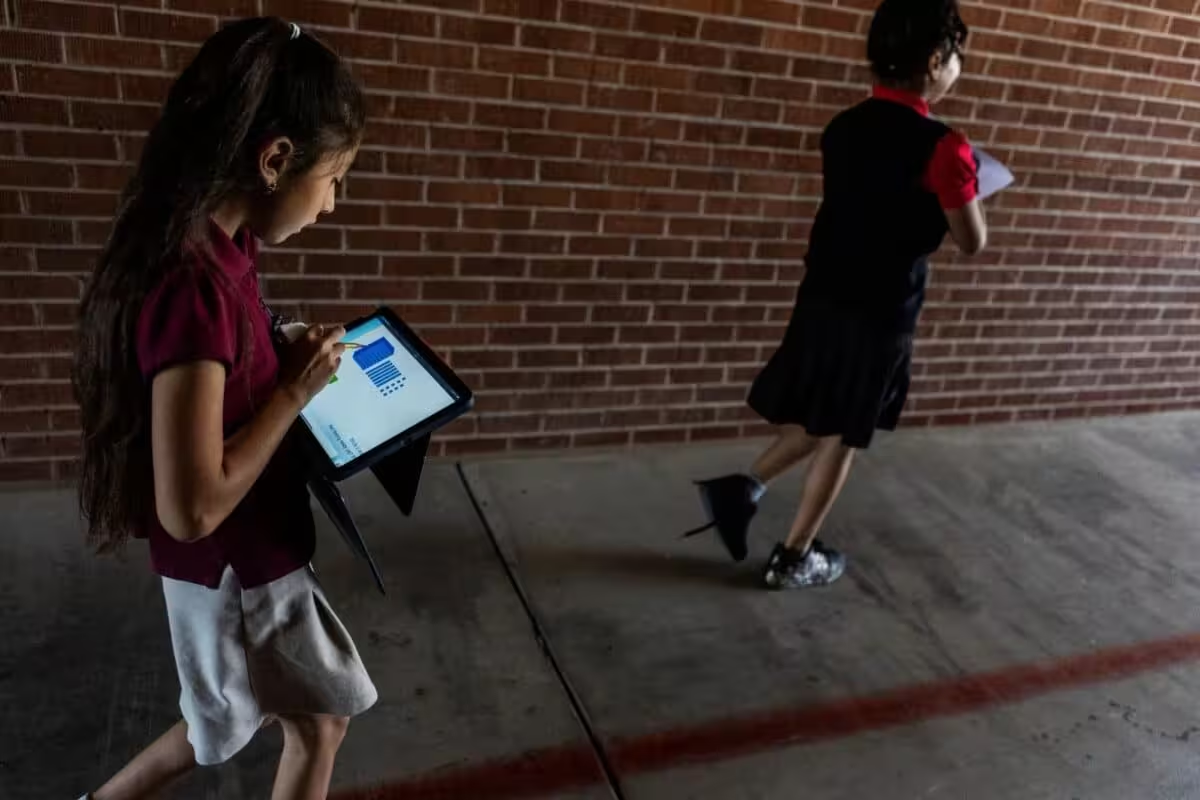
At Gorham High School in Maine, educator James Welsch observed a concerning trend: as his students transitioned toward a screen-centric classroom, their writing lost its nuance and flow. His response was a return to tradition, requiring students to pen their first drafts by hand. This shift highlights a growing skepticism surrounding the rapid integration of technology in education, a movement that critics now describe as a largely unsuccessful, multibillion-dollar experiment.
For over a century, IQ scores in Western nations rose in lockstep with the expansion of public schooling. However, that upward trajectory stalled roughly two decades ago. Generation Z now stands as the first cohort in modern history to record lower scores in literacy, numeracy, and creative aptitude than their predecessors.
The Maine Precedent: Millions Spent, Stagnant Results
Maine served as a national testing ground for digital education in 2002, when the state initiated a program providing laptops to every seventh grader. What began as a modest investment of 17,000 devices eventually expanded to a fleet of 66,000 units by 2016, with an annual price tag of approximately $12 million. Despite this consistent funding, a 15-year assessment by NPR revealed that standardized test scores remained largely unchanged.
Experts suggest that the failure was not in the vision, but in the implementation. Amy Johnson, a researcher at the University of Southern Maine, noted that while hardware became ubiquitous, the necessary pedagogical training for teachers to effectively integrate these tools into instruction never materialized. Furthermore, the program exacerbated existing inequalities: while affluent districts leveraged the technology for creative, collaborative projects, lower-income and rural schools often relegated students to basic word processing tasks.
The National Spending Surge and Cognitive Decline
Despite Maine’s lack of measurable success, the rest of the nation followed suit. According to a Bloomberg editorial board report, U.S. schools allocated roughly $30 billion to educational technology in 2024—ten times the expenditure on traditional textbooks—with projections suggesting that number could double by 2030.
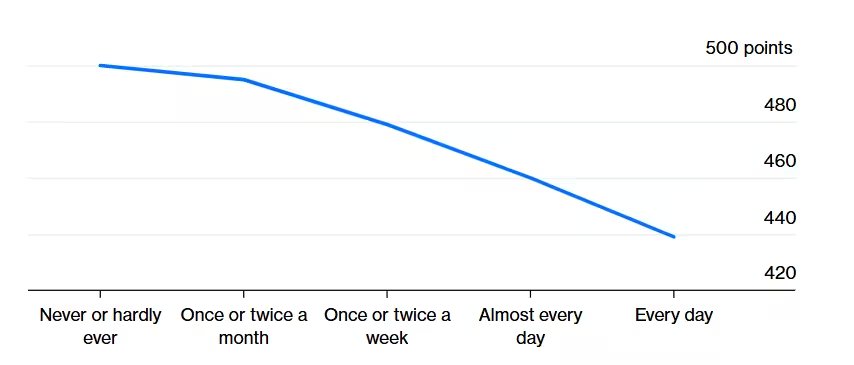
Neuroscientist Jared Cooney Horvath has argued before the U.S. Senate that this digital saturation correlates with falling performance. Data from the Program for International Student Assessment (PISA) consistently shows that excessive screen time in educational settings is linked to diminished cognitive outcomes. EdWeek Research Center data confirms that a majority of students spend several hours daily tethered to digital devices during school hours.
The Reality of Classroom Distraction
A primary obstacle to digital efficacy is the persistent challenge of off-task behavior. A study published in the journal Computers and Education analyzed university lecture hall activity and found that students spent over 60% of their screen time engaged in activities unrelated to the curriculum, with social media serving as the most significant distraction. This behavior is compounded by the design of modern applications, which are engineered to trigger addictive engagement.
Research from Baylor University’s Hankamer School of Business highlights how platforms like TikTok utilize “effortlessness,” precise content recommendations, and periodic surprises to maximize user engagement. This creates a state of “time distortion,” making it increasingly difficult for students to maintain the cognitive focus required for academic work. When attention is fragmented, memory formation is weakened and error rates increase.

A Reevaluation of Policy
Experts emphasize that the current crisis is a failure of policy, not a failing of the students themselves. The unchecked introduction of digital devices into the K-12 environment has created a classroom dynamic that often undermines traditional learning objectives. As the Fortune report notes, many students were placed in front of screens without regard for how the human brain processes information. In response, states are increasingly moving to restrict personal device usage, with dozens now implementing bans or limitations on cellphones during instructional time to reclaim the classroom environment.
This article has been fact checked for accuracy, with information verified against reputable sources. Learn more about us and our editorial process.
Last reviewed on .
Article history
- Latest version
Reference(s)
- Feinberg, Robbie. “Do Laptops Help Learning? A Look At The Only Statewide School Laptop Program.”, August 18, 2017 Maine Public News <https://www.npr.org/sections/ed/2017/08/18/536875865/15-years-later-how-did-it-go-with-maines-school-laptop-program>.
- <https://www.bloomberg.com/opinion/articles/2026-02-11/education-technology-isn-t-teaching-us-children-more-effectively>.
- <https://www.oecd.org/en/about/programmes/pisa.html>.
- Rogelberg, Sasha. “The U.S. spent $30 billion to ditch textbooks for laptops and tablets: The result is the first generation less cognitively capable than their parents.”, July 12, 2026 Fortune, doi: 4524988. <https://fortune.com/2026/02/21/laptops-tablets-schools-gen-z-less-cognitively-capable-parents-first-time-cellphone-bans-standardized-test-scores/>.
Cite this page:
- Posted by Zubair Ali