Silent Memory Traces In Fruit Flies Reveal How Forgotten Experiences Can Return And Turn False
Fruit fly study reveals forgotten memories linger in a silent neural state, reactivating when cues recreate parts of the original experience.

A new study in Nature Neuroscience, highlighted by ScienceAlert, reveals that retrieving a lost memory can sometimes generate an inaccurate version of the original event. The work shows that the mechanisms responsible for recalling forgotten associations can also fabricate false ones, shedding light on the dynamic nature of memory preservation and alteration.
Hidden Memory Traces Remain Dormant in Fruit Flies
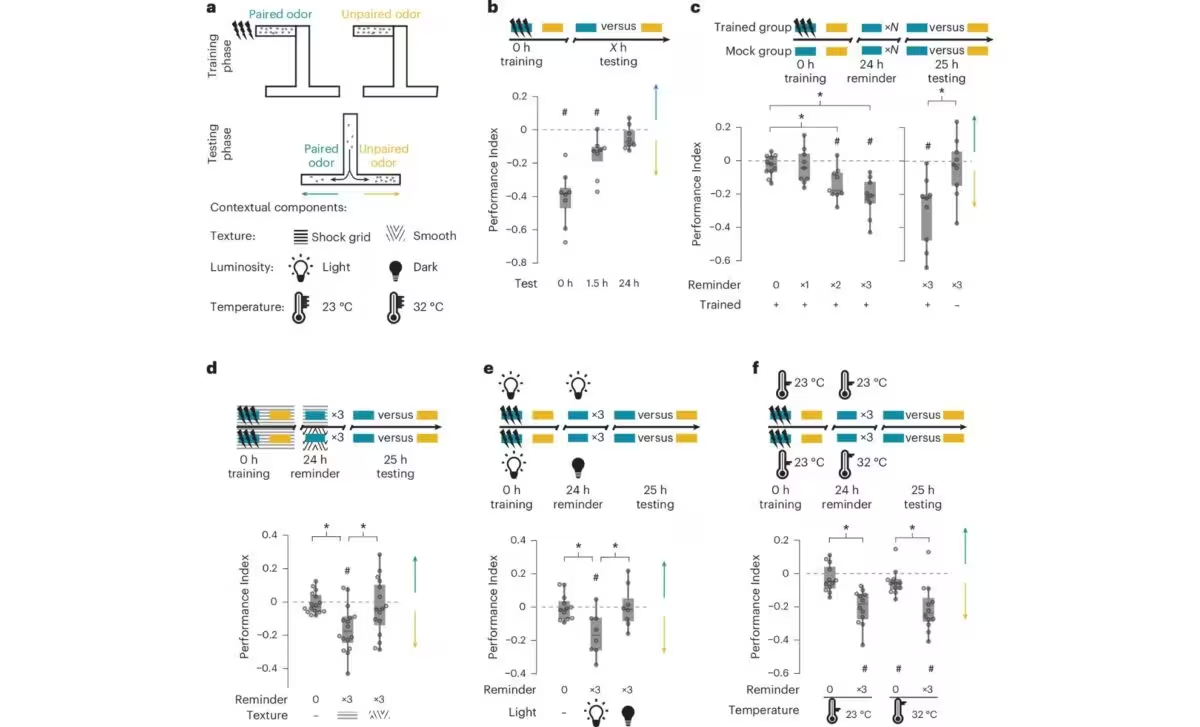
A team led by Wenbin Yang, Benedetta Zattera, and Miguel Pavão‑Delgado at Switzerland’s Friedrich Miescher Institute investigated how fruit flies (Drosophila melanogaster) store and retrieve learned information. The insects were conditioned to link a specific odor with a mild electric shock, causing them to avoid that scent afterward.
Within roughly a day, the avoidance behavior waned, making it appear as though the flies had forgotten the association. When the researchers placed the insects back into the original training chamber, the presence of multiple contextual cues—such as the chamber’s texture and lighting—reactivated the avoidance response, indicating that the memory lingered in a latent form.
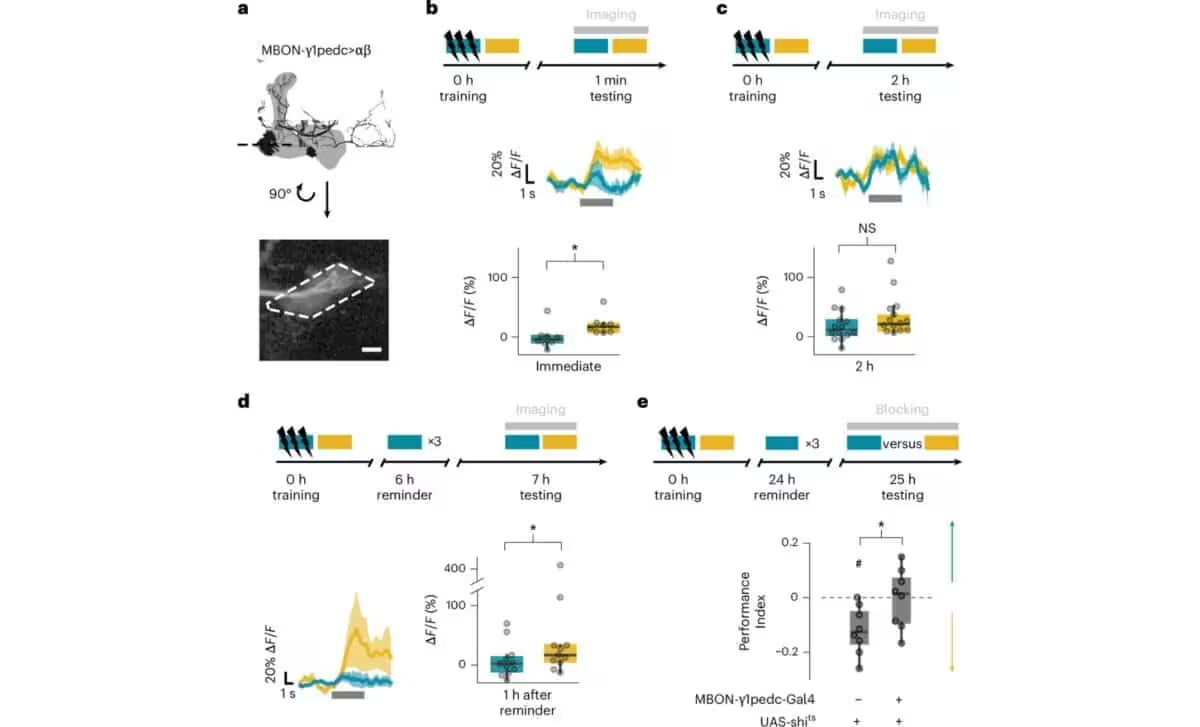
Neural recordings from the mushroom bodies—structures central to learning in flies—showed that as the behavioral avoidance faded, the corresponding neural trace diminished. Simultaneously, a distinct set of neurons began encoding a “silent” representation of the same memory, one that did not influence behavior under normal conditions.
When the full suite of reminder cues was presented, activity shifted back to the behavior‑driving neurons, reawakening the forgotten avoidance. The authors suggest that learning may generate both an active and a dormant version of a memory, with the latter serving as a reservoir that can be reactivated under the right circumstances.
Reactivating Lost Memories May Generate False Associations
A second surprising outcome emerged when the researchers introduced a different odor that had never been paired with shock during training. After exposing the flies to the full contextual reminder, the insects began to avoid this neutral scent, indicating that they had formed a false memory linking the new odor to the aversive stimulus.
ScienceAlert reported that this misassociation only arose when the odor had been part of the original training environment, implying that silent memory traces can be reconstructed inaccurately. The team linked the phenomenon to the emergence of false memories, noting that neural activity patterns differed between accurate recall and the erroneous association. Their findings echo earlier work on memory formation and highlight distinct pathways for faithful versus false retrieval.
The experiments demonstrate that separate neural circuits underlie accurate memory restoration and the generation of spurious associations, indicating that the brain can employ distinct mechanisms depending on the quality of the retrieved information.
Although the study was conducted in fruit flies, these insects share many molecular pathways with higher organisms, making them valuable models for dissecting the fundamentals of learning and memory. The work suggests that forgetting does not always equate to erasure; instead, memories may become dormant, awaiting a specific combination of cues to reemerge—though the resurrected trace may not perfectly match the original experience.
This article has been fact checked for accuracy, with information verified against reputable sources. Learn more about us and our editorial process.
Last reviewed on .
Article history
- Latest version
Reference(s)
- Talbi, Sarah. “Scientists Discovered That the Proteins Linked to Alzheimer’s May Actually Create Your Memories.”, February 17, 2026 Indian Defence Review <https://indiandefencereview.com/scientists-discovered-proteins-linked-alzheimers-create-memories/>.
Cite this page:
- Posted by Zubair Ali