The Hidden Brain Scaffold That Makes Teen Memories Fade—and Then Return
New study finds a brain structural shift can temporarily block access to memories formed in early adolescence.

Memory traces formed during early adolescence often become difficult to retrieve later in life, a phenomenon that has long puzzled researchers. New work links this puzzling pattern to a temporary reshaping of a brain region called the retrosplenial cortex and to alterations in the microscopic scaffolding that surrounds certain neurons.
The timing of these changes coincides with the age window in which psychiatric conditions such as schizophrenia and major depression most frequently emerge. While the study examines normal brain development rather than disease, the identified mechanism may help explain both the fleeting nature of adolescent memories and periods of heightened vulnerability.
Retrosplenial Cortex Shows Transient Gap in Early‑Adolescent Memory Access
The retrosplenial cortex, located near the back of the brain, receives information from the hippocampus and later stores it for long‑term use. Jelena Radulovic, M.D., Ph.D., a professor of neuroscience at Albert Einstein College of Medicine, led a team that examined how this region changes during the adolescent period.
Using mouse brains collected at five ages ranging from 21 to 75 days, the researchers measured perineuronal nets (PNNs)—dense lattices of sugars and proteins that envelop a subset of neurons. According to Earth, PNNs were plentiful at 21 and 30 days but dropped sharply between 45 and 75 days specifically in the retrosplenial cortex, whereas the hippocampus displayed a stable or increasing net density over the same interval.
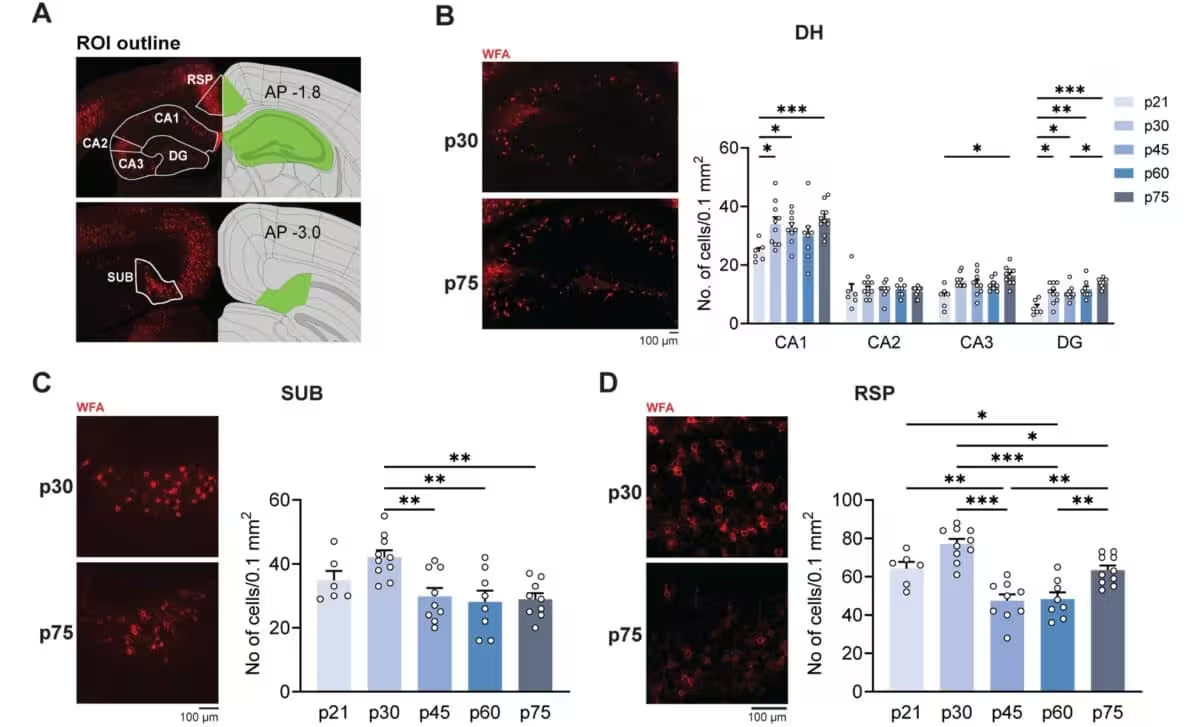
To rule out the possibility that the apparent decline simply reflected brain growth diluting net concentration, the team consulted two independent brain atlases. Both atlases indicated that the retrosplenial cortex actually contracted by roughly 7 % during the same developmental window, confirming a genuine loss of scaffolding.
Behavioral Tests Reveal Memory Remains Latent, Not Lost
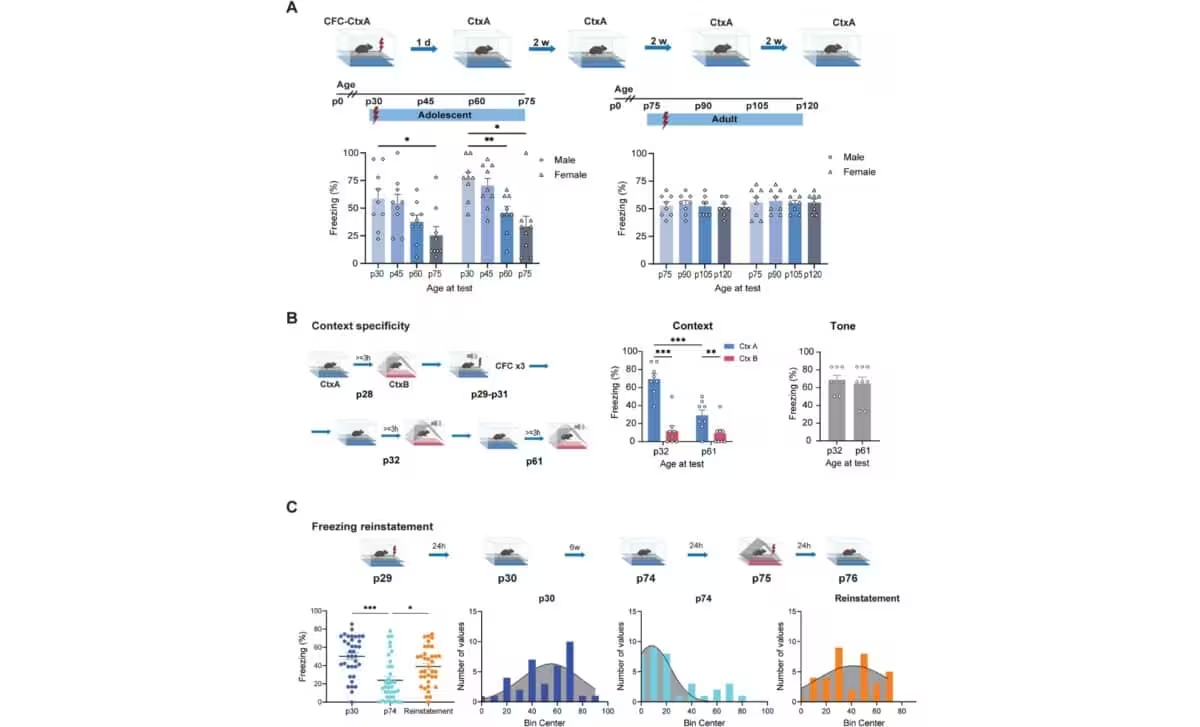
The investigators then asked whether the structural shift impacted memory. In a classic fear‑conditioning paradigm, mice explored a distinct chamber for three minutes before receiving a brief mild foot shock. Later returns to the same chamber allowed researchers to gauge memory by measuring freezing behavior.
Mice trained at 29 days initially displayed robust freezing, yet six weeks later most showed little response, suggesting a loss of access to the original context. By contrast, mice conditioned at 75 days retained strong freezing throughout the same interval. Importantly, the younger cohort still froze to an auditory cue paired with the shock and could discriminate the training chamber from a safe one, indicating that the memory trace itself was intact.
A subsequent single shock delivered in a new chamber triggered an immediate return of freezing in the original chamber for the majority of animals, indicating that the memory had been re‑accessed rather than erased. “The behavior matched the biology,” said Hui Zhang, Ph.D., a research fellow at Albert Einstein College of Medicine and first author of the study published in PLOS Biology.
Restoring Perineuronal Nets Recovers Memory but Alters Detail
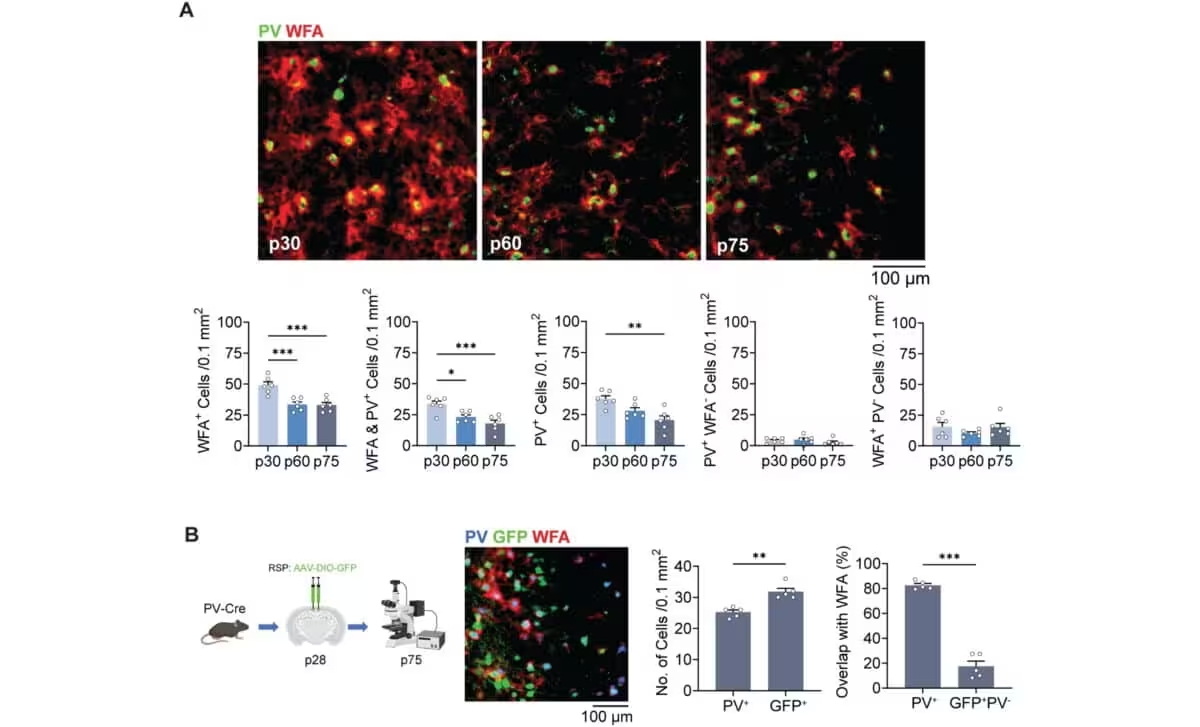
Perineuronal nets enclose parvalbumin‑expressing interneurons, fast‑firing cells that shape surrounding circuitry. Between 60 and 75 days, the number of identifiable parvalbumin cells declined, not because the cells died, but because they ceased producing the protein used for detection. Cells with the weakest net coverage were the ones that became functionally silent.
To test whether preserving the nets could protect memory, the team injected HAPLN1—a protein that stabilizes the mesh—directly into the retrosplenial cortex. This intervention maintained net density, kept parvalbumin cells active, and largely prevented the memory deficit observed in untreated adolescents.
Molecular analysis revealed that two major net components, aggrecan and neurocan, fell sharply during late adolescence in both male and female mice. Their synthesis is driven by the growth factor TGFβ2, whose gene activity also dropped dramatically in the retrosplenial cortex while remaining steady in the hippocampus. Epigenetic marks suggested that the decline follows a programmed developmental schedule rather than random fluctuation.
Administering a single dose of TGFβ2 on day 44—when nets began to thin—boosted net density, raised neurocan levels, and increased parvalbumin expression one week later. Silencing inputs from the maturing hippocampus did not alter the memory deficit, indicating that the remodeling originates within the retrosplenial cortex itself.
Mice followed into early adulthood (120–150 days) spontaneously regained freezing in the original chamber, and net density not only recovered but surpassed early‑adolescent levels. However, the recovered memory lacked specificity: the animals froze equally in a chamber where no shock had occurred, suggesting that the emotional imprint persisted while precise details faded.
The authors note that far fewer parvalbumin cells were incorporated into the rebuilt nets compared with early adolescence, and no other inhibitory neuron type compensated for the loss. This pattern mirrors the human “reminiscence bump,” where older adults recall a disproportionate number of teenage and early‑twenties experiences, retaining emotional tone but losing fine detail.
Current definitions place adolescence up to age 24, while the National Institutes of Health consider full brain maturation to occur in the mid‑to‑late twenties. The study concludes that the retrosplenial cortex undergoes an unexpected dismantling and subsequent rebuilding of its supporting scaffold well after early adolescence, temporarily limiting access to memories formed before this remodeling. Future investigations will need to determine whether a comparable process operates in humans and whether stabilizing this scaffold during late adolescence could improve both memory retention and mental‑health outcomes.
This article has been fact checked for accuracy, with information verified against reputable sources. Learn more about us and our editorial process.
Last reviewed on .
Article history
- Latest version
Reference(s)
- <https://einsteinmed.edu/>.
- Joseph, Jordan. “This brain process could explain why some adolescent memories temporarily fade.”, July 29, 2026 Earth.com <https://www.earth.com/news/why-memories-from-early-adolescence-can-fade-then-return/>.
- Zhang, Hui. “Retrosplenial cortical reorganization during late adolescence introduces instability of contextual memory circuits.”, vol. 24, no. 7, pp. e3003908, doi: 10.1371/journal.pbio.3003908. <https://journals.plos.org/plosbiology/article?id=10.1371/journal.pbio.3003908>.
- <https://www.nih.gov/>.
Cite this page:
- Posted by Zubair Ali