Massive Study Reveals DNA Only Explains A Tiny Fraction Of Your Personality
A massive global study of over one million people has identified 1,000 genetic variants linked to personality, proving DNA isn’t our only life architect.

The age-old debate regarding the origins of human individuality has long centered on the interplay between biological inheritance and lived experience. While identical twins share nearly identical genetic blueprints, their distinct personalities frequently diverge, highlighting that our DNA provides only a foundational sketch rather than a complete portrait of who we are.
To better understand the biological basis of human temperament, researchers recently conducted the most comprehensive genetic analysis of the Big Five personality traits—extraversion, agreeableness, conscientiousness, neuroticism, and openness to experience—ever performed. The study, published in Nature, synthesized data from 46 separate cohorts, encompassing a total of 1.14 million participants.
Thousands of Genetic Variants Linked to Personality
Led by a team including Ted Schwaba of Michigan State University, Elliot Tucker-Drob of the University of Texas at Austin, and Michel Nivard of the University of Bristol, the researchers employed genome-wide association studies (GWAS) to identify specific genetic markers that correlate with personality differences. Rather than searching for a “gene for personality,” the team looked for thousands of variants, each contributing a negligible amount to the overall picture.
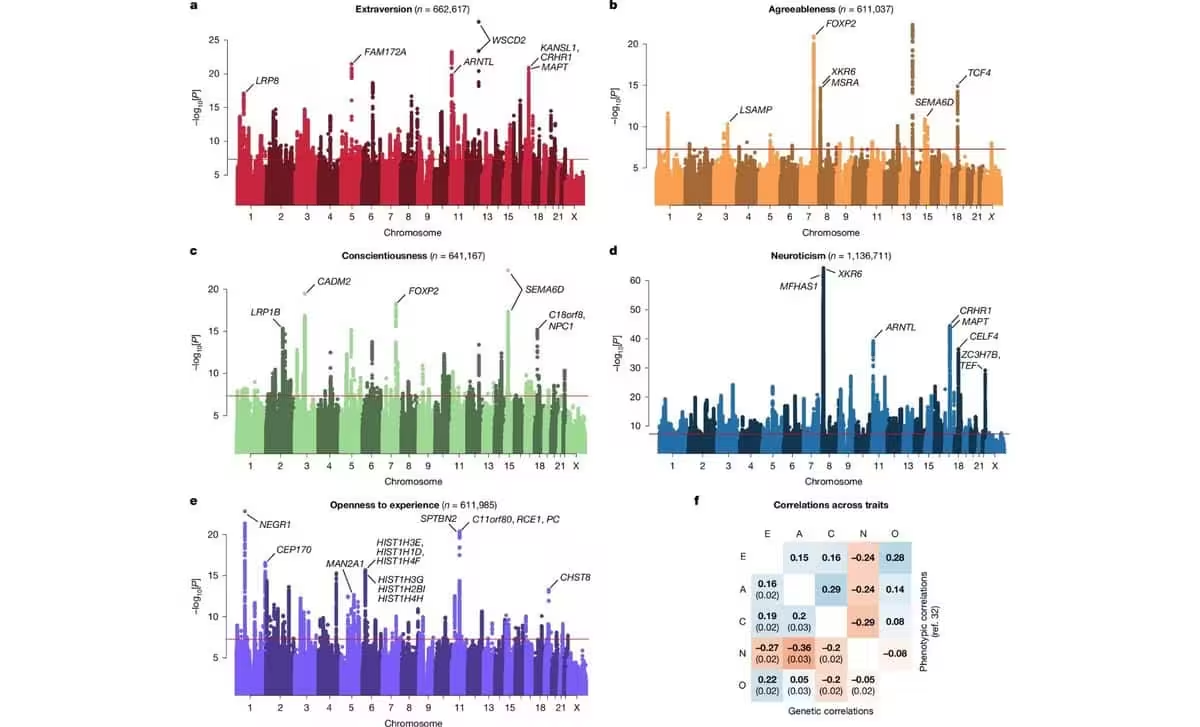
The analysis successfully pinpointed 1,260 lead genetic variants associated with the Big Five, 824 of which had not been previously linked to personality traits. Despite this breakthrough, Nivard noted that the individual effect of any single variant remains virtually undetectable at the level of a single human being.
The Dominance of Environmental Factors
While the study confirms that genetics play a role, the findings underscore that environmental factors remain the primary architects of personality. The identified genetic variations accounted for only 7.4 to 10.6 percent of the individual differences observed in the Big Five traits. When researchers attempted to use this genetic data to predict personality in independent groups, the predictive power dropped to less than 4 percent, rendering DNA an unreliable tool for assessing an individual’s character.
By comparing fraternal twins and siblings, the team was able to differentiate between shared family environments and genetic inheritance. They discovered that the genetic influence on personality remains remarkably consistent regardless of whether individuals are related, further cementing the conclusion that culture, diet, surroundings, and personal life experiences are the dominant drivers of human behavior.
Variations in Agreeableness
One notable finding was that the genetic architecture of agreeableness displayed more inconsistency across populations compared to the other four traits. Researchers suggest this may be due to the varied ways different cultures and research groups measure the trait, which encompasses qualities like warmth, sympathy, and honesty. Because these questionnaires often prioritize different cultural interpretations of “kindness” or “cooperation,” the genetic signals tied to them can appear disparate.
The research also touched upon broader societal implications, including a genetic correlation between extraversion and susceptibility to COVID-19 during the early stages of the pandemic, likely linked to the social habits inherent to more extroverted individuals. Moving forward, the researchers emphasize that while genetic studies offer a powerful lens for observing population-level trends, direct personality assessment remains the most accurate way to understand an individual.
This article has been fact checked for accuracy, with information verified against reputable sources. Learn more about us and our editorial process.
Last reviewed on .
Article history
- Latest version
Reference(s)
- Schwaba, Ted. “Robust inference and correlates from genetic associations with personality - Nature.”, September 2, 2026, pp. 1-11. Nature, doi: 10.1038/s41586-026-10992-9. <https://www.nature.com/articles/s41586-026-10992-9>.
- “Ted Schwaba | Michigan State University.” <https://psychology.msu.edu/people/s/schwaba-ted>.
- “Profile for Elliot Tucker-Drob at UT Austin.” <https://liberalarts.utexas.edu/prc/faculty/et5793>.
- “Dr Michel Nivard - Our People.” <https://www.bristol.ac.uk/people/person/Michel-Nivard-4b8a3436-e7aa-42bc-8f35-88c0f1e62e65/>.
Cite this page:
- Posted by Zubair Ali