Physicists Boost Superconductivity by Manipulating the Energy Hidden in Empty Space
Researchers have observed quantum electromagnetic fluctuations in empty space by manipulating an ultrathin superconductor within a custom-designed cavity.

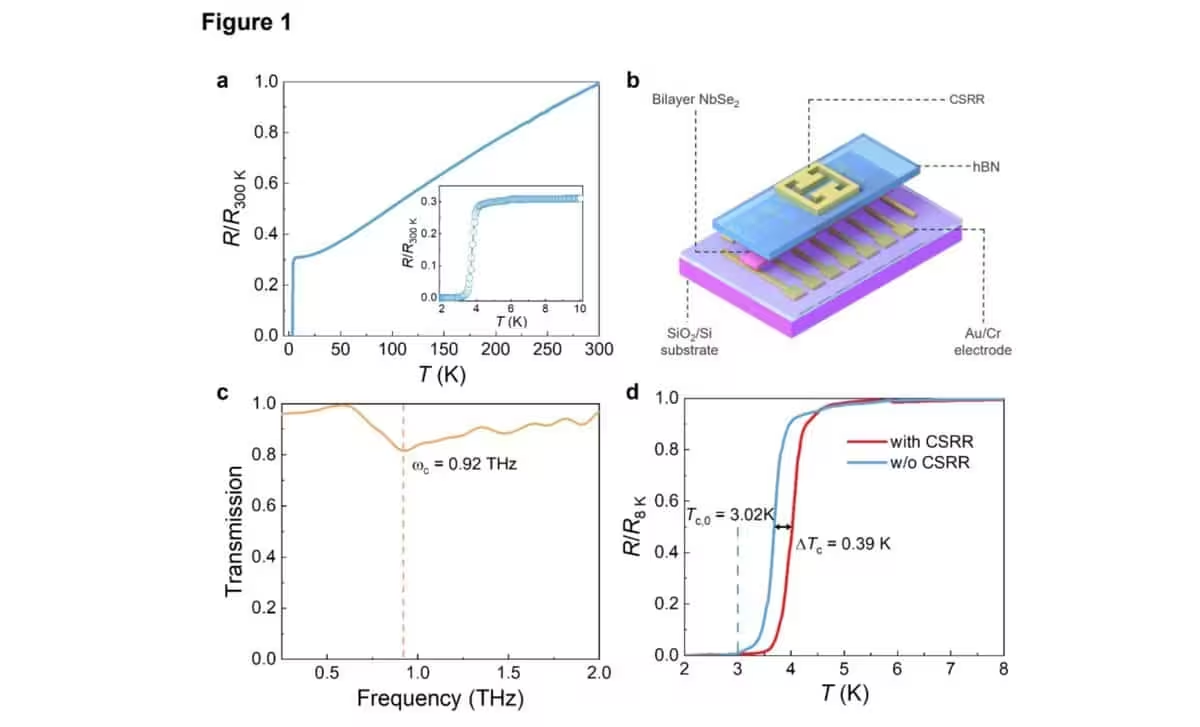
Researchers have successfully manipulated the fundamental properties of matter by engineering the electromagnetic vacuum, a breakthrough that provides new insight into the control of superconductivity. By integrating thin layers of niobium diselenide (NbSe2) into precisely designed terahertz cavities, scientists have demonstrated that they can tune the material’s superconducting transition temperature, achieving a notable increase of approximately 10 percent in bilayer samples.
This work explores a core principle of quantum physics, which posits that even a vacuum is not truly empty but is instead filled with electromagnetic fluctuations. By reshaping this environment using resonators, researchers can influence the behavior of macroscopic systems, a feat that has long been theorized but historically difficult to achieve at this scale.
Precision Tuning of Superconducting States
A research team led by Weibo Gao at Nanyang Technological University utilized a complementary split-ring resonator (CSRR) to investigate how these fluctuations impact NbSe2 of varying thicknesses. To prevent interference, the material was isolated from the gold resonator structure by a 30-nanometer layer of hexagonal boron nitride.
The results revealed a clear relationship between the cavity’s resonance frequency and the material’s performance. For bilayer NbSe2, a cavity resonance of 0.92 THz boosted the transition temperature from 3.02 K to 3.41 K. This effect was highly localized; the shift was most pronounced where the electromagnetic field was strongest, with the enhancement diminishing toward the edges of the resonator and vanishing entirely outside of it. Control experiments using Raman spectroscopy and plain gold surfaces confirmed that the observed changes were driven by the resonant electromagnetic field rather than thermal artifacts or structural variations.
Non-Linear Responses and Theoretical Frameworks
Interestingly, the influence of the cavity is not uniform across all frequencies. Tests on ten-layer samples showed that while a 0.92 THz setting enhanced superconductivity, a 0.69 THz frequency actually suppressed the transition temperature, and a 2.00 THz frequency resulted in negligible changes. This non-monotonic behavior suggests that the interaction between the vacuum state and the superconducting electrons is highly sensitive to the specific geometry and frequency of the resonator.
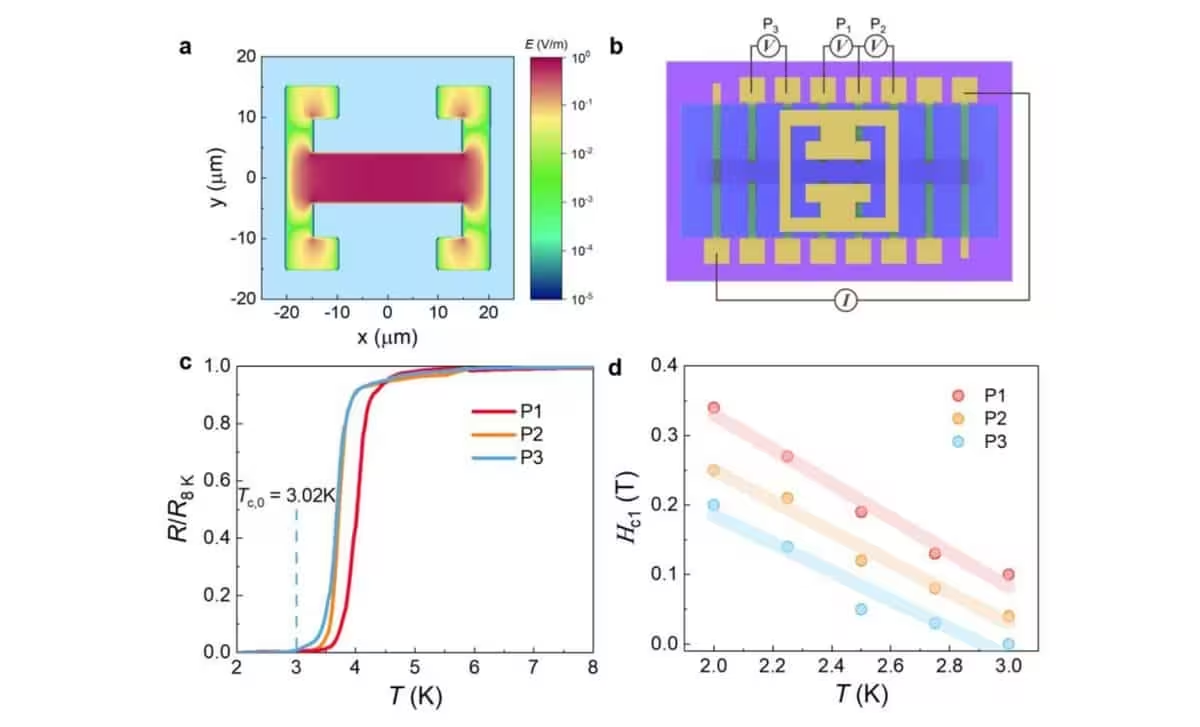
To explain these observations, the researchers turned to quantum electrodynamical density functional theory. Their calculations indicate that photon coupling effectively redistributes spectral weight within the Eliashberg function—a key component in understanding electron-phonon interactions. The model suggests that photon-induced changes to the average phonon frequency and electron-phonon coupling strength work in opposition, providing a theoretical mechanism for why the superconducting state might be either strengthened or weakened depending on the specific tuning of the environment.
While these calculations were based on idealized monolayer models and do not perfectly map onto the thicker experimental samples, the findings provide a robust framework for understanding how vacuum engineering can be used to modulate quantum materials. These studies represent a significant step forward in the potential for light-matter interaction to influence macroscopic quantum phases.
This article has been fact checked for accuracy, with information verified against reputable sources. Learn more about us and our editorial process.
Last reviewed on .
Article history
- Latest version
Reference(s)
- Wang, Zheyan. “Evidence for vacuum-enhanced superconductivity in NbSe2 - Nature.”, August 19, 2026, pp. 1-6. Nature, doi: 10.1038/s41586-026-11037-x. <https://www.nature.com/articles/s41586-026-11037-x>.
Cite this page:
- Posted by Farah Siddiqui