Why Venus Might Have Swallowed Its Own Moon According To New Research
New research may have finally solved the long-standing mystery of why Venus lacks a moon, offering fresh insights into the planet’s chaotic orbital history.
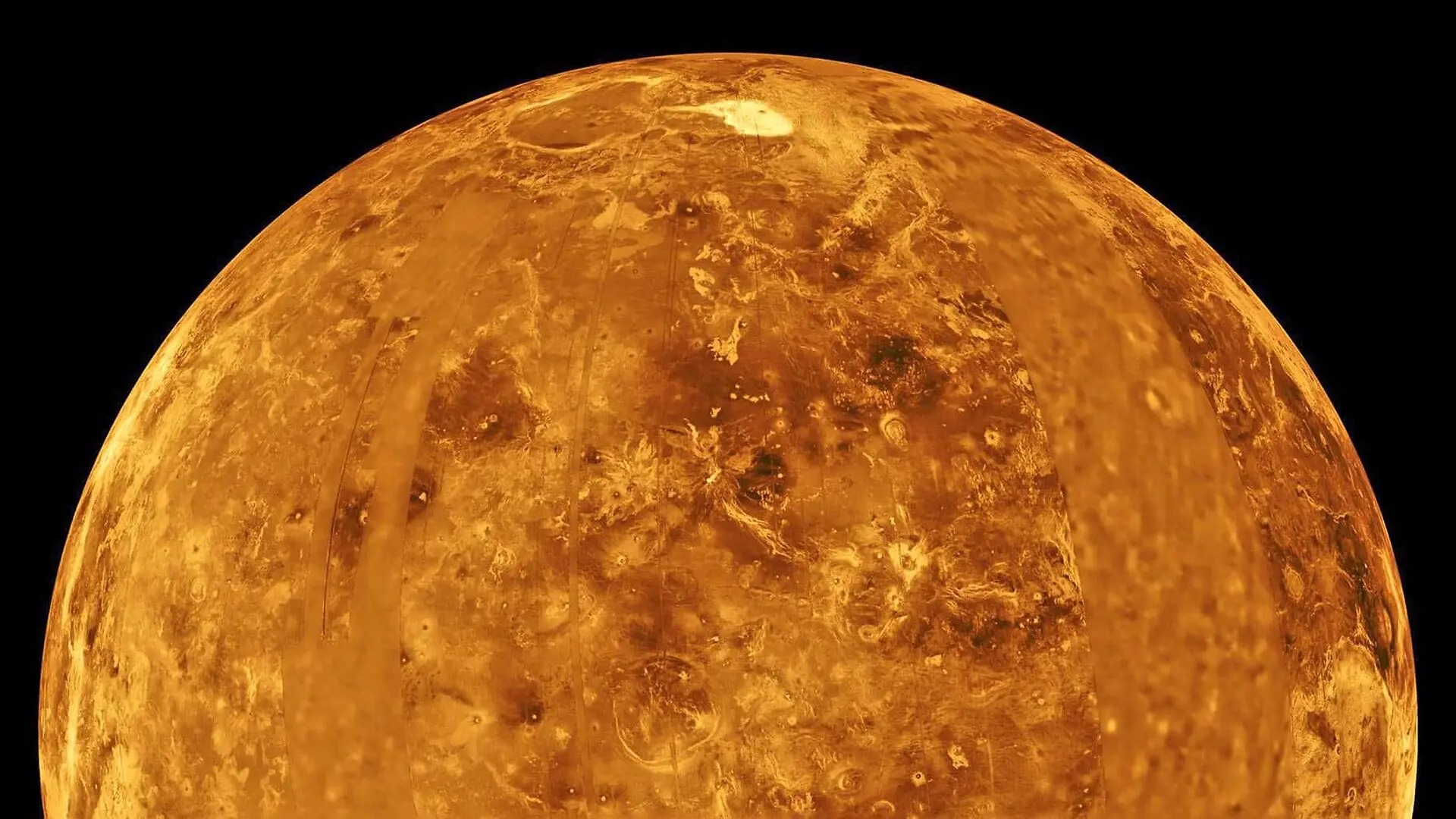
For decades, planetary scientists have wrestled with a curious cosmic discrepancy: why does Earth possess a massive, stabilizing moon while its near-identical twin, Venus, drifts through the solar system entirely alone? New research suggests the answer is not that Venus never had a moon, but that it may have been the architect of its own satellite’s demise.
Traditional theories have often pointed toward catastrophic impacts or a complete lack of moon-forming events to explain the lunar void surrounding Venus. However, a study published in The Astrophysical Journal challenges these assumptions, proposing a mechanism rooted in fundamental orbital mechanics rather than random disaster.
The Physics of a Planetary Collision
Stephen Kane, an astrophysicist at the University of California, Riverside, suggests that the fate of a moon is inextricably linked to the rotation rate of its host planet. On Earth, our rapid 24-hour rotation imparts energy to our moon, causing it to gradually drift outward at a rate of approximately four centimeters per year. Because Earth spins quickly, it effectively pushes its lunar companion away.
Venus, by contrast, operates on a drastically different timescale, requiring 243 Earth days to complete a single rotation. According to Kane’s mathematical models, this lethargic spin creates a gravitational environment that forces any orbiting body to spiral inward rather than outward. Through a series of simulations testing various lunar sizes and orbital parameters, the research consistently showed that any moon circling Venus would be destined to crash into the planet’s surface.
“When I made this discovery, I was shocked,” says Kane. “I thought surely the broad range of scenarios I was exploring would lead to a variety of results. But it all went pretty much in the same direction.”
Rewriting Venus’s Geological History
Confirming this theory through physical observation presents a significant challenge. Approximately one billion years ago, Venus underwent a massive resurfacing event that wiped away the majority of its ancient geological record, potentially burying any evidence of a lunar impact deep beneath its thick, toxic atmosphere.
However, researchers remain hopeful that future seismic exploration could reveal deep-seated structural anomalies similar to those found within Earth, which are believed to be remnants of our own moon-forming collision. Such evidence could clarify whether Venus once possessed a satellite and how that collision might have fundamentally altered the planet’s trajectory.
Implications for Planetary Habitability
The disappearance of a moon would be more than a footnote in Venusian history; it would represent a cataclysmic event capable of reshaping the planet’s climate, rotation, and potential to host life. A massive impact would transfer significant angular momentum to the planet, potentially triggering tectonic shifts or atmospheric changes that could have rendered a once-habitable world inhospitable.
This finding carries profound weight for the broader search for life beyond our solar system. As astronomers scan distant stars for Earth-like planets, the presence of a moon is often considered a proxy for stability and habitability. Kane’s work warns that simply spotting an Earth-sized planet in the habitable zone is not enough; the rotation rate of that world may dictate whether it can hold onto its moon, or whether it is doomed to consume it.
“My study shows a disturbing scenario for many of those cases,” Kane explains. “If these planets don’t rotate fast enough, the moon will crash to the surface, and that would change the course of history for those planets.”
This article has been fact checked for accuracy, with information verified against reputable sources. Learn more about us and our editorial process.
Last reviewed on .
Article history
- Latest version
Reference(s)
- Kane, Stephen R.., et al. “Tidal Demise: The Evolution and Fate of a Hypothetical Venus Moon.” The Astrophysical Journal, vol. 1009, no. 1, September 14, 2026, pp. 31 American Astronomical Society, doi: 10.3847/1538-4357/ae9d6c. <https://doi.org/10.3847/1538-4357/ae9d6c>.
Cite this page:
- Posted by Farah Siddiqui