Engineered Human Cells Use RNA Logic Gates to Make Complex Decisions for Cancer Therapy
Lab research paves the way for smart cell therapies that trigger only when specific disease signals are present.

Synthetic biologists have begun to rewire living cells so they can carry out pre‑programmed tasks, much like tiny computers. By tapping into the cell’s own molecular machinery, researchers are building compact genetic circuits that respond only when specific combinations of signals are present.
The work, led by Ph.D. candidate Keren Roas together with Dr. Lior Nissim, was motivated by the need for more precise therapeutic cells. In cancer treatment, for instance, a cell should ignore isolated warning signs and activate its response only after multiple disease‑associated markers are detected.
A Compact Approach to Cellular Logic Design
Conventional genetic designs rely on long chains of molecular switches, which quickly become unwieldy inside a cell. To overcome this, the team employed RNA trans‑splicing—a mechanism where fragments from distinct RNA strands merge into a single transcript that the cell can translate. This strategy enabled the construction of AND gates, a fundamental logic element that yields an output solely when two inputs arrive together, as described in the published study.
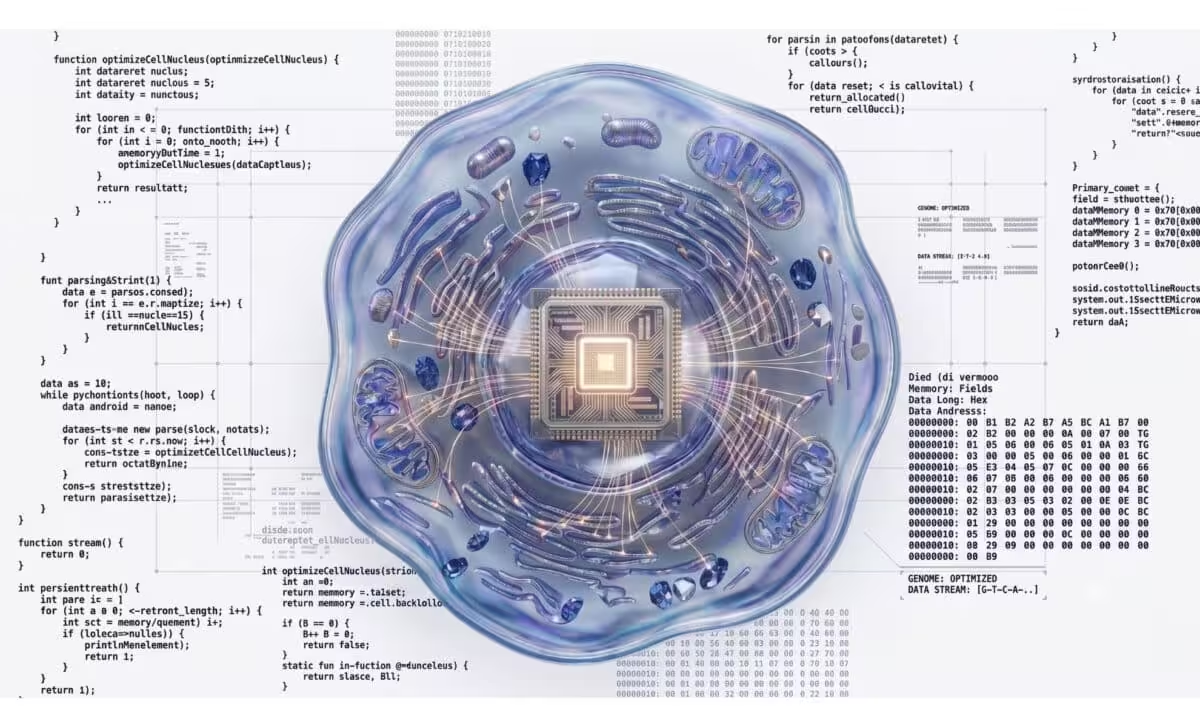
“Our new approach allows cells to carry out complex programs using far fewer calculations and genetic building blocks,” Dr. Lior Nissim said in a statement. “This makes it possible to build much more advanced biological programs without losing functionality.”
Engineered Cells that Choose Actions and Flag Ambiguities
Tests in cultured human cells demonstrated that the circuits can go beyond simple binary switches. Some cells were programmed to emit distinct outputs depending on how many biomarkers they sensed, while others were set to pick a single response from several alternatives based on the precise signal mix.
An error‑warning feature was also incorporated. As reported by ZME Science, when a cell received contradictory instructions—analogous to two commands arriving simultaneously—it produced a dedicated alert instead of executing an erroneous program.
To illustrate a therapeutic scenario, the researchers equipped cells with the ability to secrete interleukin‑15 (IL‑15), a cytokine that can boost the activity of cancer‑fighting immune cells.
From Bench to Bedside: Hurdles Still to Overcome
All experiments were performed under controlled laboratory conditions, with the engineered circuits delivered into human cells via standard transfection methods. The authors acknowledge several technical barriers that must be cleared before clinical translation.
Key concerns include preventing unintended interactions between RNA fragments, minimizing background “leakage” from genetic switches, and devising robust techniques for integrating larger circuit designs into cellular genomes.
Therapeutic applications would require cells to discriminate among intricate combinations of biomarkers, ignore false positives, and act only within the correct tissue environment. Many diseases—cancer, autoimmune disorders, metabolic syndromes—are characterized by multiple molecular cues rather than a single indicator.
At present, the study offers synthetic biology a more streamlined toolkit for programming cellular decision‑making. While still confined to the laboratory, the work marks a step toward endowing living cells with sophisticated, programmable functions that could one day be harnessed for medicine.
This article has been fact checked for accuracy, with information verified against reputable sources. Learn more about us and our editorial process.
Last reviewed on .
Article history
- Latest version
Reference(s)
- Roas, Keren. “Modular Scalable Synthetic Gene Circuits for Complex Functions Within Minimal Computational Layers in Human Cells - Nature Communications.”, June 16, 2026 Nature, doi: 10.1038/s41467-026-74408-y. <https://www.nature.com/articles/s41467-026-74408-y>.
- “Lior Nissim.” <https://scholar.google.com/citations?user=Dkutb08AAAAJ&hl=iw>.
- Tarita, Tudor. “Scientists Turned Human Cells into Tiny Biological Computers.”, July 2, 2026 ZME Science <https://www.zmescience.com/science/biology/scientists-turned-human-cells-into-tiny-biological-computers/>.
Cite this page:
- Posted by David Anderson