Four Nuclear Bombs Fell Over Spain in 1966—The Hidden Toll on the Cleanup Crew
Mid‑air crash over southern Spain scattered four thermonuclear weapons, sparking a massive plutonium cleanup and an 80‑day sea search.
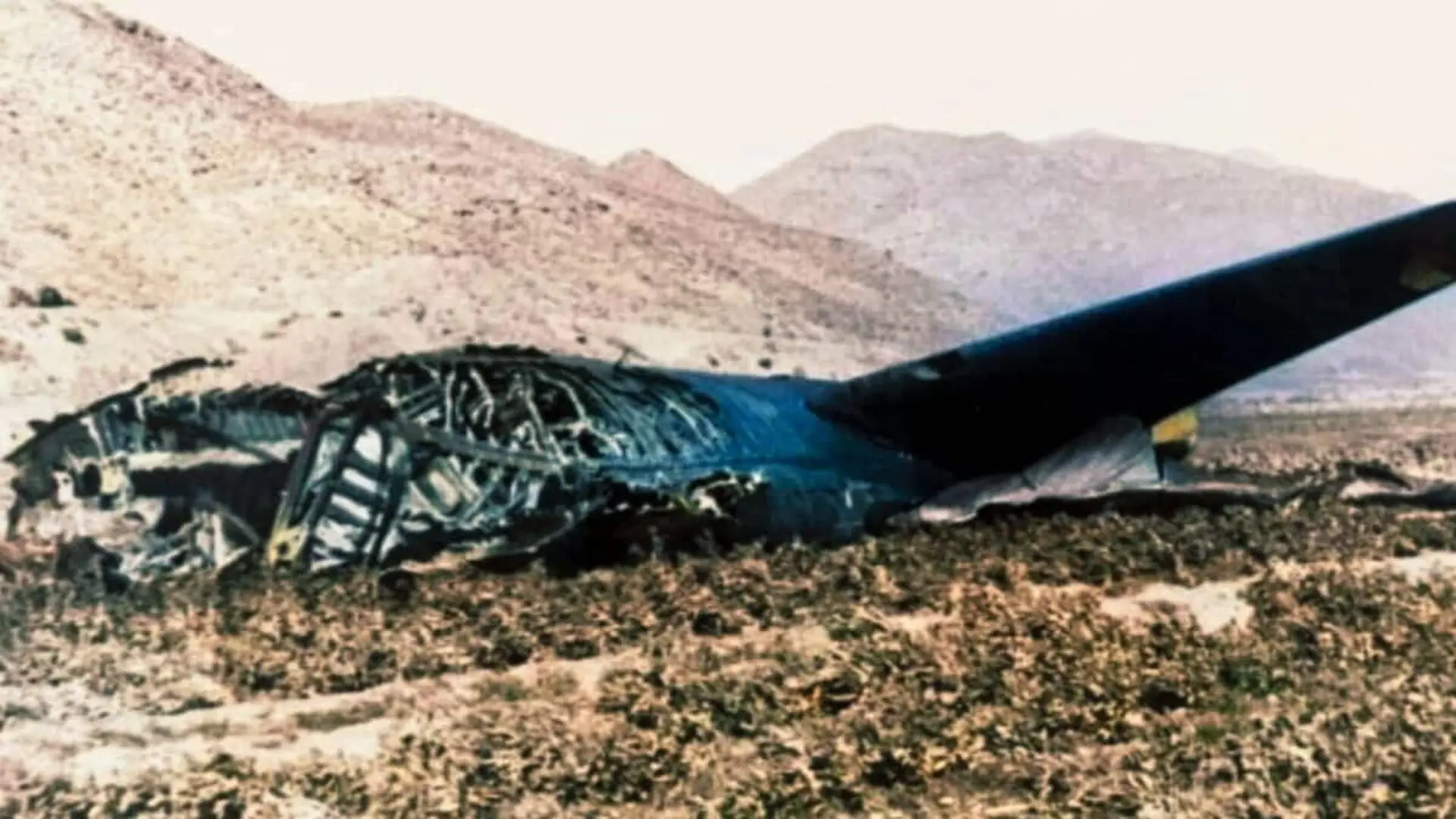
On 17 January 1966 a United States Air Force B‑52 bomber, loaded with four thermonuclear weapons, shattered in mid‑air over southern Spain after colliding with a KC‑135 aerial refueling tanker near the village of Palomares. The impact hurled three of the weapons onto the ground and sent the fourth to the Mediterranean Sea.
The aircraft, tail number “Tea 16,” was a B‑52G that had departed Seymour Johnson Air Force Base in North Carolina for an Operation Chrome Dome airborne‑alert sortie. After completing two prior refuelings and a brief orbit around Turkey, the bomber approached the KC‑135 for a third in‑flight refuel. According to the Air & Space Forces, the B‑52 was traveling too fast, causing the tanker’s refueling boom to strike the bomber’s longeron, damaging the left wing and triggering its separation. The ensuing breakup released all four nuclear weapons.
Two of the weapons detonated their conventional explosives upon impact, spreading plutonium across a beach, a tomato field and a cemetery adjacent to Palomares. The United States Air Force dispatched teams to contain the contamination and begin recovery operations.
Over 1,600 Service Members Mobilized for Decontamination
In the aftermath, the Air Force identified a subgroup dubbed “the High 26,” whose members were thought to have incurred the highest radiation exposure. Subsequent record reviews concluded that the overall dose to personnel was modest.
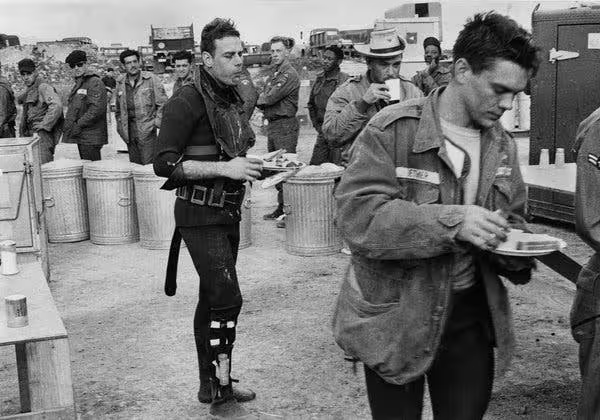
A 2016 New York Times investigation highlighted the experiences of lower‑rank staff who joined the cleanup, including a cook, a grocery clerk and Air Force musician Frank B. Thompson. Thompson, a 22‑year‑old trombonist at the time, recounted being sent to search the contaminated fields without protective gear or fresh clothing.
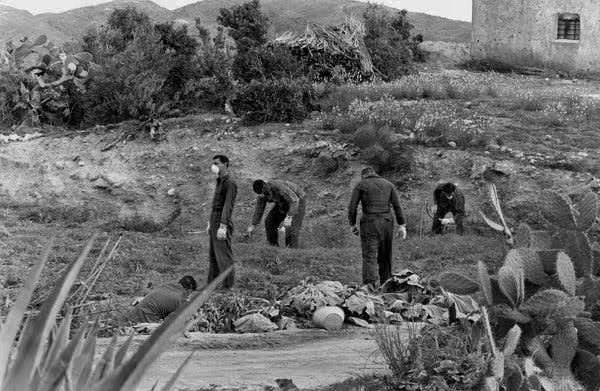
Thompson recalled, “There was no talk about radiation or plutonium or anything else. They told us it was safe, and we were dumb enough, I guess, to believe them.” By 2016 he had been diagnosed with cancers of the liver, lung and kidney. The article noted that veterans were seeking acknowledgment for illnesses they linked to the cleanup, while the Air Force maintained that safety protocols had limited exposure for the roughly 1,600 participants.
Declassified documents later revealed that radiation levels near the damaged weapons exceeded the detection limits of some monitoring equipment, and many workers handled contaminated material wearing only standard cotton uniforms.
Naval Search Teams Locate the Lost Bomb After Eleven Weeks
While ground crews worked around Palomares, the fourth weapon remained hidden beneath the Mediterranean. The U.S. Navy committed more than 30 vessels and the deep‑sea submersible Alvin to the hunt. On 7 April 1966, the USS Petrel successfully recovered the Mk 28 bomb after an 80‑day immersion.
The recovered bomb showed extensive corrosion: its tail had been severed in two places, the nose bore multiple dents, yet the safety switch remained in the “safe” position. Spanish officials inspected the weapon aboard the ship while photographers documented the recovery.
Palomares Lessons Shape Response to the 1968 Thule Crash
The Palomares incident occurred during Operation Chrome Dome, a Strategic Air Command program that kept nuclear‑armed bombers aloft for up to 24 hours, at times with as many as 12 aircraft in the sky simultaneously. Two years later, a similar disaster unfolded near Thule Air Base in Greenland on 21 January 1968 when a B‑52 suffered a cabin fire, forced the crew to abandon, and crashed onto sea ice, detonating the high‑explosive components of its four weapons and scattering radioactive material.
Lawrence Livermore National Laboratory drew directly on the Palomares experience to inform its Greenland response. Its Hazards Control Department had previously devised a portable detector called FIDLER (Field Instrument for Detection of Low Energy Radiation) to rapidly survey large contaminated zones. Scientists Nate Benedict and Joe Tinney deployed the instrument in Greenland, mapping fallout around the crash site and using those measurements to guide subsequent decontamination efforts.
Operation Chrome Dome was terminated on 22 January 1968, the morning after the Thule accident, shifting the United States’ nuclear alert posture from continuous airborne patrols to ground‑based readiness.
This article has been fact checked for accuracy, with information verified against reputable sources. Learn more about us and our editorial process.
Last reviewed on .
Article history
- Latest version
Cite this page:
- Posted by David Anderson