Scientists Discover a Hidden Mechanism That Keeps Evolution Moving After Species Reach Fitness Peaks
Evolution doesn’t stop at perfection. Scientists have discovered a hidden process that continues to shape life in unexpected ways beyond simple adaptation.

Evolutionary biology has long operated under the assumption that once a species reaches an adaptive peak—a state of high fitness within its environment—any further genetic shifts are largely the product of random genetic drift. However, new research suggests that this view is incomplete, revealing that the very architecture of evolutionary landscapes can steer populations along non-random paths even after they have seemingly reached their prime.
The study, rooted in the fitness landscape models pioneered by Sewall Wright in the 1930s, treats evolutionary outcomes as a topographical map. In this framework, peaks represent high-fitness combinations of traits, while valleys represent less effective configurations. Traditionally, once a population scales a peak, it was thought to lose the directional guidance of natural selection, leaving it to drift aimlessly.
Rethinking Evolutionary Stasis
Biologists Naama Brenner and Razi Fachareldeen of the Technion Israel Institute of Technology have challenged this narrative by investigating how populations navigate regions of equal fitness. Their work highlights the concept of degeneracy, a biological phenomenon where distinct genetic or structural pathways yield identical functional outcomes. From the redundancy in the genetic code to the varied ways different antibodies can neutralize the same pathogen, nature is rife with examples of diverse traits converging on the same survival utility.
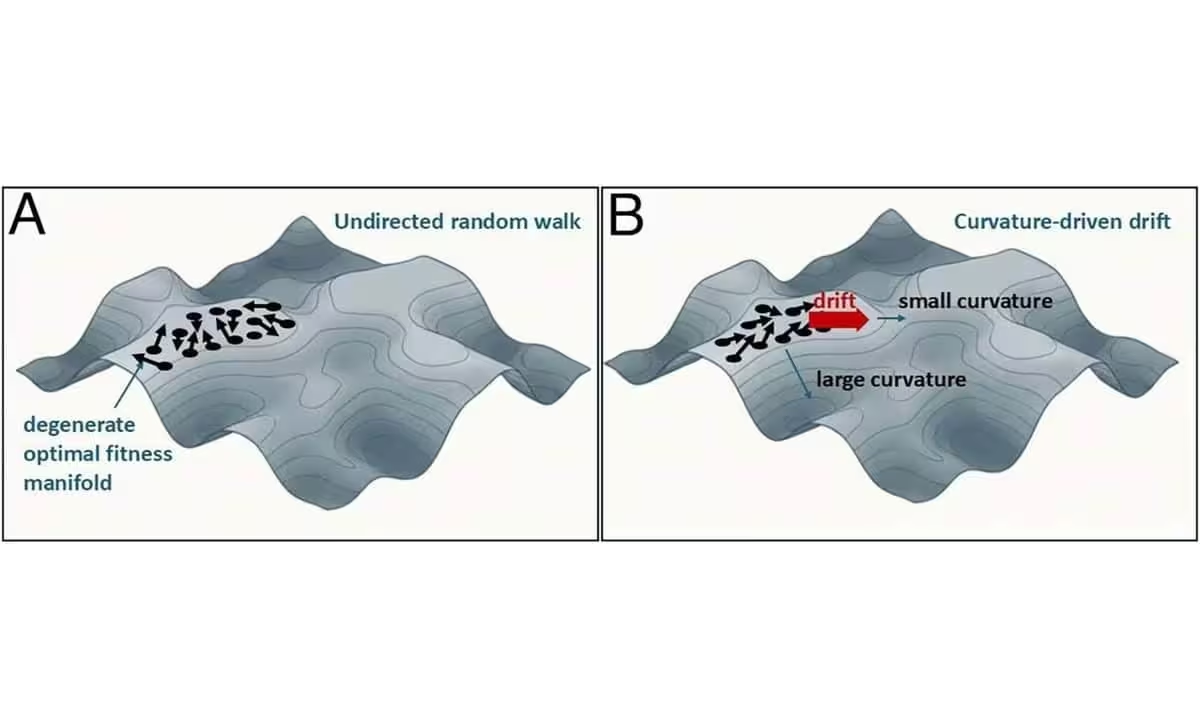
By employing sophisticated mathematical modeling, the researchers demonstrated that evolution does not simply stall once a population hits a plateau of maximum fitness. Instead, it enters a state of guided movement they term directional drift. Unlike the stochastic nature of random drift, this movement is dictated by the specific curvature of the fitness landscape.
Geometry as a Driver of Change
As detailed in the study published in PNAS, the interaction between population variability and the geometry of the landscape creates a subtle but persistent bias. The researchers found that populations naturally gravitate toward broader, flatter regions of the landscape. Because these areas are less susceptible to the disruptive effects of new mutations, they offer greater stability.
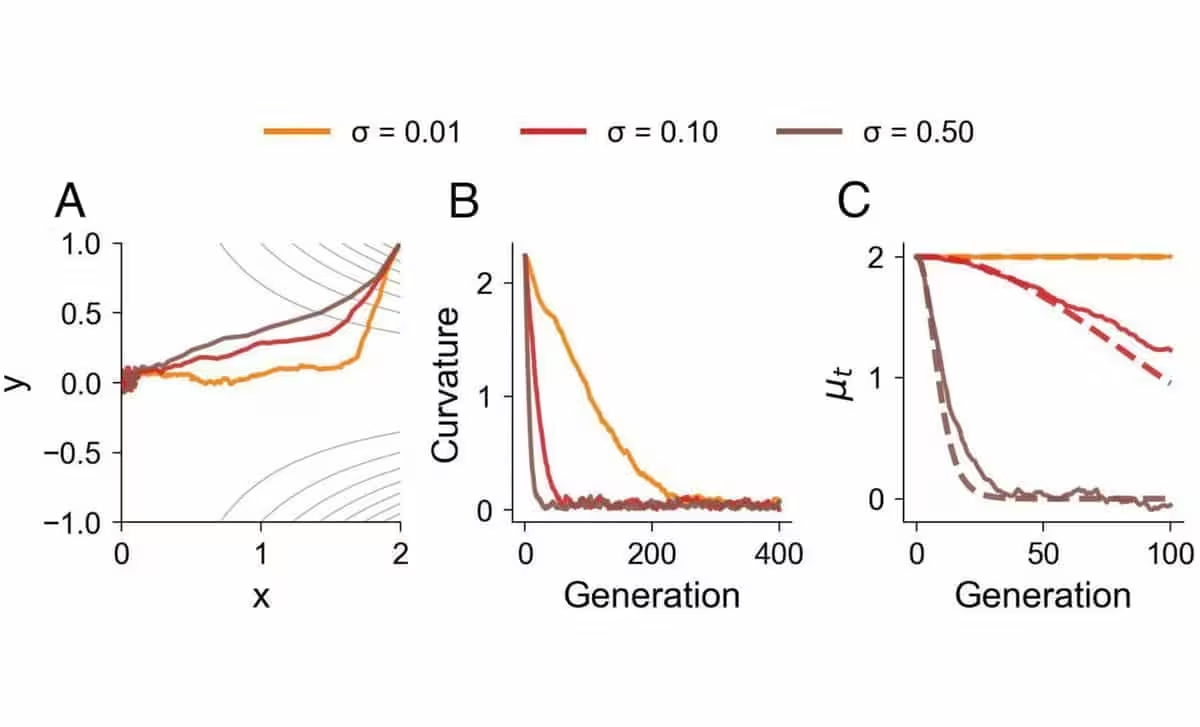
Essentially, evolution can continue to optimize for robustness even without the pressure of changing environments. This implicit bias means that a species does not need to actively “strive” for stability; rather, the shape of the landscape makes stable regions more accessible over time, allowing the population to drift into a more protected state.
Unlocking New Evolutionary Insights
This discovery provides a fresh perspective on why certain species appear to change even when their external environment remains constant. By mapping phenotypic shifts across generations against this geometric model, scientists may be able to better understand the long-term trajectories of life. The researchers noted that their findings offer a complementary, dynamic interpretation of existing data, and they are calling for future empirical studies to bridge the gap between natural variation and this geometric, model-based understanding.
This article has been fact checked for accuracy, with information verified against reputable sources. Learn more about us and our editorial process.
Last reviewed on .
Article history
- Latest version
Reference(s)
- “Genetic drift, an evolutionary process affecting all populations, - Sanders 3rd Edition Ch 20 Problem 6.” <https://www.pearson.com/channels/genetics/textbook-solutions/sanders-3rd-edition-9780135564172/ch-20-population-genetics-and-evolution-at-the-population-species-and-molecular-/genetic-drift-an-evolutionary-process-affecting-all-populations-can-have-a-signi?irclickid=UKHVaSTsqxyZW3TxYIy9l3yMUkrzN32n2w4AUs0&sharedid=popularmechanics.com&irpid=10078&irgwc=1&afsrc=1>.
- Fachareldeen, Razi., et al. “Evolution on degenerate fitness landscapes is not random: Curvature drives directional drift.” Proceedings of the National Academy of Sciences, vol. 123, no. 32, August 3, 2026 National Academy of Sciences, doi: 10.1073/pnas.2605142123. <https://www.pnas.org/doi/10.1073/pnas.2605142123>.
Cite this page:
- Posted by Elizabeth Taylor