Fifteen-Year Study Reveals Hidden Patterns Behind Foreign Player Signings In Chinese Super League
Analysis of 1,380 registrations shows global network reach predicts player movement better than geographic distance.

A fifteen-year analysis of foreign player origins in the Chinese Super League reveals that recruitment spans across multiple continents, yet player registrations remain tightly concentrated within a select group of major countries. Between 2010 and 2024, the professional football league recorded 1,380 foreign player season registrations originating from 94 football associations, though a small number of nations consistently supplied the majority of talent. The research demonstrates that an origin country’s broader international destination reach and its structural position within the global transfer market are strong predictors of player registrations in China, whereas geographic distance and national economic differences show no significant statistical association after accounting for these global network factors.
The study, published in PLOS One by Zijie Li, Maoteng Cheng, and Fugao Jiang, investigated the spatiotemporal evolution of foreign player origins and the macroeconomic and network characteristics associated with season registration counts. While leagues in Europe have decades of established history, the Chinese Super League expanded its international connections after global transfer markets were already mature, offering a clear case study for how a later-developing destination league builds its foreign player source structure.
What the Global Transfer Network Data and Spatial Maps Reveal
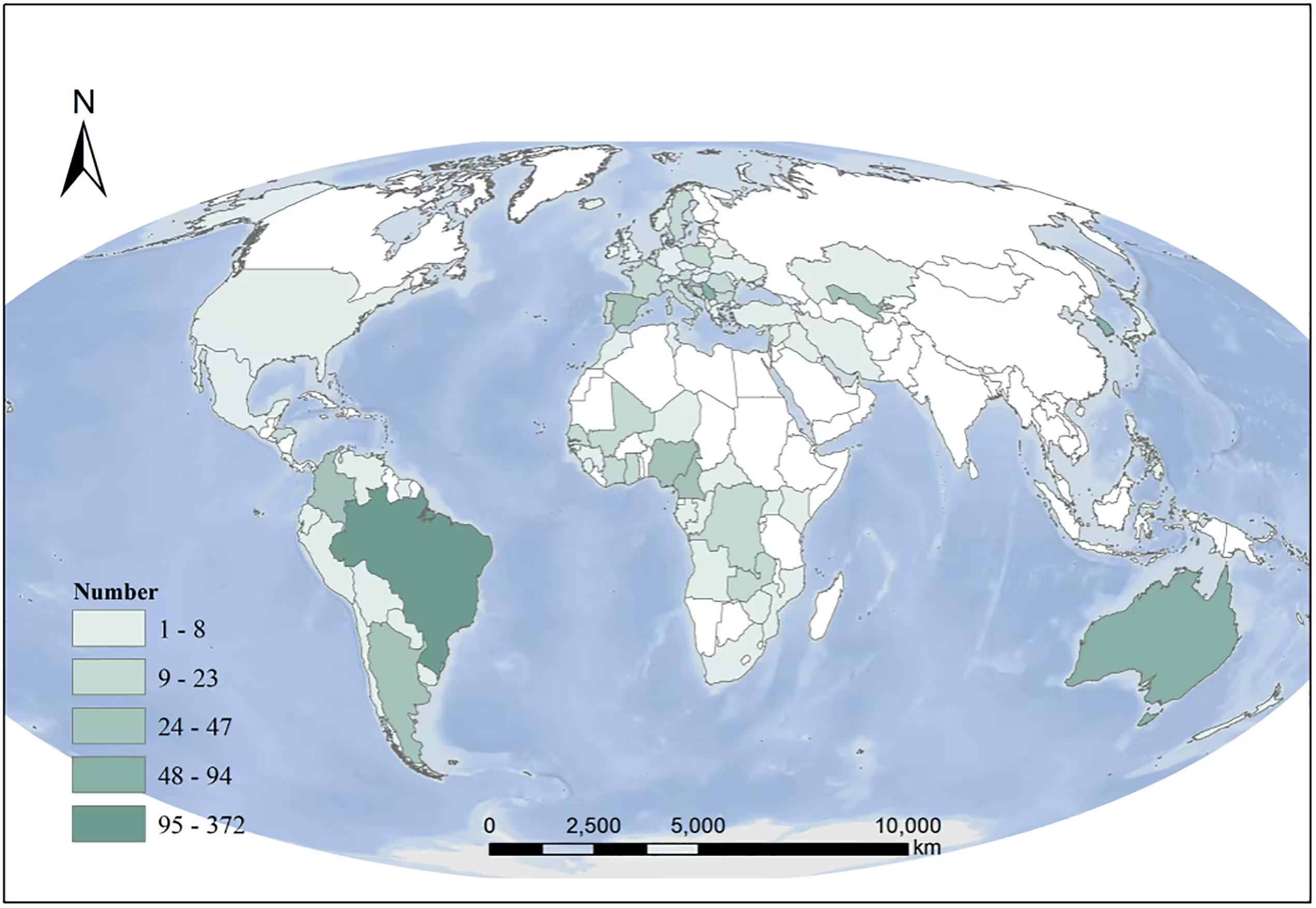
To understand the geography of foreign talent, the authors utilized descriptive mapping, standard deviational ellipse models, and spatial autocorrelation tests. Brazil emerged as the single largest origin, accounting for 372 registrations or nearly 27 percent of the total over the fifteen-year period. Other recurrent major origins included South Korea, Australia, Serbia, Argentina, Colombia, Nigeria, and Croatia. Across continental regions, South America led with 494 registrations, followed by Europe with 342, Africa with 229, and Asia with 223.
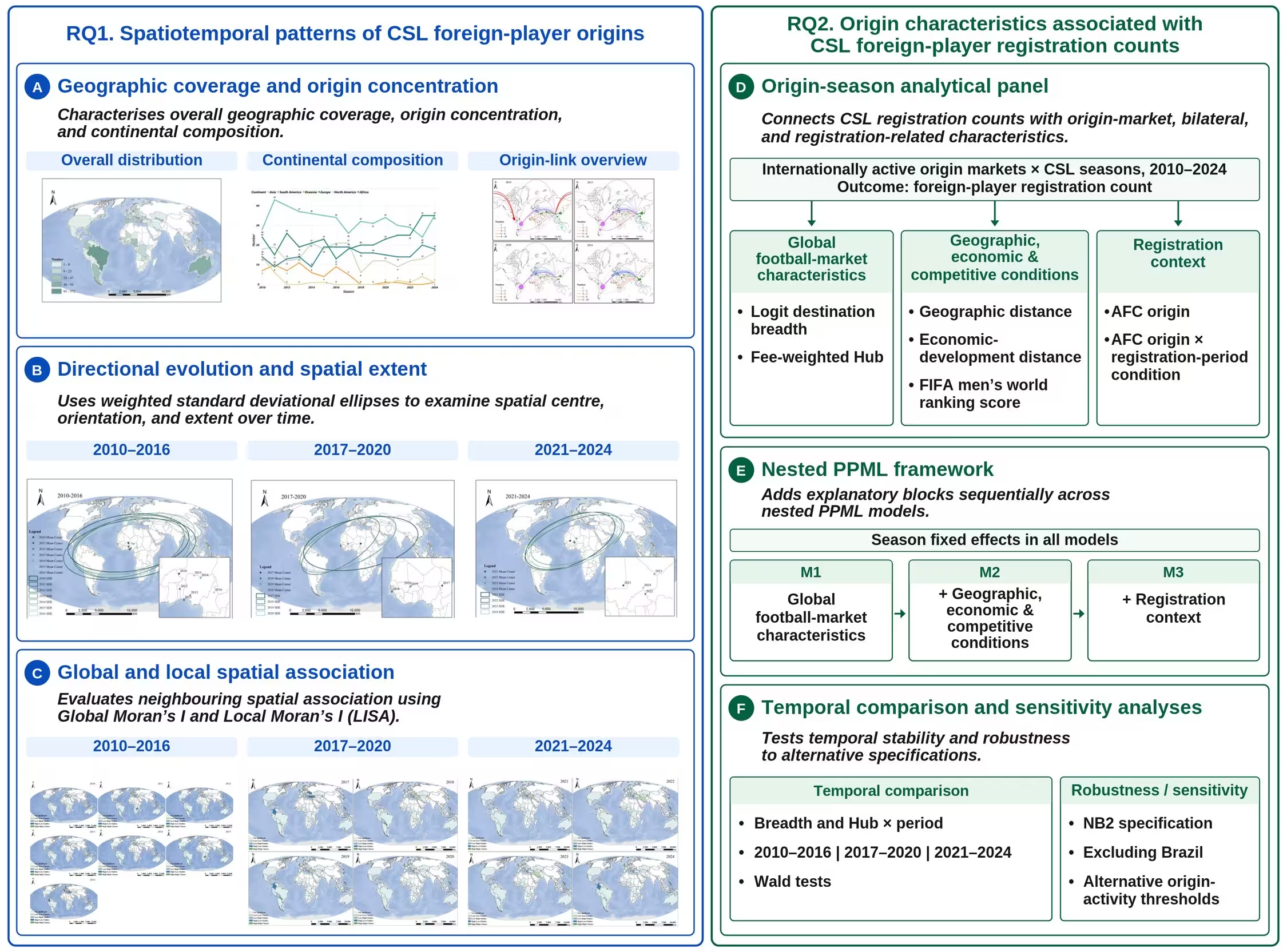
The directional analysis showed that the weighted mean center of player origins shifted over time, notably experiencing a directional movement toward the West Africa and Sahel regions in certain seasons. However, spatial autocorrelation tests using Global Moran’s I indicated no persistent neighboring spatial clustering across seasons. This suggests that player sourcing did not simply spill over to geographically neighboring countries, but rather followed distinct global network connections.
Why Global Market Reach Matters More Than Geographic Proximity
Using Poisson pseudo-maximum likelihood regression models on a panel of 97 origin countries and 1,447 observations, the researchers examined what drives player registration counts. They found that logit destination breadth, which measures the range of international destination markets reached by players from a given origin, had a strong positive association with CSL registrations. Similarly, a fee-weighted Hub metric capturing an origin’s structural position within the positive-fee transfer market showed a significant positive association.
Surprisingly, variables such as geographic distance, economic-development distance measured by purchasing power parity GDP per capita, and the FIFA men’s world ranking score were not statistically significant in the full regression specification. Once researchers controlled for an origin’s international market reach and fee-weighted network position, physical distance and national economic differences did not further differentiate registration counts.
The Impact of Regional Registration Rules Over Time
Institutional policies also played a measurable role in shaping talent flows. The Chinese Super League operated an Asian Football Confederation specific foreign player registration distinction from 2010 to 2017 before removing it ahead of the 2018 season. The regression models confirmed a positive and statistically significant interaction for Asian Football Confederation origins during the 2010–2017 period, indicating that league regulations directly influenced the regional composition of registered players.
Temporal comparisons across three distinct blocks (2010–2016, 2017–2020, and 2021–2024) revealed no systematic differences in the core market reach and network position associations over time. Robustness checks, including alternative count models and the exclusion of Brazil from the dataset, yielded consistent results, confirming the stability of the findings.
The research was published in PLOS One on November 17, 2026.
This article has been fact checked for accuracy, with information verified against reputable sources. Learn more about us and our editorial process.
Last reviewed on .
Article history
- Latest version
Reference(s)
- Li, Zijie., et al. “Foreign-player origins in the Chinese Super League: Spatiotemporal patterns and origin-country characteristics associated with registration counts.” PLOS One, vol. 21, no. 11, November 17, 2026, pp. e0362871 Public Library of Science (PLoS), doi: 10.1371/journal.pone.0362871. <https://doi.org/10.1371/journal.pone.0362871>.
Cite this page:
- Posted by Michael Ellison