Archaeologists Discover Rare Intact 600 Year Old Royal Chamber Hidden Beneath Peru City
After a century of excavations, researchers have finally opened a mysterious, untouched chamber at a famous site, revealing an unprecedented discovery.
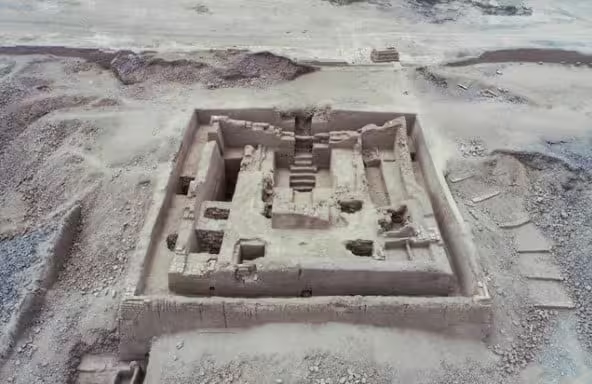
Archaeologists working at the vast adobe complex of Chan Chan in northern Peru have unveiled a funerary platform and central chamber that remained hidden and undisturbed for approximately 600 years. Located within the Utzh An walled sector, the site contains human remains and a wealth of burial offerings associated with the Chimú elite, surviving intact despite centuries of systematic looting that plagued other parts of the UNESCO World Heritage site.
Although the sprawling desert city has been under archaeological investigation for over a century, the discovery of a 15th-century platform reserved for Chimú royalty represents a significant milestone. Because the site was largely bypassed by historical tomb raiders—who typically targeted such elite burials following the Inca conquest—researchers now have a rare, pristine window into the burial customs of the region’s pre-Columbian rulers.
A Rare Window Into Untouched History
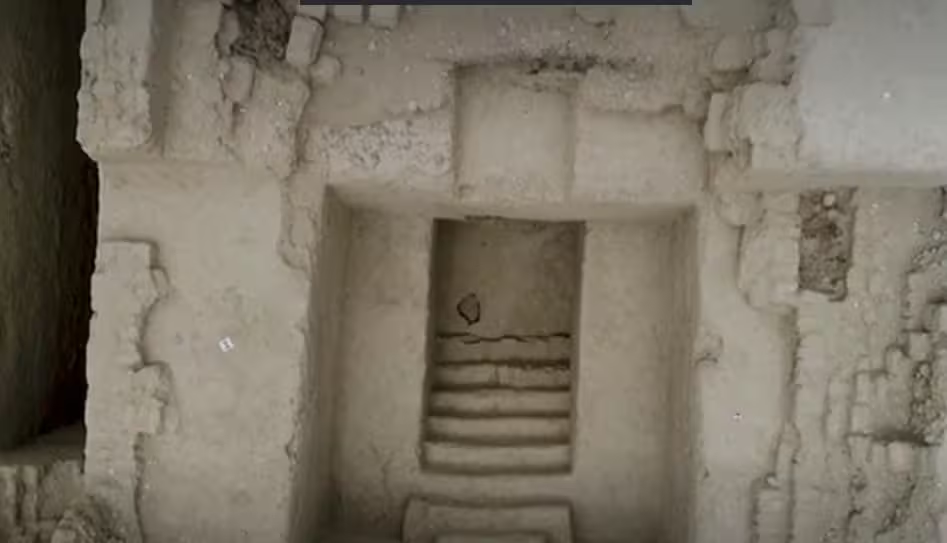
Lead archaeologist Jorge Meneses noted that this is the first instance where Peruvian researchers have accessed a funerary platform that retained its original, unaltered contents. The central chamber, accessible via an eight-foot staircase, measures four feet in width and stands 16 feet tall. According to reporting by the BBC, Meneses emphasized that the site’s integrity offers exceptional insights that go beyond the artifacts themselves.
“The first time that Peruvian archaeologists have been able to come across an almost intact [funerary] platform, with unaltered contents, a platform that was designed for an elite individual, whose main chamber has remained sealed for almost 600 years.”
Ritual Practices and the Red-Stained Remains
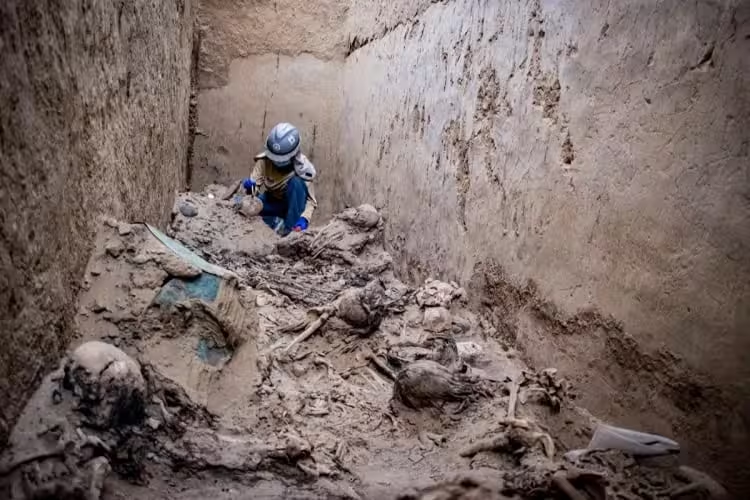
The excavation team identified 38 distinct sets of human remains distributed throughout the funerary complex, including rooms flanking the primary tomb. A striking feature of the central burial was the skull of the primary occupant, which had been stained a vivid, blood-red hue. Peruvian Ministry of Culture archaeologist Henry Gayoso Rullier, as cited by The Art Newspaper, explained that this coloration likely stems from the use of cinnabar, or mercury sulfide.
“This pigment, likely mercury sulfide, known as cinnabar, is present across the Central Andes,” he said. “It was used in pottery, murals, on warriors’ bodies, in sacrifices, and on funerary masks covering the bodies and faces of the deceased.”
Evidence of reburial—such as disarticulated or missing bones—suggests that the Chimú practiced complex ancestor veneration, where the remains of the deceased were kept and handled by the living. Alongside these remains, the team recovered a variety of grave goods, including copper and gold ornaments, beaded jewelry, intricate textiles, and weaponry, all of which underscore the high status of those interred within the platform.
Urban Sophistication in the Desert
Chan Chan served as the capital of the Chimú Empire from roughly 900 C.E. until its eventual fall to the Inca in the late 15th century. As the largest pre-Columbian adobe city, it flourished in one of the planet’s most arid environments, relying on a sophisticated network of canals to transport water into the desert. Each successive king traditionally commissioned his own walled palace, which functioned as both a royal residence and, eventually, a funerary compound.
Vanderbilt University anthropologist Ari Caramanica notes that the site offers a comprehensive view of how elite individuals served as the focal point for ritualized social life and death. The discovery reinforces the idea that these platforms were not merely tombs, but active sites where the power of the ruling class was reinforced through complex funerary performance.
This article has been fact checked for accuracy, with information verified against reputable sources. Learn more about us and our editorial process.
Last reviewed on .
Article history
- Latest version
Reference(s)
- “Ancient tomb found in Peru in a largely undisturbed state.”, September 9, 2026 <https://www.bbc.com/news/videos/c07lpd9dgzdo>.
- <https://independent.academia.edu/HenryLuisGayosoRullier/Books>.
- Valdés, Constanza. “600-year-old funerary platform discovered in Peru.”, September 18, 2026 The Art Newspaper - International art news and events <https://www.theartnewspaper.com/2026/09/18/funerary-platform-discovered-peru-chan-chan-chimu>.
- “Ari Caramanica.” <https://scholar.google.com/citations?user=9c_FPl8AAAAJ&hl=en>.
Cite this page:
- Posted by Vikram Desai