Hidden Charge Discovered in Cancelled Band Inversions
Crystal defects can trap a persistent half-integer charge even when standard topological edge states vanish.
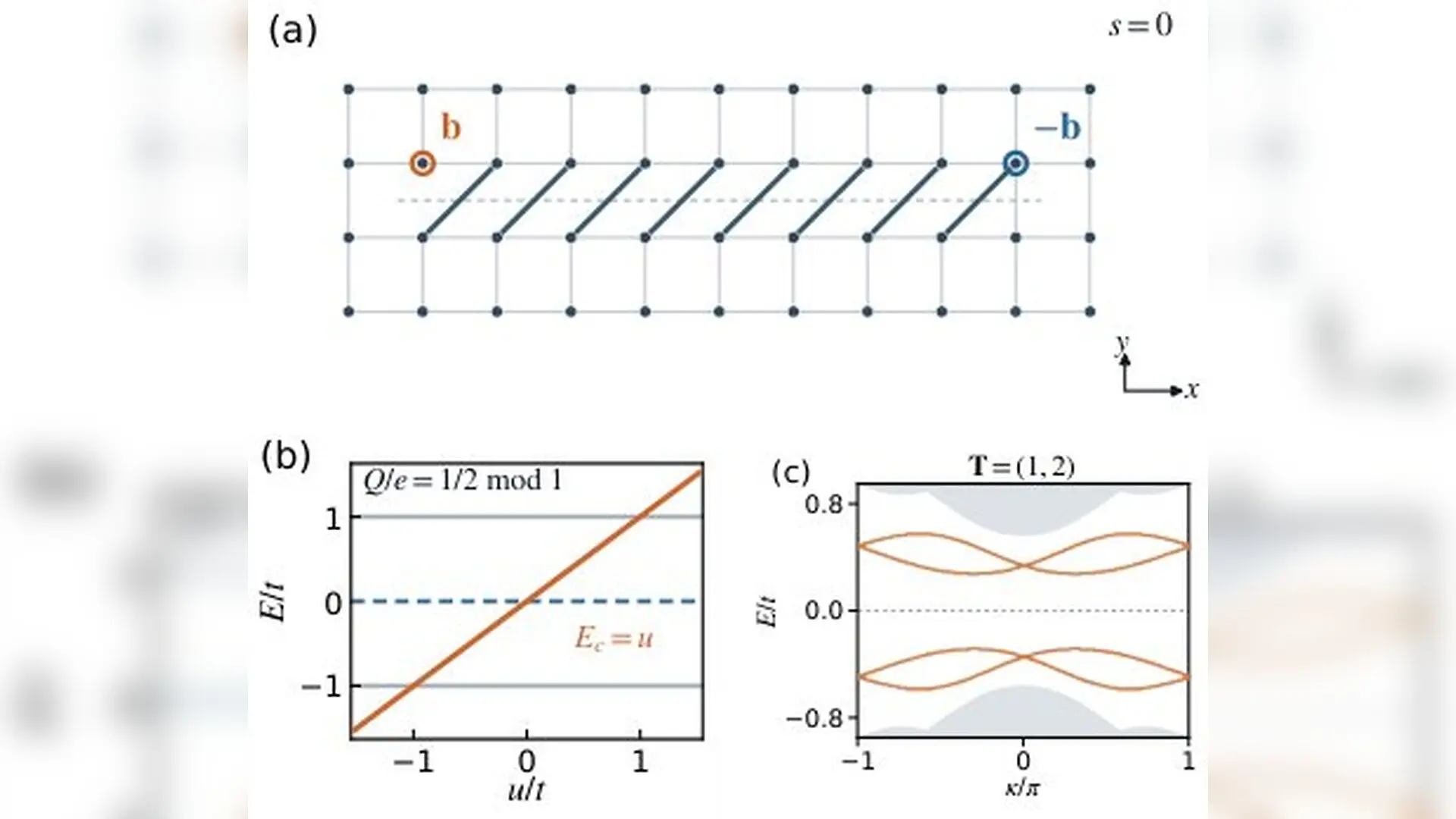
When two opposing band inversions cancel each other out in a crystalline material, physicists usually expect the resulting Hall response to vanish and the material to behave like a standard insulator. New theoretical calculations reveal that these cancelled structures conceal a hidden topological feature in their bulk geometry. Researchers have discovered that crystal lattice defects known as dislocations bind a persistent half-integer electric charge in such materials, pointing to a quantized polarization that survives long after individual boundary states have disappeared.
Topological insulators are materials that conduct electricity exclusively along their edges or surfaces while remaining completely insulating in their interiors. This behavior is typically governed by band inversions, where the normal energetic ordering of electron orbitals flips across certain momentum points in the Brillouin zone. While a single inversion produces a robust, quantized Hall conductance, multiple inversions can sometimes counteract one another. In these scenarios, the net Hall response drops to zero, and the counterpropagating edge modes can hybridize and open up an energy gap, making the system look deceptively trivial.
Detecting Hidden Bulk Topology Through Crystal Defects
To investigate whether any topological signature survives this cancellation, the authors analyzed two-dimensional and three-dimensional lattice models featuring opposing band inversions. Instead of relying on transport measurements or edge states, both of which can be obscured when energy gaps open, the team examined the impact of crystal dislocations. A dislocation represents a line defect where a plane of atoms is inserted or missing, creating a local mismatch in the periodic lattice structure. Circumnavigating such a defect reveals a missing or excess lattice translation defined by a Burgers vector.
The analysis, published in the arXiv preprint server, demonstrates that this lattice mismatch leaves the underlying bulk electric polarization uncompensated at the core of the defect. By continuously deforming the crystal model into a set of decoupled chains without closing the bulk energy gap or breaking inversion symmetry, the authors tracked how electrons distribute across the lattice. In this chain limit, the calculation simplifies to counting occupied bonds. Each standard dimer shares an electron equally between neighboring cells, but a dislocation terminates a chain and leaves a bond half-unpaired, yielding a fractional charge of exactly one-half of an elementary charge modulo one.
Proving the Fractional Charge Survives Without In-Gap States
A central question addressed by the study is whether this fractional charge is merely a byproduct of localized energy states sitting inside the band gap. To test this, the researchers introduced local scalar potentials to shift the core energy levels completely out of the gap. Analytical calculations in the chain limit and numerical simulations in full two-dimensional lattices showed that even when the in-gap bound state is pushed entirely into the continuous bulk bands, the integrated core charge remains anchored at a half-integer value.
The reason lies in the distinct origins of the two phenomena. While the in-gap state corresponds to an unpaired orbital residing directly at the defect core, the fractional charge is carried collectively by the network of occupied bonds extending throughout the surrounding crystal. Local perturbations at the core can alter the integer occupation branch, but they can only change the total charge by an integer multiple of the elementary charge, leaving the fractional component intact.
Separating Crystalline Charge From Hall Responses in Semimetals
Expanding their framework to three dimensions, the authors examined anti-higher-order Weyl semimetals, where straight dislocation lines run parallel to conserved momentum slices. Between the material nodes, the slice Chern number vanishes and opposing band inversions cancel out, creating regions governed by the same polarized phase found in two dimensions. Dislocations in these specific slices bind a half-integer crystalline charge.
Outside the nodes, however, single inversions dominate, and the slices carry a non-zero Chern number that generates an anomalous Hall response. To distinguish between the crystalline polarization charge and the charge induced by the Hall effect, the team modeled the insertion of magnetic flux and the inclusion of screw dislocation components. The response to applied flux scales strictly with the slice Chern number, whereas the crystalline polarization is encoded entirely in the zero-flux background charge. This decoupling allows researchers to isolate the fractional defect charge experimentally.
Implications for Artificial Lattices and Correlated States
These findings offer new pathways for exploring topological phases that evade traditional transport detection. The authors suggest that the predicted half-integer charges can be tested experimentally by tuning core potentials in artificial electronic lattices using scanning tunnelling microscopy, or by measuring site-resolved atomic occupations in fermionic optical lattices. Furthermore, analogous cancelations of Chern numbers in strongly correlated systems, such as twisted semiconductor bilayers, indicate that fractional defect charges might also emerge in interacting many-body states.
The study was posted to the arXiv preprint server on November 19, 2026.
This article has been fact checked for accuracy, with information verified against reputable sources. Learn more about us and our editorial process.
Last reviewed on .
Article history
- Latest version
Reference(s)
- Juričić, Vladimir. “Fractional Charge at Dislocations from Band-Inversion Cancellation.” arXiv.org <http://arxiv.org/abs/2611.26616v1>.
Cite this page:
- Posted by Bilal Abbasi