HIV Monitoring Trends Reveal Declining CD4 Checks Across Asia
A 16-year study of over 8,400 patients shows stable viral load testing alongside a sharp drop in routine immune system assessments.

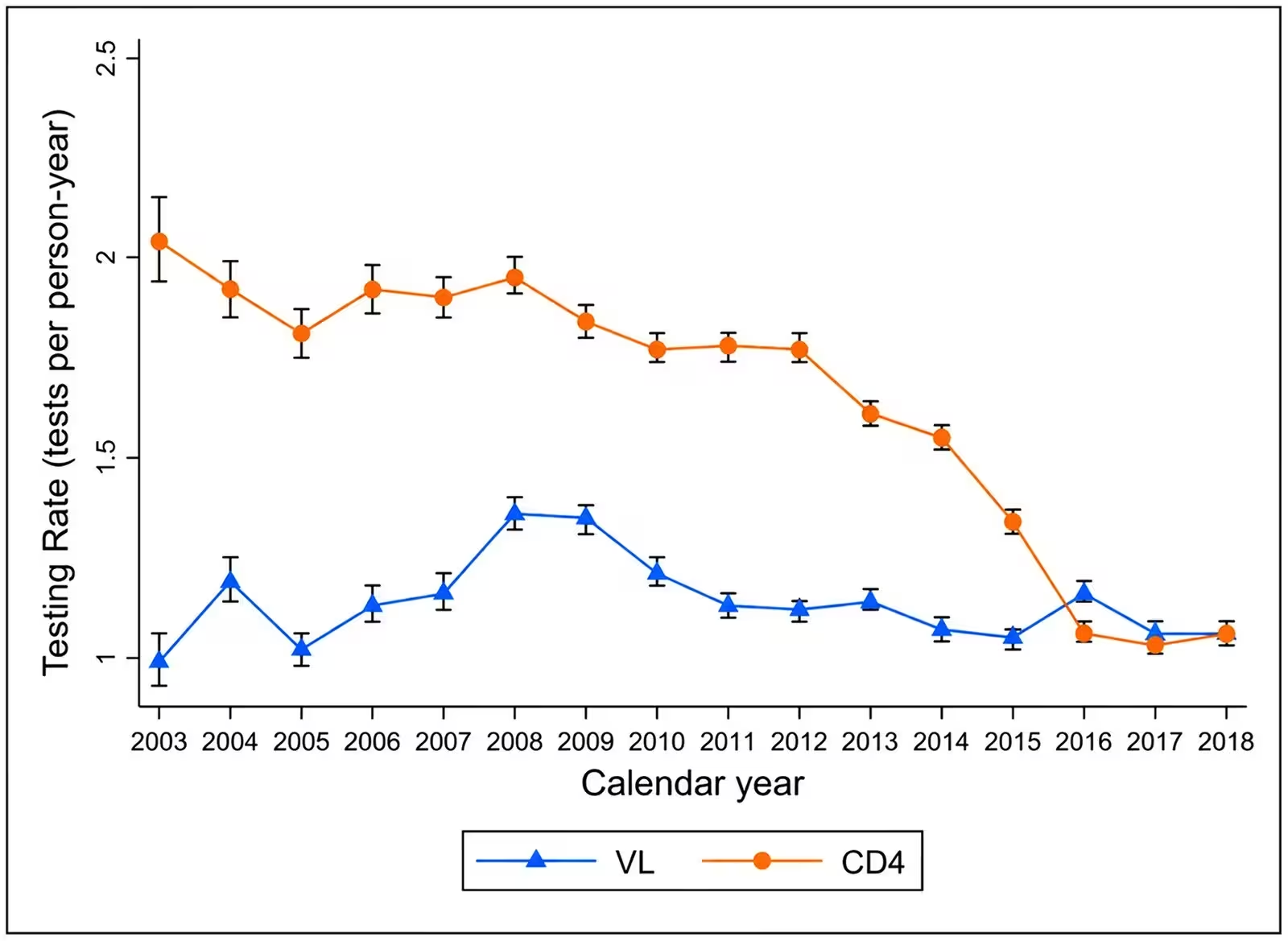
A massive multi-country analysis tracking more than 8,400 adults with HIV across 12 nations in the Asia-Pacific region reveals that while viral load testing rates held steady at roughly one test per person-year between 2003 and 2018, routine CD4 cell count monitoring plummeted dramatically over the same timeframe.
The research, published in PLoS One, examined medical records from 21 clinical sites participating in the TREAT Asia HIV Observational Database to understand how international recommendations for managing antiretroviral therapy translate into real-world hospital and clinic practices.
How Monitoring Practices Shifted Across 12 Countries
Antiretroviral therapy helps people with HIV live long, healthy lives by suppressing the virus to undetectable levels. To ensure these medications work, doctors rely on viral load tests, which measure the amount of HIV genetic material in the blood, and CD4 cell count tests, which track the health of the immune system by counting specific white blood cells called T helper cells.
Over the 16-year observation period covering 8,446 eligible participants, the team found that viral load testing remained consistent at an overall average of 1.12 tests per person-year. However, CD4 monitoring dropped sharply from 2.04 tests per person-year in 2003 down to 1.06 tests per person-year by 2018.
The authors note that this downward trend in CD4 testing aligns with evolving global guidelines. As health organizations began recommending viral load monitoring as the primary method for assessing treatment success, the clinical utility of frequent, routine CD4 checks for patients who were already virologically stable came into question.
Socioeconomic Disparities and Testing Frequencies
The analysis uncovered stark inequalities in how often patients received monitoring tests depending on where they lived and their personal backgrounds. Residence in higher-income nations was strongly linked to increased testing rates. Patients living in upper-middle-income countries and high-income countries had significantly higher viral load and CD4 testing rates compared to those in lower-middle-income settings, reflecting ongoing gaps in laboratory infrastructure, training, and financial resources.
Demographic factors also played a major role in testing patterns. Men who have sex with men, individuals who acquired HIV through injecting drug use, and patients co-infected with hepatitis C experienced lower rates of testing. The authors suggest these disparities may stem from challenges in health-seeking behavior, inconsistent follow-up care, and structural hurdles within regional support networks for marginalized groups.
What the Data Reveals About Survival and AIDS Diagnoses
During the study, 759 patients developed a new AIDS-defining illness, and 357 deaths were recorded among those with adequate follow-up data. Interestingly, neither viral load nor CD4 testing frequencies showed a direct statistical association with preventing new AIDS diagnoses.
However, the data revealed a complex relationship between frequent CD4 testing and mortality risks. Patients who underwent more than two CD4 tests in the preceding year faced a higher risk of mortality. Rather than indicating that testing causes harm, the researchers explain this as a reflection of clinical reality, because sicker patients or those experiencing treatment complications naturally require more intensive medical attention and frequent laboratory evaluations.
Future Directions for Regional HIV Care
The findings emphasize the need for differentiated monitoring strategies that account for local realities. While annual viral load testing remains vital for tracking treatment efficacy in stable patients, healthcare providers must ensure that vulnerable groups do not fall through the cracks of the medical system.
The authors caution that the study’s observational design carries limitations, including potential confounding factors and a heavy representation of urban referral centers that may not reflect rural clinics. Future public health efforts must focus on bridging resource gaps and improving retention in care to ensure equitable, life-saving monitoring for every patient living with HIV.
The research was published in PloS one on November 19, 2026.
This article has been fact checked for accuracy, with information verified against reputable sources. Learn more about us and our editorial process.
Last reviewed on .
Article history
- Latest version
Reference(s)
- Pasayan, Mark Kristoffer Ungos., et al. “Trends in viral load and CD4 cell count monitoring among adults with HIV in the Asia-Pacific region: A multicentre observational cohort study of the TREAT Asia HIV Observational Database, 2003–2018.” PLOS One, vol. 21, no. 11, November 19, 2026, pp. e0346353 Public Library of Science (PLoS), doi: 10.1371/journal.pone.0346353. <https://doi.org/10.1371/journal.pone.0346353>.
- Posted by Hassan Raza