The Parthenon Frieze Was Designed to Be Experienced Through Movement Not Just Sight
New research suggests the Parthenon frieze was designed for a gradual, cinematic reveal, shaping how ancient visitors interpreted the sacred procession.
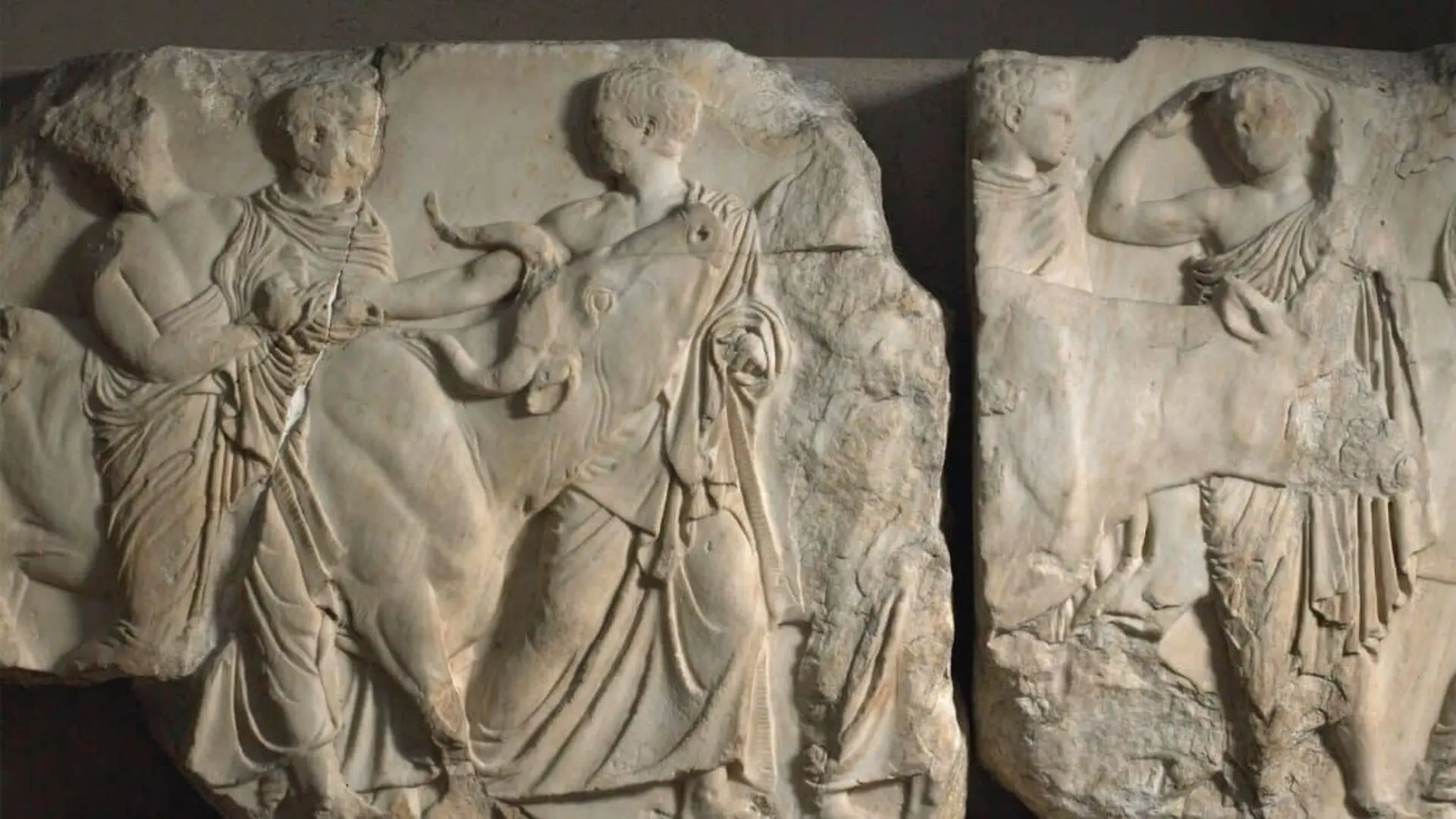
For centuries, the Parthenon frieze has been analyzed as a static masterwork, yet its positioning—tucked behind a colonnade some 12 meters above the ground—has long puzzled scholars. A new study published in the Bulletin of the Institute of Classical Studies suggests that this placement was not a design failure, but a deliberate architectural choice intended to shape how ancient spectators engaged with the narrative.
Researcher Ellie Mackin Roberts argues that the 160-meter-long relief, featuring 378 human figures and roughly 245 animals, was designed for “ambulatory viewing.” In this framework, the act of walking around the temple is essential to the experience, with the colonnade acting as a filter that forces the viewer to engage with the procession in fragmented, rhythmic glimpses rather than a single, sweeping panorama.
Sculpture as an Architectural Experience
The challenges of viewing the frieze have been well-documented. Early research by Richard Stillwell indicated that spectators could only catch sight of the carvings through gaps in the columns at steep angles of 50 to 60 degrees. Subsequent scholarship by Robin Osborne proposed that the viewer’s physical progress around the structure mirrored the ritual procession depicted in the marble.
Experimental archaeology has bolstered this theory. Bonna Wescoat utilized full-scale, painted reproductions at the Nashville Parthenon to replicate the original viewing conditions. Her work confirmed that while the frieze remains legible, it is consumed in a series of partial, interrupted views. Mackin Roberts notes that this “kinetic activation” means that the sequence only becomes meaningful through the spectator’s motion—an experience that, while conceptually similar to a zoetrope, functions by moving the observer past a static, segmented narrative.
Compressing Ritual Time
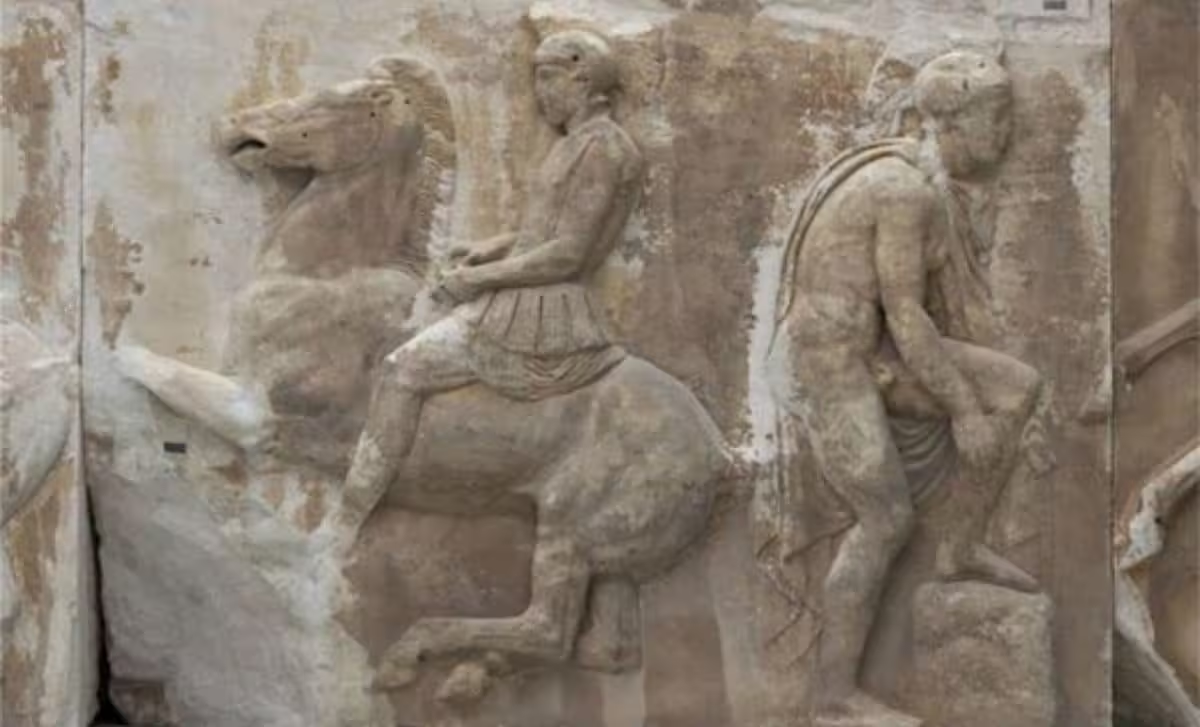
The study breaks down the experience into five essential elements: sequential organization, kinetic activation, rhythmic structure, compressed duration, and embodied spectatorship. The rhythm is further dictated by the composition itself; the density of horsemen and attendants creates natural visual breaks that prevent the long procession from feeling like an undifferentiated mass.
Time, in particular, was heavily manipulated by the design. A person walking the 200-meter perimeter of the temple at a standard pace would finish the circuit in roughly three to five minutes. Given that the actual Panathenaic procession to the Acropolis likely spanned one to two hours, the frieze serves to condense that ceremonial duration by a ratio of roughly 30 to 1, creating a rhythmic, accelerated distillation of the event.
A Climax at the Eastern Front
As the procession moves from the preparation seen on the west to the dense cavalcades on the north and south, the tempo shifts upon reaching the eastern side. Here, the movement slows, culminating in the enigmatic peplos scene at the center.
Mackin Roberts suggests that this central image is not a snapshot of a single instant, but rather a composition layered with temporal depth, depicting multiple stages of textile handling. This scene is fundamentally linked to the colossal statue of Athena Parthenos located within the temple. For the ancient viewer, the ritual sequence concluded by connecting the temporary, annually handled cloth depicted on the wall with the permanent, chryselephantine idol of the goddess standing inside.
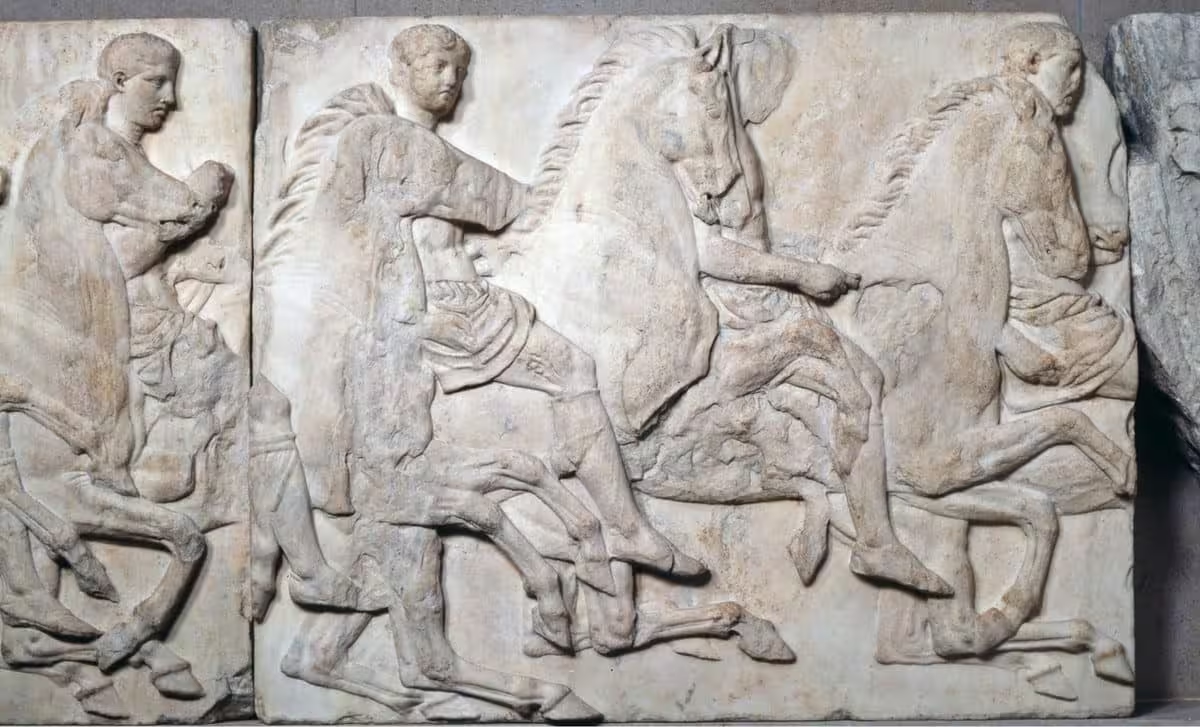
This insight highlights a significant discrepancy in modern museum displays. Whether at the British Museum or the Acropolis Museum, the frieze is typically presented at eye level and flattened into linear sections. While these arrangements offer a clarity of detail that was unavailable to ancient viewers, they arguably strip away the architectural “gating” and the physical engagement required to truly perceive the narrative as it was originally intended.
This article has been fact checked for accuracy, with information verified against reputable sources. Learn more about us and our editorial process.
Last reviewed on .
Article history
- Latest version
Reference(s)
- , doi: 10.1093/bics/qbag026/8711811. <https://academic.oup.com/bics/advance-article/doi/10.1093/bics/qbag026/8711811?login=false>.
- “ORCID.” <https://orcid.org/0000-0002-8958-3905>.
- “Google Scholar.” <https://scholar.google.com/scholar_lookup?title=The%20Panathenaic%20frieze%3A%20optial%20relations&author=R.%20Stillwell&publication_year=1969&journal=Hesperia%3A%20The%20Journal%20of%20the%20American%20School%20of%20Classical%20Studies%20at%20Athens&volume=38&pages=231-421>.
- “Google Scholar.” <https://scholar.google.com/scholar_lookup?title=The%20viewing%20and%20obscuring%20of%20the%20Parthenon%20frieze&author=R.%20Osborne&publication_year=1987&journal=Journal%20of%20Hellenic%20Studies&volume=107&pages=98-105>.
Cite this page:
- Posted by Hassan Raza