AI Agents Outperform Expert Chemists at Predicting Molecular Binding Poses
New benchmarks reveal human experts score near random chance on complex protein-ligand structures, while language model agents achieve up to 74 percent accuracy.
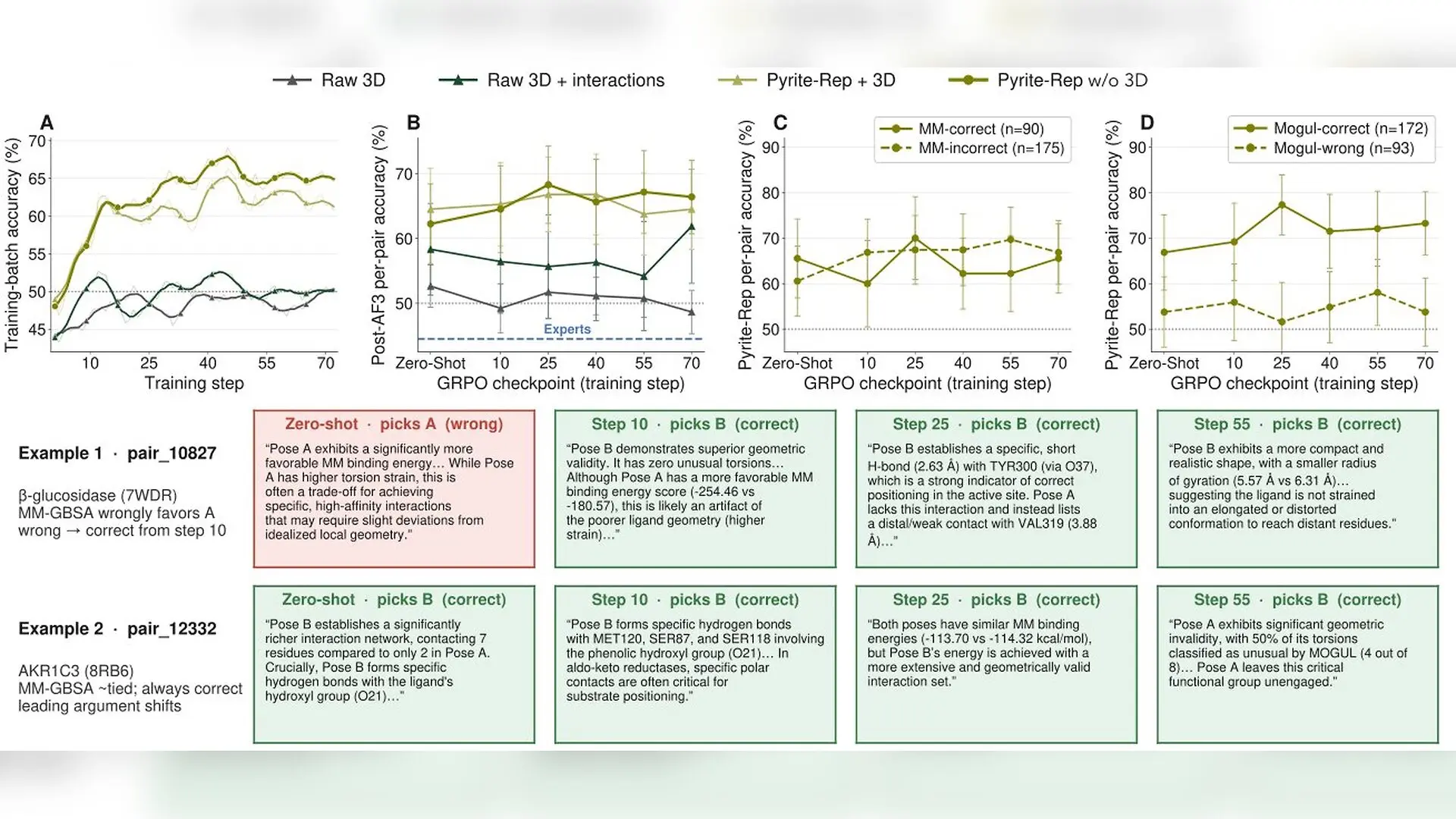
Predicting how small drug molecules bind to target proteins remains a central bottleneck in drug discovery, and new tests reveal that even expert human chemists struggle to identify the most accurate atomic binding poses. Modern artificial intelligence cofolding models can rapidly generate thousands of plausible 3D binding configurations, but sorting through these high-quality candidates to find the true structure presents a severe challenge. Traditional physics-based scoring functions often fail in these refined evaluation spaces, sometimes actively opposing true molecular stability.
To address this evaluation gap, a research team introduced a specialized pairwise benchmark featuring 1,500 distinct pose pairs across 285 protein and ligand structures. The study, published on the arXiv preprint server by Megha Srivastava and colleagues at Stanford University and Genesis Molecular AI, examines whether advanced language model agents can successfully interpret complex molecular geometry and computational chemistry signals.
Why Expert Chemists Perform Near Random Chance on Pose Ranking
When five expert chemists with an average of more than 10 years of experience in computer-aided drug discovery evaluated the benchmark pairs, their accuracy hovered around 42 to 45 percent, performing below or near random chance. The human evaluators frequently relied on standard physics metrics like MM-GBSA binding energy, which estimates thermodynamic stability. However, because the generated poses all represent high-quality candidates, lower energy scores proved anti-correlated with actual correctness.
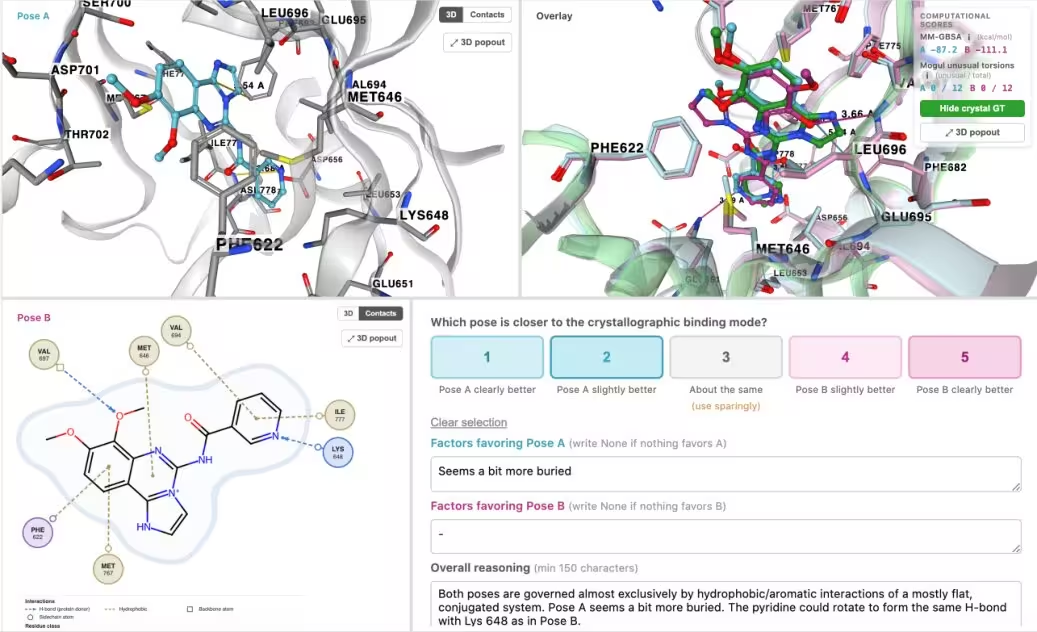
The authors suggest that cofolding models produce subtle geometric differences that defy traditional intuition. While human inter-annotator agreement reached 77 percent, conventional chemical heuristics frequently misled the experts when distinguishing between highly refined structural decoys.
How Structured Repositories and Language Agents Change the Equation
To test automated solutions, the researchers developed PyriteRep, a structured data format containing 29 features that describe molecular geometry, atomic interactions, and torsional strain. Feeding this structured data into language models substantially improved performance compared to raw 3D coordinates alone.
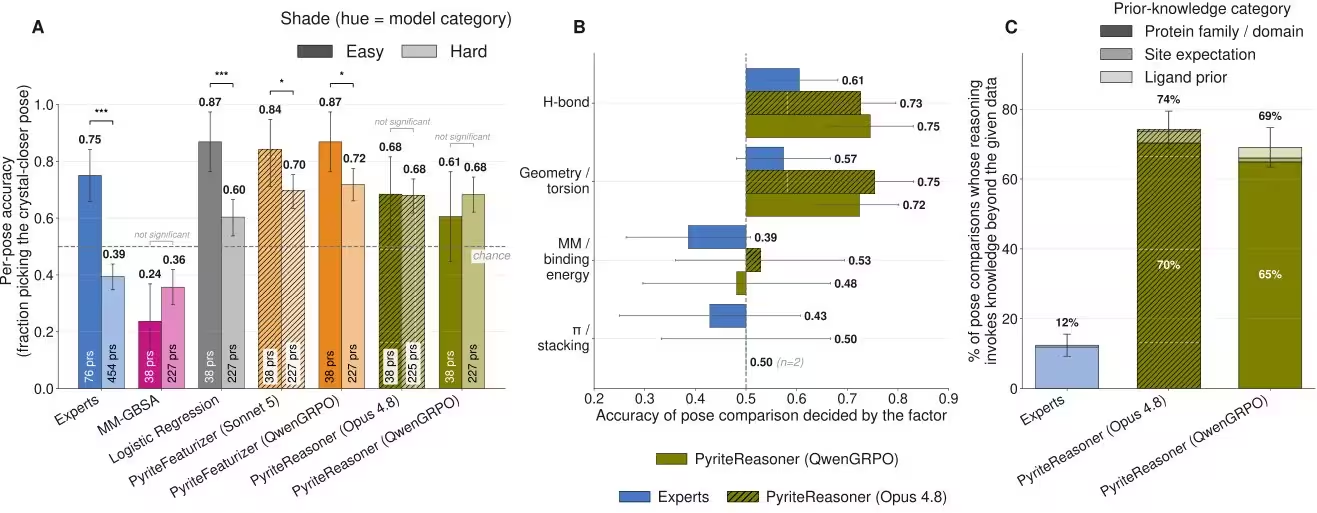
The team created two primary AI agents. The first, PyriteReasoner, directly compares pose pairs through explicit text-based reasoning, achieving up to 67 percent accuracy. The second, PyriteFeaturizer, acts as a coding agent that writes Python scripts to discover predictive structural features for a simple logistic regression classifier. Combined with reinforcement learning via Group Relative Policy Optimization, the featurizer approach reached up to 74 percent accuracy on evaluation splits.
What This Means for Future Computational Drug Discovery
The findings indicate that large language models excel when used to discover structural features and write quantitative code rather than making isolated text judgments. By avoiding the cognitive biases that trip up human experts, these automated agents offer a promising pathway toward reliable pose ranking. The authors note that closing the remaining accuracy gap will require larger training sets and broader testing across diverse generative frameworks to ensure these ranking pipelines translate smoothly into real-world therapeutic development.
The study was posted to the arXiv preprint server on November 10, 2026.
This article has been fact checked for accuracy, with information verified against reputable sources. Learn more about us and our editorial process.
Last reviewed on .
Article history
- Latest version
Reference(s)
- Srivastava, Megha. “Pyrite: Building and Benchmarking Protein-Ligand Pose Ranking Agents.” arXiv.org <http://arxiv.org/abs/2611.14511v1>.
Cite this page:
- Posted by Hassan Raza