AI Model Predicts Molecular Interactions at Scale
Trained on 3.2 trillion tokens, Bonbon reveals emergent biological capabilities and discovers novel drug candidates across nine disease targets.
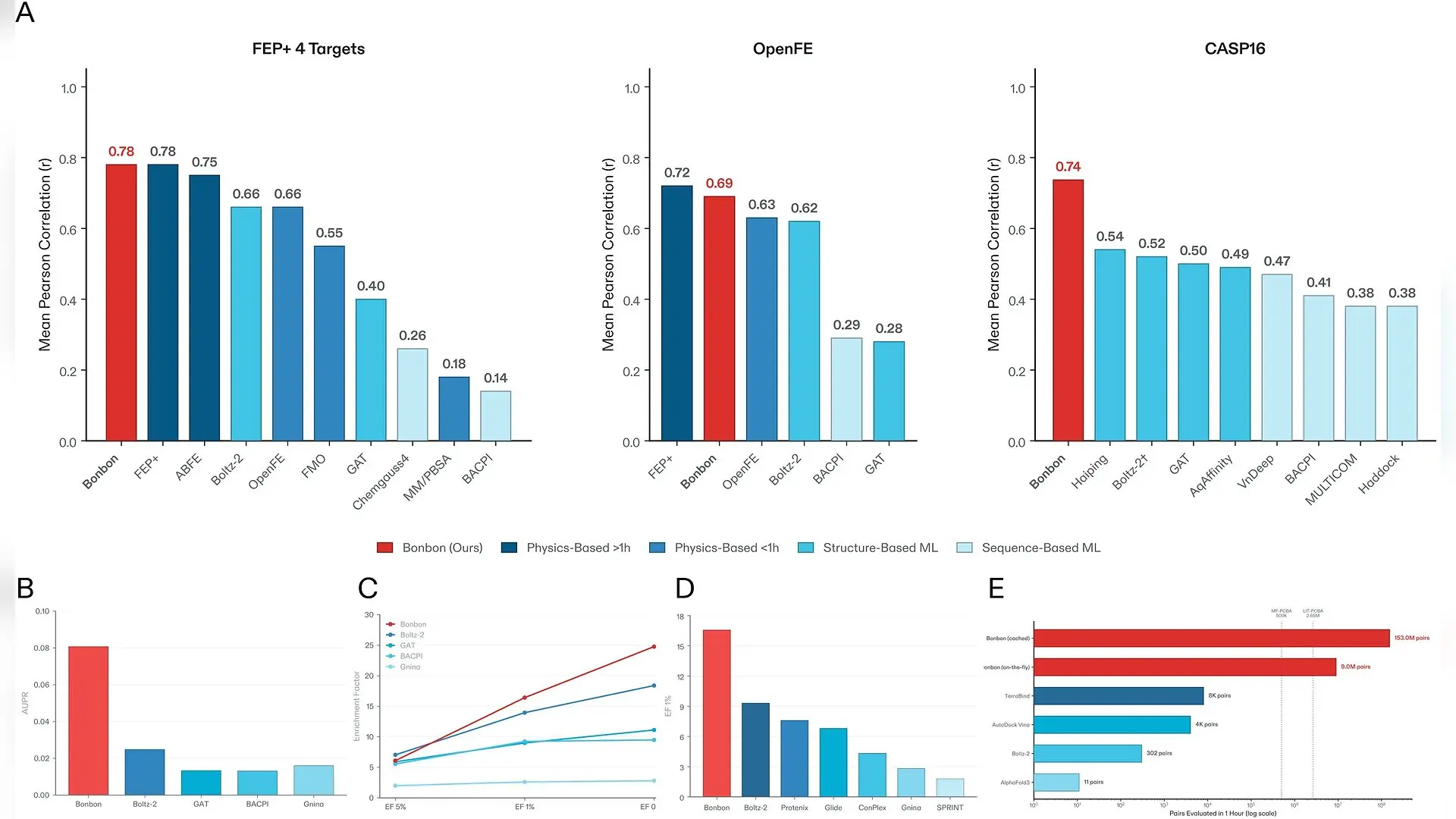
Proteins and small molecules interact in complex ways that researchers can now predict much faster using a newly developed artificial intelligence system called Bonbon. Trained on approximately 3.2 trillion tokens of paired protein and ligand sequences, this transformer-based model discovers hidden biological rules without requiring structural 3D coordinates or task-specific supervision during pretraining.
How a Data-Heavy Scaling Regime Unlocks Hidden Interaction Rules
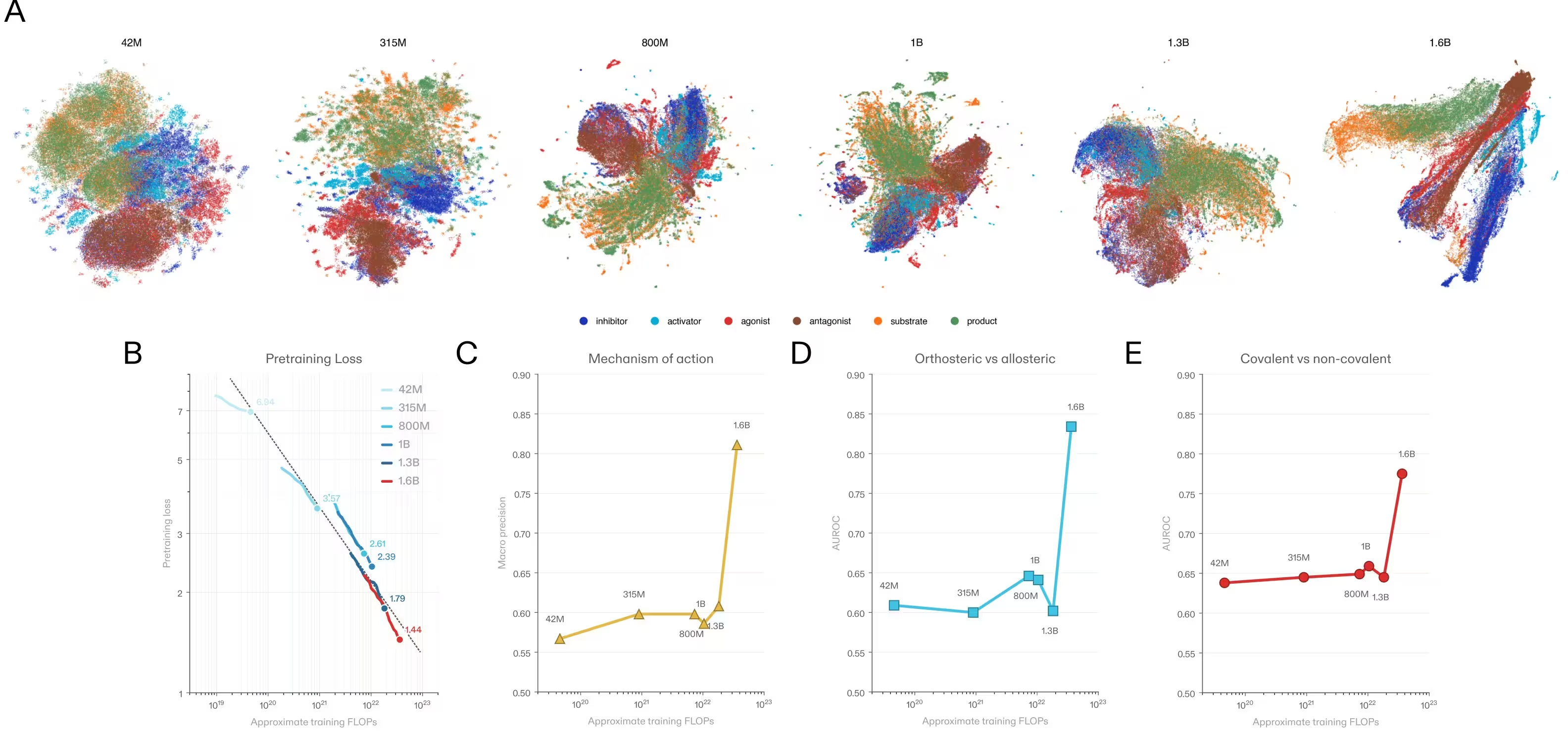
To overcome the inherent information sparsity of paired biological interaction data, the model was built using a parameter-to-token ratio of 1:2,000, which is significantly more data-heavy than standard natural language models. Controlled scaling experiments across six model sizes, ranging from 42 million to 1.6 billion parameters, revealed that pretraining loss decreases smoothly with computing power while complex biological capabilities appear suddenly at the largest scale. As described in the study published on arXiv, the 1.6 billion parameter configuration crosses a critical threshold where high-level interaction features abruptly emerge.
What Are the Three Hierarchical Levels of Resolution Discovered by the Model?
From a single shared representation space, the system exhibits three distinct zero-shot emergent capabilities that operate at different levels of biological resolution. At the functional level, it predicts the mechanism of action across six classes, accurately distinguishing between agonists and antagonists on the same receptor. At the residue level, attention weights correlate linearly with ligand proximity, allowing the software to pinpoint binding sites even on challenging targets like G protein-coupled receptors and transporters that lack well-defined cavities. At the bond level, dense representations distinguish between covalent and non-covalent engagement and successfully localize reactive residues.
How Fast Is the New System Compared to Traditional Methods?
Beyond theoretical capabilities, these frozen representations transfer directly to standard computational benchmarks for binary binding and affinity prediction. When processing molecular pairs on a single NVIDIA H100 graphics processing unit, the system operates at speeds up to 42,500 pairs per second with cached representations, making it approximately five orders of magnitude faster than traditional co-folding or physics-based simulation tools.
What Were the Results of Wet-Lab Validations Across Nine Disease Targets?
To test real-world utility, the authors evaluated compounds generated de novo against nine diverse disease targets spanning seven protein families, including targets completely absent from the training data. Prospective biochemical assays confirmed active inhibitors for all nine targets, yielding dose-response hit rates and identifying novel chemical structures with low Tanimoto similarity to known drugs. These findings demonstrate that large-scale sequence models can extract the functional grammar of molecular interactions directly from unlabeled biological data.
The study was posted to the arXiv preprint server on November 10, 2026.
This article has been fact checked for accuracy, with information verified against reputable sources. Learn more about us and our editorial process.
Last reviewed on .
Article history
- Latest version
Reference(s)
- Mashiach, Adi. “Emergent Biological Capabilities in a Foundation Model for Molecular Interactions.” arXiv.org <http://arxiv.org/abs/2611.14504v1>.
Cite this page:
- Posted by Priya Sharma