Daily Qat Chewing Habit Fails to Block Recovery in Jaw Disorder Patients
A prospective study of 148 patients reveals high overall success rates for conservative jaw therapy despite regional consumption patterns.
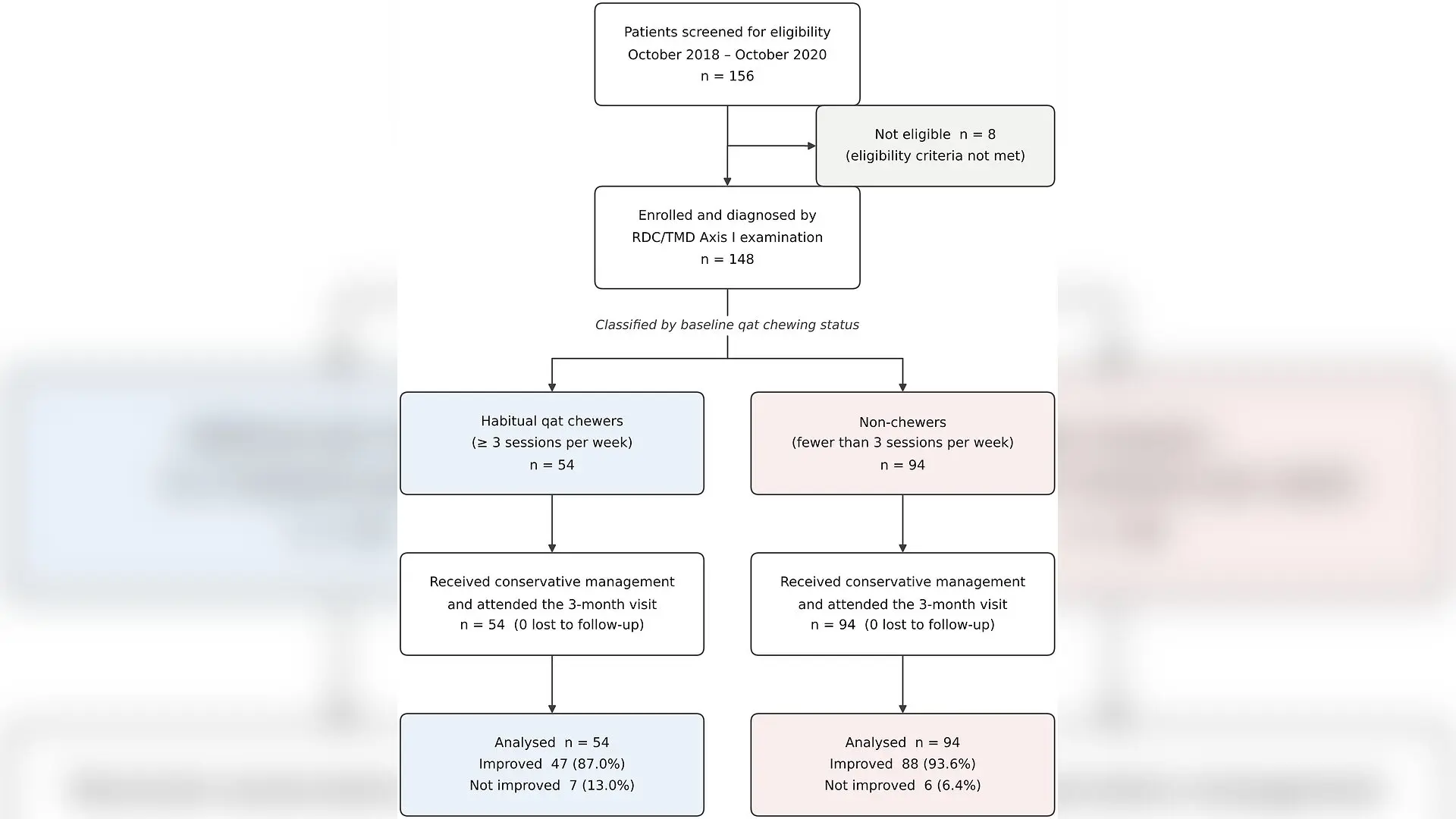
Chewing the leafy stimulant qat does not appear to block recovery from painful jaw joint conditions, according to a prospective cohort study that followed 148 patients through conservative treatment. The research, published in PLOS One, sheds light on temporomandibular disorders among Yemeni adults facing high psychosocial stress and daily consumption habits.
Temporomandibular disorders, commonly known as TMD, encompass a group of painful conditions affecting the jaw joint, chewing muscles, and related craniofacial structures. Worldwide, these conditions affect roughly 10 to 15 percent of adults, predominantly younger and middle-aged women. First-line medical care is conservative, consisting of patient education, self-care routines, behavioral modifications, and simple pharmacotherapy. While these approaches succeed in most individuals, environmental and cultural circumstances can heavily influence outcomes.
Yemen presents a unique setting due to widespread daily qat chewing. Users retain a bolus of leaves in the cheek and chew it for hours, exposing the oral cavity to sympathomimetic alkaloids like cathinone that stimulate jaw muscle activity. Previous imaging studies have linked long-term consumption to degenerative condylar changes and joint damage. However, prior research had never examined how chewers actually respond once they seek and receive treatment.
How the Three-Month Clinical Follow-Up Was Conducted
The investigation tracked 148 consecutive patients aged 11 to 65 years who presented to the Oral Medicine Department of Sana’a University and Al-Kuwait Teaching Hospital between October 2018 and October 2020. Every participant received an Axis I clinical examination based on established research diagnostic criteria. Of the total cohort, 54 individuals were classified as habitual qat chewers who engaged in the habit three or more times per week, while 94 participants served as non-chewers.
All patients received standard conservative management, which included reassurance, structured education, and self-care instructions such as eating a soft diet and avoiding wide jaw openings. Treating clinicians supplemented these measures with nonsteroidal anti-inflammatory drugs, anxiolytics like diazepam, tricyclic antidepressants, or stabilization splints where clinically indicated. Patients were reviewed at three weeks, six weeks, and three months, with zero loss to follow-up across the entire cohort.
Surprising Pain Distribution and Treatment Responses
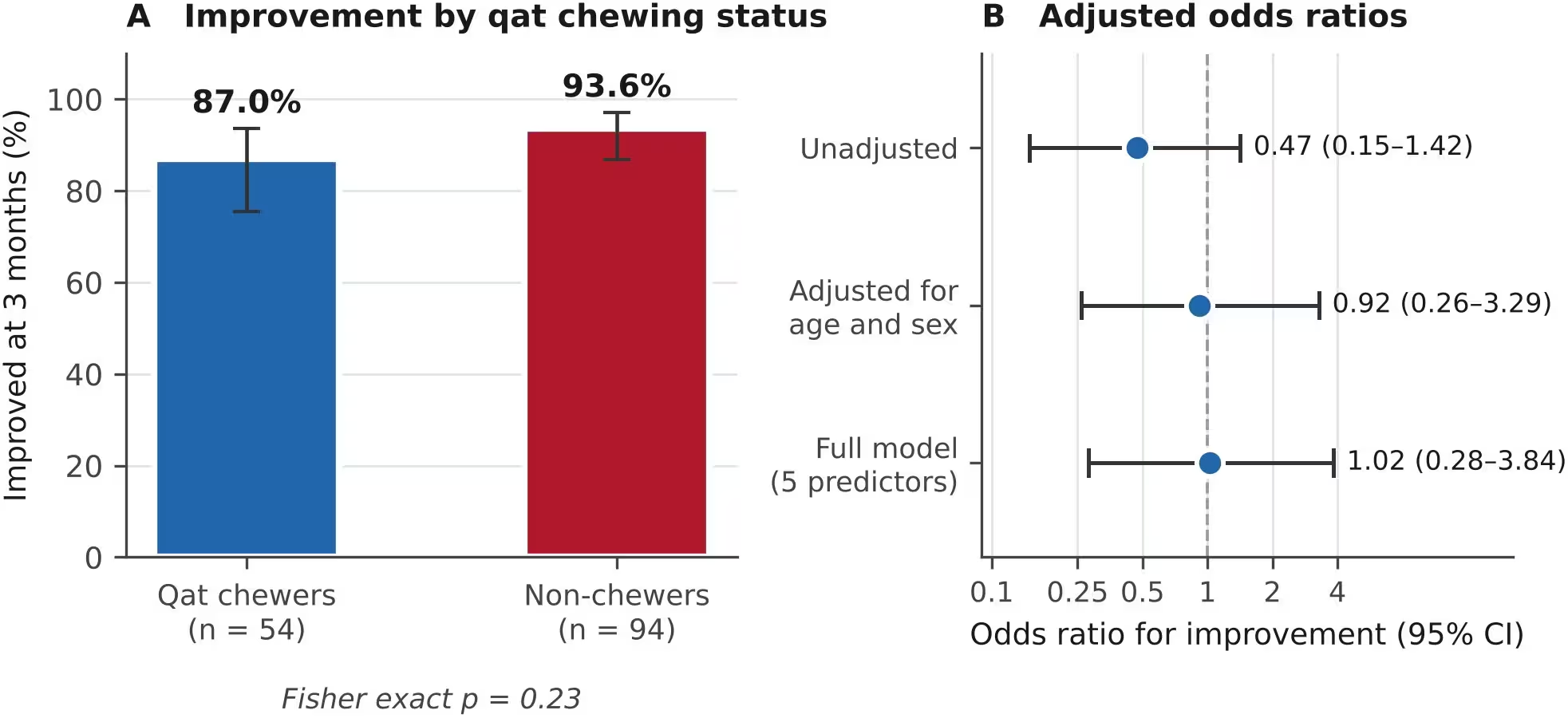
At the three-month mark, 135 of the 148 patients, amounting to 91.2 percent of the cohort, reported overall clinical improvement. Among the qat chewers, 87.0 percent improved, compared to 93.6 percent of non-chewers. The absolute difference of 6.6 percentage points was not statistically significant, indicating that habitual chewers responded nearly as well to conservative therapy as non-chewers.
Interestingly, baseline pain distributions differed sharply between the two groups. Chewers tended to cluster at opposite ends of the rating scale, reporting either no pain at all or severe pain, with none falling into the mild pain category. Among patients who did report pain, 95.0 percent of chewers rated it as moderate or severe, compared to 63.4 percent of non-chewers. Furthermore, chewers were notably older on average than non-chewers, and statistical modeling revealed that age was the primary predictor of treatment response.
Limitations and What the Findings Mean for Patients
The authors noted several important constraints, including a modest sample size that possessed adequate statistical power only for detecting large differences. Additionally, the study lacked blinded outcome assessments, and patient adherence to dietary restrictions was not quantitatively captured. Because qat chewing naturally contradicts the soft diet advice given during self-care, behavioral non-adherence remains a confounding variable.
Despite these limitations, the clinical implications offer reassurance for healthcare providers working in regions where qat consumption is prevalent. The data indicate that clinicians should not withhold conservative, reversible TMD therapies from patients who chew qat, as the vast majority can still achieve meaningful symptom relief.
The research was published in PLOS One on November 13, 2026.
This article has been fact checked for accuracy, with information verified against reputable sources. Learn more about us and our editorial process.
Last reviewed on .
Article history
- Latest version
Reference(s)
- Hajeb, Raji Mansoor., et al. “Habitual qat chewing and short-term response to conservative management of temporomandibular disorders: A prospective cohort study in conflict-affected Yemen.” PLOS One, vol. 21, no. 11, November 13, 2026, pp. e0362744 Public Library of Science (PLoS), doi: 10.1371/journal.pone.0362744. <https://doi.org/10.1371/journal.pone.0362744>.
Cite this page:
- Posted by Hassan Raza