A Metal Detectorist Expected Another Roman Coin, Instead He Unearthed a Roman Gold Ring Buried in a Field for 17 Centuries
Ancien anneau médiéval révélé par un détecteur de métaux dans un champ du Somerset

A metal‑detector enthusiast probing a Somerset field has unearthed a remarkable Roman gold ring that had lain hidden for almost 1,700 years. The piece, dubbed the Ilminster Ring, dates to a time when Roman Britain operated independently of the imperial core.
When Kevin Minto’s detector gave a signal near Ilminster, he anticipated another Roman coin – he had already retrieved dozens from that spot. Instead, the device revealed a hefty gold band unlike any of his previous finds.
The ring, recovered together with a cache of coins and assorted artefacts, stands out for its intricate workmanship and substantial mass, earning it a place among the most exquisite examples of Roman jewellery ever recorded in the United Kingdom.
An Opulent Piece Likely Intended for a High‑Status Owner
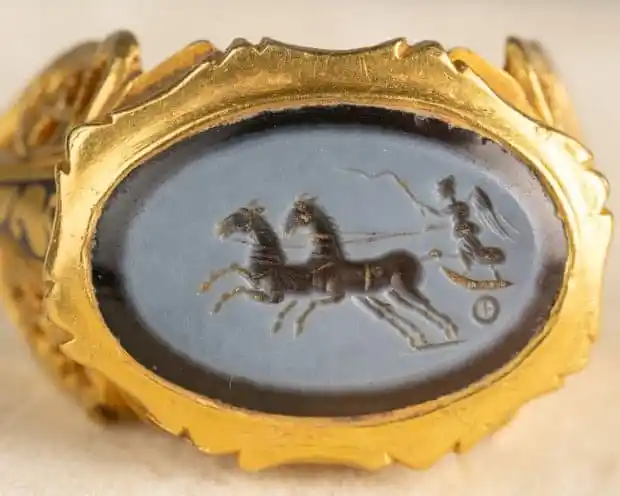
Weighing close to 48 grams, the Ilminster Ring is forged from solid gold. Its front is set with a bluish‑gray stone that bears a finely carved portrait of Victoria, the Roman goddess of victory.
According to a statement from the South West Heritage Trust, the depiction shows Victoria steering a two‑horse chariot while clutching a whip and reins, complete with wings and a helmet – symbols traditionally linked to triumph and military prowess. The image was rendered using the intaglio technique, where the design is incised into the gem rather than raised.
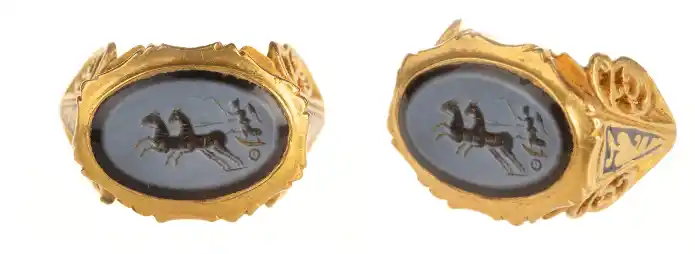
Amal Khreisheh, senior curator at The South West Heritage Trust, highlighted the ring’s size and weight, noting its sophisticated gold‑working and detailed engraving. She added that:
“While other examples are known, these elements combine to create a spectacular ring that is only paralleled by continental discoveries.”
The sheer volume of gold implies the wearer enjoyed considerable wealth. Archaeologists speculate the owner may have been a prosperous landowner, merchant, or regional official.
Hidden Amid the Turbulent End of Roman Rule in Britain
The ring formed part of a larger hoard that also contained 297 Roman coins along with lead and pottery fragments. Its burial coincides with the chaotic interval between 286 and 296 CE, when the province functioned as a breakaway state under Carausius and later Allectus – a phase often referred to as the Carausian Revolt.
For affluent individuals, those years brought instability, shifting loyalties, and heightened security concerns, prompting many to conceal valuable items in the hope of reclaiming them later. Throughout Roman Britain, similar deposits have been uncovered, reflecting a broader pattern of protective hoarding.
According to the South West Heritage Trust, the Ilminster Ring was likely concealed shortly after the revolt ended, and the person who buried it never returned. Khreisheh remarked:
“Usually archaeologists handle broken things – such as pieces of pottery or animal bones. Things like this don’t come along very often,”
A Detectorist’s Dream Come True
Minto began investigating the site in 2017, gradually amassing Roman coins from the field. The following year, his detector uncovered the gold ring. Speaking to The Guardian, he described the moment of realization: initially he mistook the object for a coin, then for a brooch, before recognizing it as a ring.
“It’s hard to explain what it feels like when you find something like that,” he said. “It was like being hit by an express train. At first I thought it was a coin, then a brooch, and then realised it was a ring. You’re a little dumbfounded, really. One of the boys I was with was screaming: ‘We’re rich, we’re rich.’”

Future research will focus on pinpointing the ring’s manufacturing origin – whether it was crafted locally in Britain or imported from elsewhere in the Roman world – and on examining a lead‑lined coffin found by Minto in the same field for possible links to the ring’s original owner.
This article has been fact checked for accuracy, with information verified against reputable sources. Learn more about us and our editorial process.
Last reviewed on .
Article history
- Latest version
Reference(s)
- “Extraordinary Roman Gold Ring Acquired.” South West Heritage Trust <https://swheritage.org.uk/news/ilminster-ring/>.
- Morris, Steven. “Somerset detectorist strikes gold with ‘spectacular’ Roman ring find.”, June 2, 2026 The Guardian <https://www.theguardian.com/uk-news/2026/jun/02/somerset-detectorist-roman-ring-find-ilminster>.
Cite this page:
- Posted by Hassan Raza