Hidden Core Vibrations Reveal How Cosmic Strings Move Beyond Standard Physics
A new theoretical framework and lattice simulations show how massive internal excitations alter string geometry and energy flow.
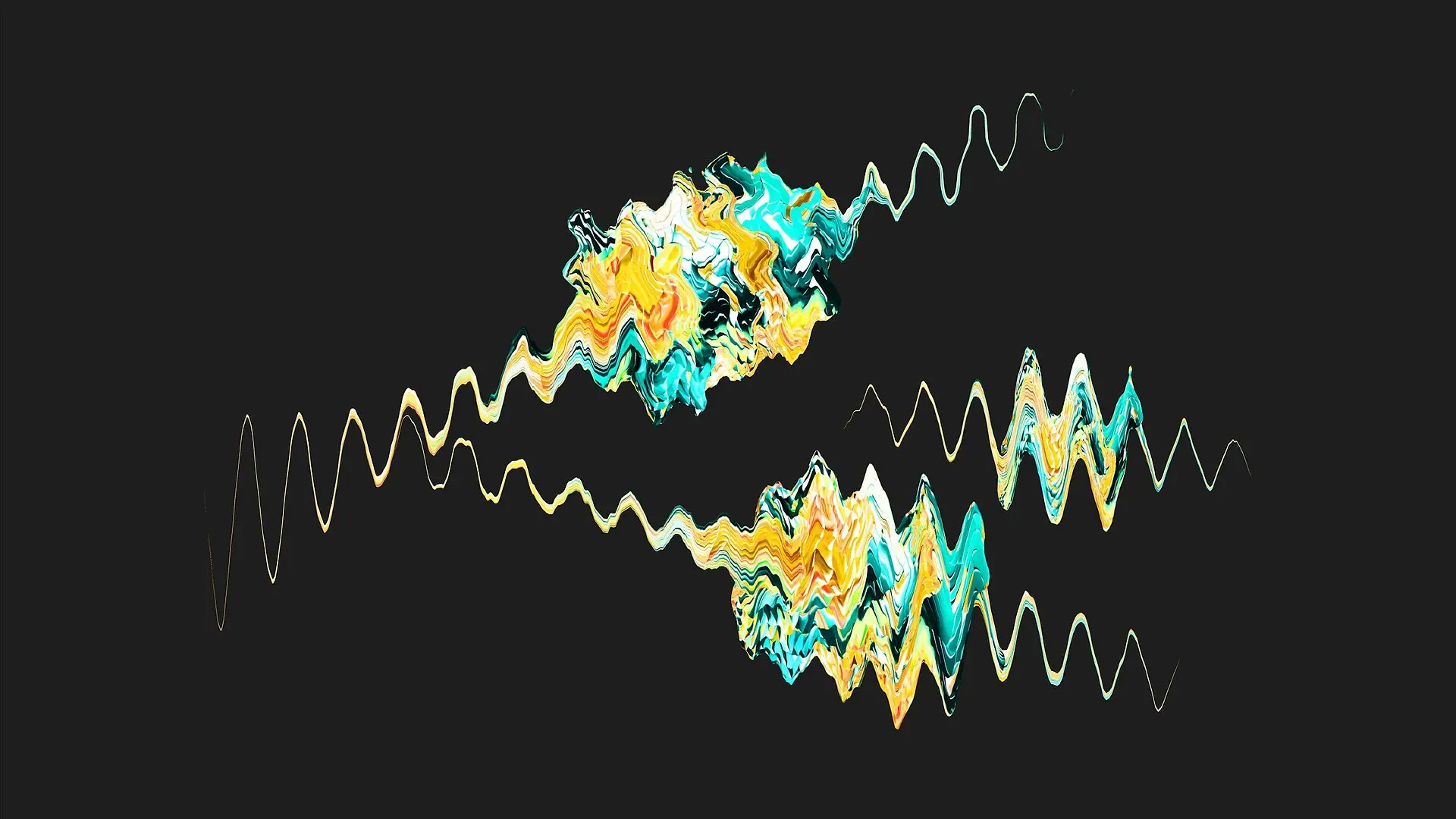
Cosmic strings can host complex internal vibrations hidden within their cores, revealing new ways that energy flows between string motion and microscopic excitations. Researchers have derived a covariant worldsheet theory that maps out these hidden oscillations beyond traditional frameworks, showing how the internal structure of these topological defects alters their macroscopic evolution.
How Internal Core Excitations Bypass Traditional String Approximations
Cosmic strings are linear topological defects that may have formed during symmetry-breaking phase transitions in the early Universe. For decades, the standard way to describe their motion has been the Nambu-Goto action, which treats a string as a zero-width object governed solely by massless Goldstone modes that represent transverse displacements. However, field theory strings possess a finite width and can support massive excitations localized directly inside their cores.
A team of theoretical physicists composed of Sergio Alameda-Calvo, Josu C. Aurrekoetxea, Jose J. Blanco-Pillado, Alberto García Martín-Caro, and J.M. Queiruga has developed an effective field theory that incorporates these hidden internal degrees of freedom. Their study is available as a preprint on the arXiv preprint server. By expressing microscopic fields in coordinates adapted to the string worldsheet and integrating over transverse directions, the authors constructed a comprehensive action that captures both the geometry of the string and the dynamics of its massive bound modes.
Geometric Curvature Controls Scalar and Vector Modes Differently
At critical coupling in the Abelian-Higgs model, the string supports two distinct types of localized massive excitations alongside the massless transverse Goldstone modes. One is a scalar shape mode that describes axially symmetric deformations of the core, while the other is a massive vector mode associated with gauge field polarization along the string. The authors found that these two modes interact with the surrounding geometry through fundamentally different mechanisms.
Through careful mathematical derivation and dualization of the vector mode into a pseudoscalar, the team discovered that the shape scalar mode couples directly to the intrinsic Ricci scalar curvature of the worldsheet. In contrast, the pseudoscalar field couples to the curvature of the normal bundle, which describes how the transverse frame rotates along the string length. This geometric distinction explains why shape excitations amplify planar transverse motion while vector excitations produce helical deformations.
Lattice Simulations Confirm Parametric Instabilities and Wave Collisions
To test these theoretical predictions, the researchers performed advanced numerical lattice field theory simulations using adaptive mesh refinement via the GRDzhadzha code developed by the GRTL Collaboration. They examined three distinct physical scenarios, including parametric amplification of transverse waves, the excitation of bound modes by colliding transverse disturbances, and direct energy exchange between the vector and shape modes.
When simulating the collision of counterpropagating transverse waves, the incoming string carried no initial internal excitation. The overlap region during the collision generated specific curvature sources that successfully excited the bound modes according to the predicted theoretical rates. Furthermore, the time delays measured after the wave collisions matched standard Nambu-Goto expectations, confirming that standard string trajectory mechanics accurately provide the geometric sources required to wake up the internal modes.
These findings provide a predictive framework for understanding cosmic string networks beyond standard approximations, offering new insights that could eventually help account for discrepancies between traditional string evolution models and numerical simulations.
The study was posted to the arXiv preprint server on November 19, 2026.
This article has been fact checked for accuracy, with information verified against reputable sources. Learn more about us and our editorial process.
Last reviewed on .
Article history
- Latest version
Reference(s)
- Alameda-Calvo, Sergio. “Worldsheet Effective Theory of Abelian-Higgs Cosmic Strings beyond Nambu--Goto.” arXiv.org <http://arxiv.org/abs/2611.26013v1>.
Cite this page:
- Posted by Karan Das