Every Galaxy Is a Radio Source: Astronomers Discover Mysterious Baseline Emission Floor
Ultra-deep LOFAR surveys reveal that massive, quiet galaxies maintain a hidden radio baseline driven by supermassive black hole accretion.
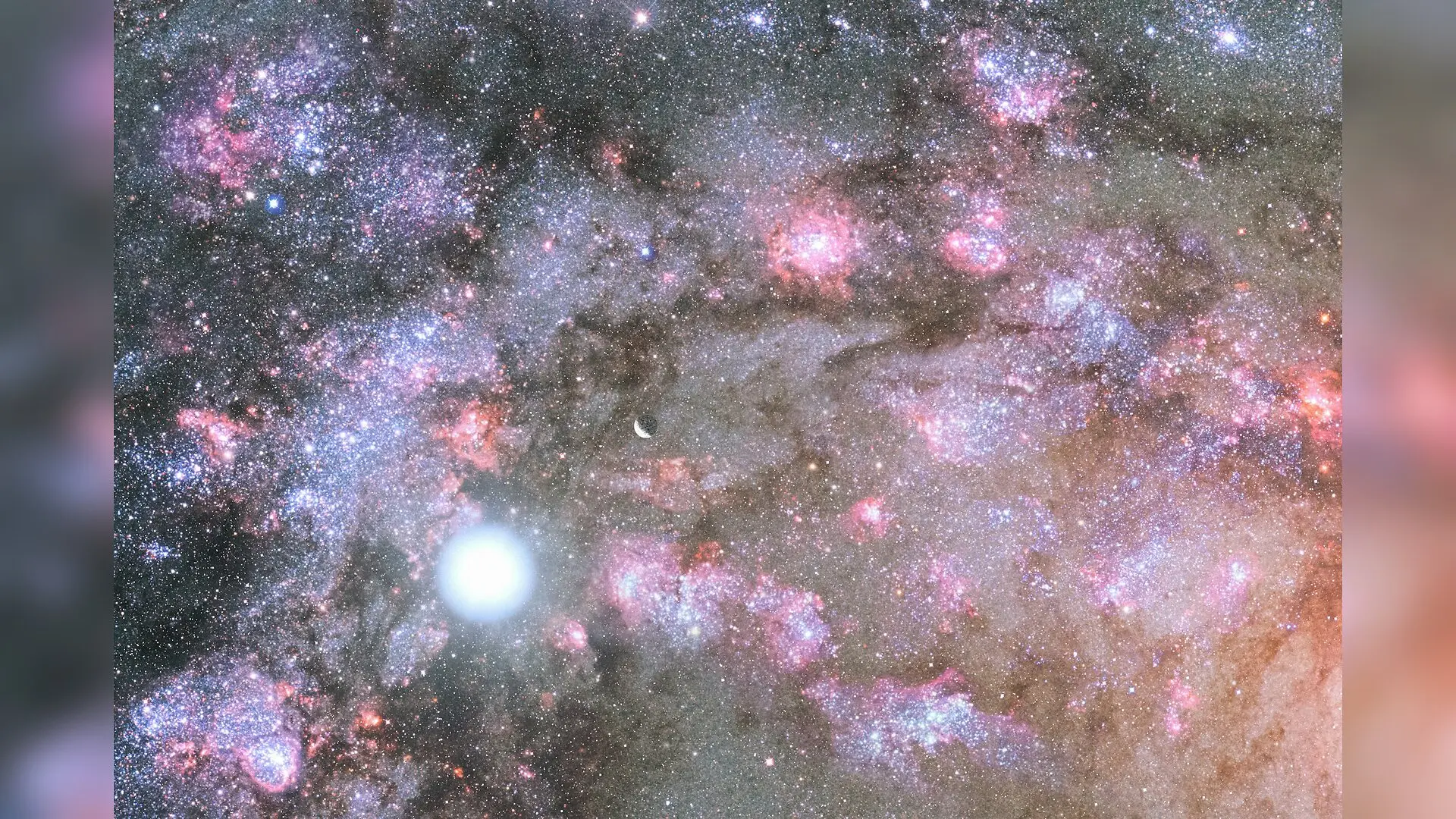
Deep radio observations of 113,228 galaxies have revealed that every single galaxy acts as a radio source, driven by a hidden baseline of activity that defies standard star formation models. An international team of astronomers has identified a mass-dependent minimum radio luminosity operating across the cosmos, where massive, quiet galaxies maintain a baseline emission that refuses to drop below a strict floor.
The research, published in the arXiv preprint server by Shravya Shenoy and colleagues, re-examined the relationship between 150 megahertz radio emissions, star formation rates, and stellar masses. Using ultra-deep wide-field maps from the second data release of the LOFAR Two-metre Sky Survey Deep Fields, covering the ELAIS-N1 field, the team analyzed a vast catalog of near-infrared selected galaxies with redshifts under one.
How Ultra-Sensitive Radio Maps Reveal Hidden Galactic Engines
For decades, astronomers relied on radio waves as an indirect tracer of star birth. Thermal radiation from ionized gas around massive young stars and non-thermal synchrotron radiation from supernova shocks normally dictate how loud a galaxy is in the radio spectrum. This close connection forms the foundation of the far-infrared-to-radio correlation, which links dust heating to stellar nurseries.
However, the new LOFAR data reach an unprecedented root-mean-square noise level of 10.7 microjansky per beam at the center of the mosaic. This extreme sensitivity allowed the researchers to probe faint radio populations that were previously invisible. When the team plotted radio luminosity against star formation rates for 113,228 galaxies, they recovered the classic correlation, but also uncovered an unexpected twist at the low-luminosity end.
What Happens When Galaxies Fall Silent
In galaxies with stellar masses above 10 billion solar masses and radio luminosities between 10 to the 20th and 10 to the 22nd watts per hertz, the radio emission stops scaling with star formation entirely. Instead, the signal flattens out, converging onto a minimum floor dictated solely by the mass of the host galaxy. This behavior stands out most clearly in quiescent systems with low specific star formation rates, where star-forming activity has largely wound down.
To explain this mysterious radio floor, the authors evaluated several potential drivers, including low-mass X-ray binaries, cosmic-ray confinement, and environmental quenching. None of these stellar or environmental processes could account for the steep scaling observed. Instead, the team concluded that widespread, continuous low-level accretion onto supermassive black holes provides the most plausible explanation.
Connecting Low-Level Accretion to Supermassive Black Holes
The researchers developed a two-component model combining traditional star-formation-driven emission with an accretion-driven term to match their observations. The model suggests that supermassive black holes operate at effective Eddington-scaled accretion rates between 10 to the minus 5th and 10 to the minus 4th power. This implies that weak active galactic nuclei activity is not an occasional event, but a persistent and widespread feature of massive galaxies.
The authors note that failing to account for this accretion-driven radio floor can lead to systematic overestimates of star formation rates in quiescent galaxies. As upcoming facilities like the Square Kilometre Array and LOFAR 2.0 push deeper into the universe, understanding this baseline radio emission will become crucial for interpreting the true evolutionary history of galaxies across cosmic time.
The study was posted to the arXiv preprint server on November 19, 2026.
This article has been fact checked for accuracy, with information verified against reputable sources. Learn more about us and our editorial process.
Last reviewed on .
Article history
- Latest version
Reference(s)
- Shenoy, Shravya. “Every galaxy is a radio source: a stellar-mass dependent minimum 150 MHz luminosity identified in the LoTSS Deep Fields.” arXiv.org <http://arxiv.org/abs/2611.26618v1>.
Cite this page:
- Posted by Nida Rehman