Supersonic Plasma Plunge Above Sunspot Splits in Two
High-cadence solar observations reveal a 90 kilometer-per-second plasma stream whose evolution is closely tied to magnetic loops in the sun’s outer atmosphere.
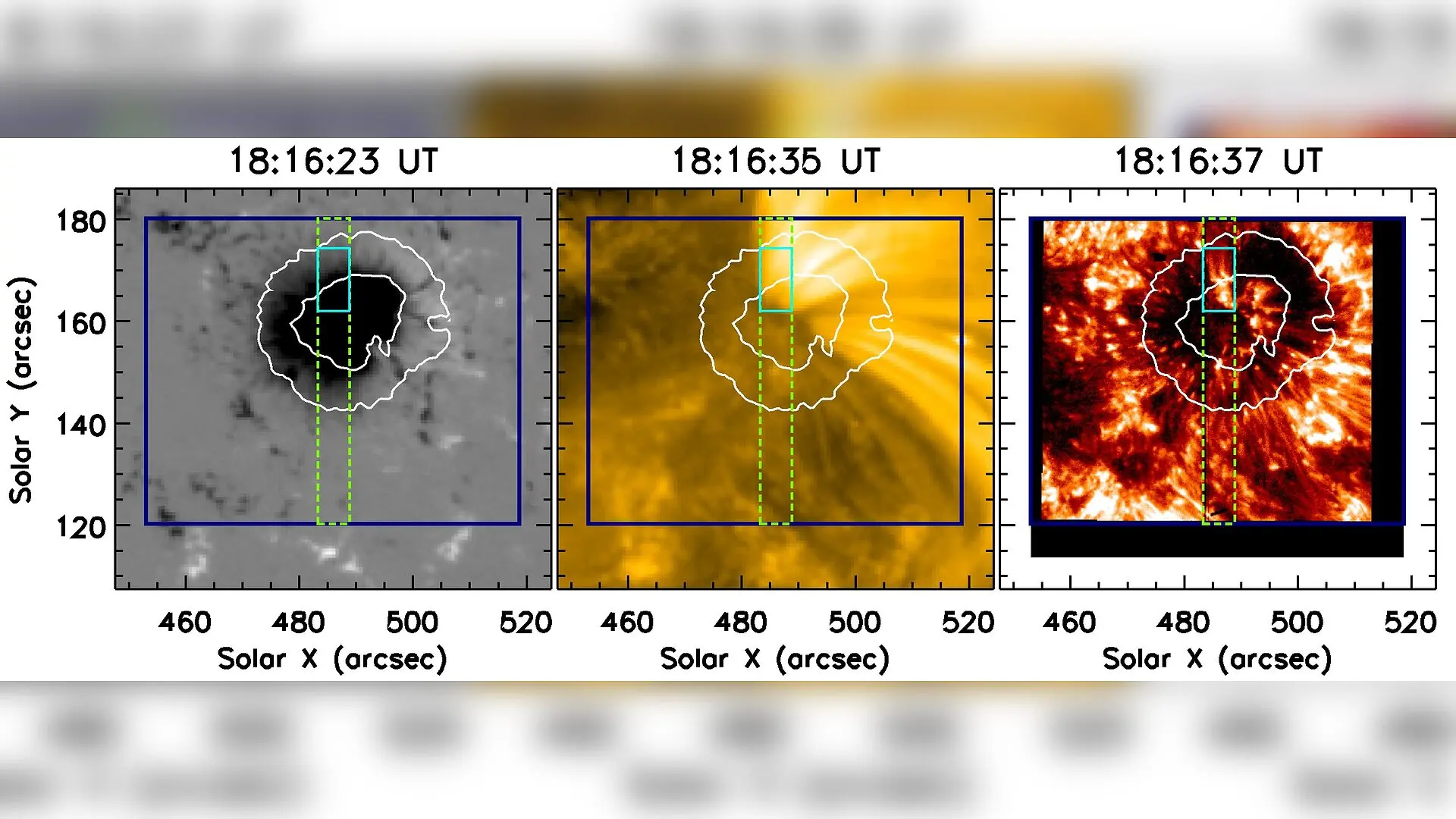
A high-speed plasma stream plunging down toward a sunspot has revealed a surprising life cycle, starting as a unified plunge before splitting into separate structural channels. This supersonic flow above sunspot NOAA active region 12135 maintained speeds reaching roughly 90 kilometers per second while locking its physical evolution to the magnetic loops glowing miles above in the Sun’s outer atmosphere.
Solar physicists Bablu Mandal, S. Krishna Prasad, Avijeet Prasad, and Ambrish Pandey analyzed the three-hour observation sequence, available on the arXiv preprint server, to track how these sunspot-specific flows connect to wider solar weather. The research team focused on the solar transition region, a narrow, highly energetic boundary layer where temperatures spike from tens of thousands of degrees at the sun’s surface to over a million degrees in the corona.
How Did Researchers Track the Supersonic Plunge?
To capture the rapid plasma motions, the authors utilized high-cadence repeated raster observations from the Interface Region Imaging Spectrograph, a space telescope designed to probe the lower layers of the solar atmosphere. Instead of standard analytical methods, the team applied a complex triple Gaussian fitting technique to spectral lines of ionized silicon and oxygen, allowing them to isolate the downward-moving plasma from surrounding solar noise.
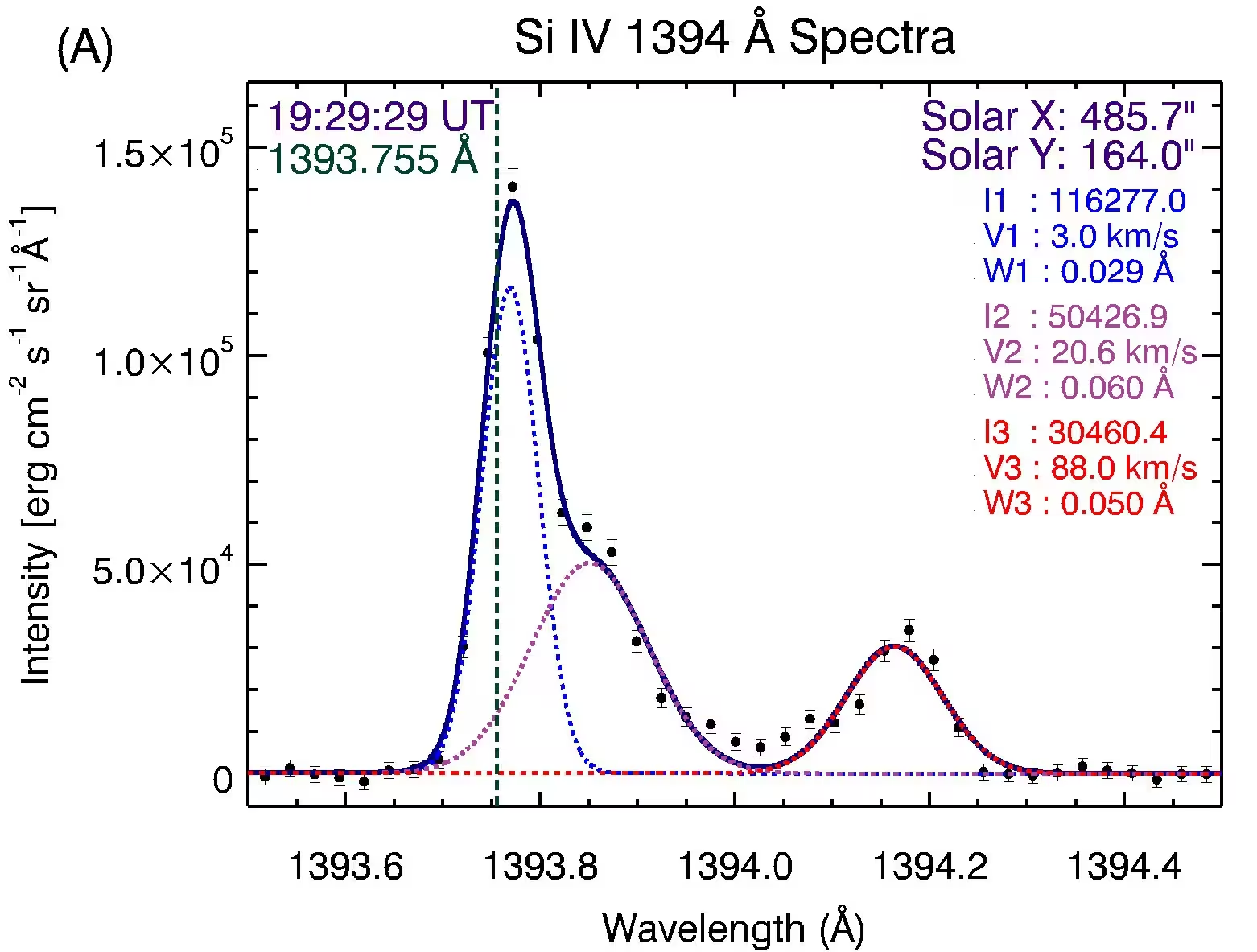
The observations revealed that at the start of the sequence, downward flows appeared in both the central dark umbral core of the sunspot and its lighter surrounding penumbra. Over the course of approximately 103 minutes, the penumbral downflow gradually faded away, while the umbral stream intensified. This main umbral channel initially formed a single unified structure before eventually splitting into two distinct spatial segments.
What Were the Measured Speeds and Densities of the Flow?
Calculations of the physical properties within the downflow region showed that the plasma accelerated over time, with speeds climbing from roughly 73 kilometers per second up to about 90 kilometers per second for ionized silicon lines. By comparing these speeds to the local sound speed of roughly 42 kilometers per second in the transition region, the authors confirmed that the plasma was moving at supersonic velocities.
Despite the changing speeds and splitting structure, the electron density within the flow remained remarkably constant throughout the observation period, averaging around 10 to the power of 10.87 per cubic centimeter. The estimated mass flux, which measures the amount of material surging downward per unit area and time, aligned closely with values recorded in previous solar investigations.
How Do Sunspot Downflows Connect to Solar Coronal Loops?
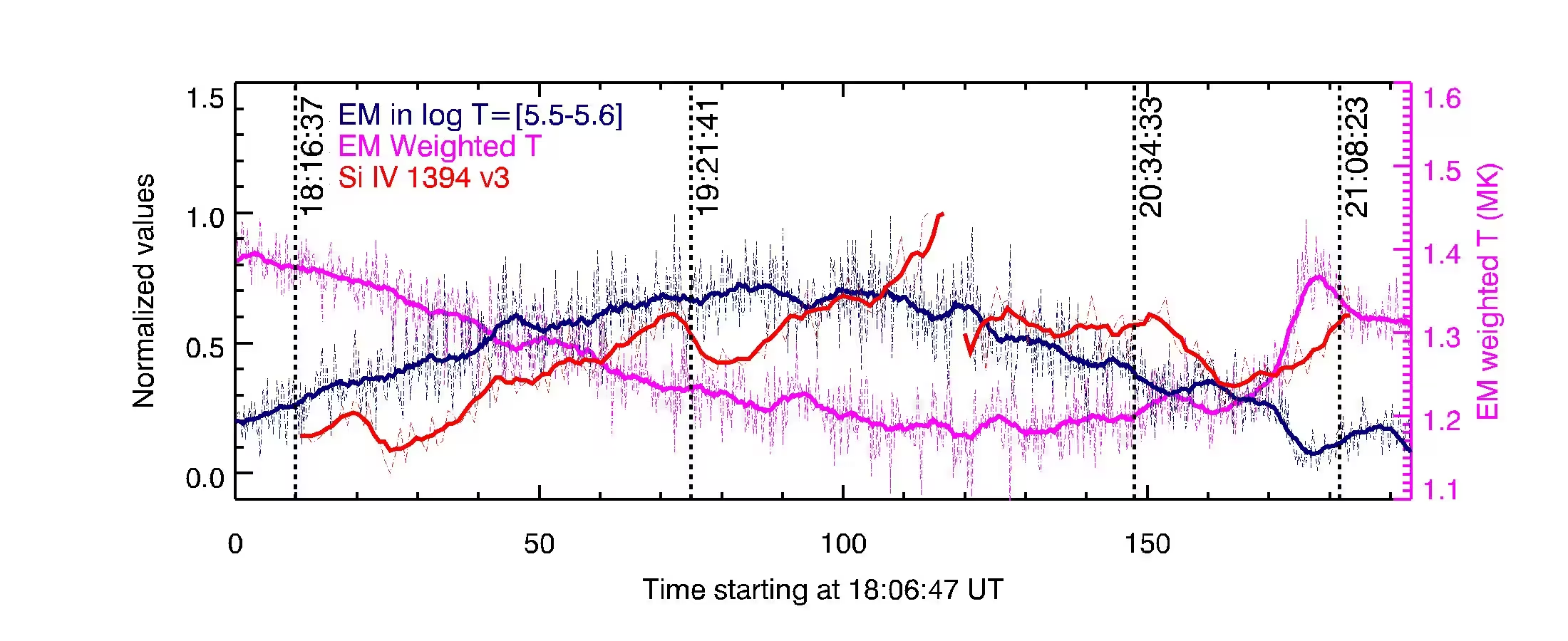
By pairing the telescope’s spectroscopic data with wide-angle imaging from the Atmospheric Imaging Assembly on the Solar Dynamics Observatory, the authors investigated whether the plasma streams were linked to overlying coronal loops. Differential emission measure analysis, a method used to quantify atmospheric plasma along the line of sight across various temperatures, revealed that changes in the cool coronal plasma closely tracked the evolution of the downflow speed.
As the penumbral downflow faded, a loop structure visible in extreme ultraviolet wavelengths disappeared from the exact same location. Later in the sequence, as the downflow split, the coronal loops became more prominent and aligned with cooler structures in the solar atmosphere. This synchronized behavior strongly points toward a coronal origin for the downflow activity.
What Triggers the Dynamic Shifts in Solar Plasma?
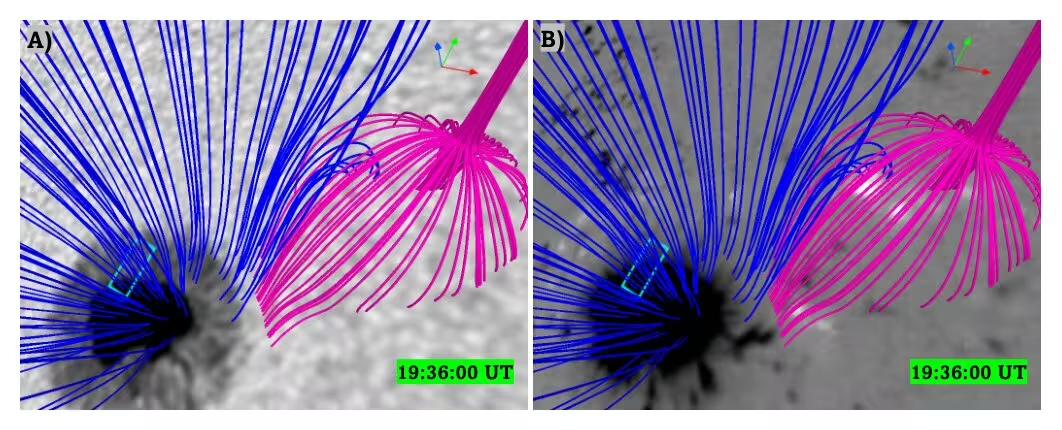
To understand the magnetic environment driving these changes, the research team performed Non-Force-Free Field extrapolations using vector magnetograms from the Helioseismic and Magnetic Imager. This modeling technique reconstructs the three-dimensional magnetic field above the sunspot by minimizing resistive and viscous dissipation rates.
The magnetic reconstruction uncovered a fan-spine topology located just northwest of the sunspot. During the observation window, instruments captured recurring transient brightenings and a small-scale microflare near the footpoint of this magnetic structure. The authors suggest that magnetic reconnection between closed loops in the fan-spine system and nearby open field lines could be dictating the large-scale evolution of the overlying coronal loops, though direct magnetic connectivity between the flare site and the downflow region remains unproven due to current instrument resolution limits.
The study was posted to the arXiv preprint server on November 19, 2026.
This article has been fact checked for accuracy, with information verified against reputable sources. Learn more about us and our editorial process.
Last reviewed on .
Article history
- Latest version
Reference(s)
- Mandal, Bablu. “Spatio-Temporal Evolution of a Steady Transition Region Downflow above a Sunspot.” arXiv.org <http://arxiv.org/abs/2611.25949v1>.
Cite this page:
- Posted by Aisha Ahmed