Dying Stars Trigger Luminous X-Ray Flashes When Shocks Burst Through Dense Gas Cocoons
A new theoretical framework links mysterious extragalactic X-ray flashes to supernova shock waves crashing through shells of gas shed right before a star dies.
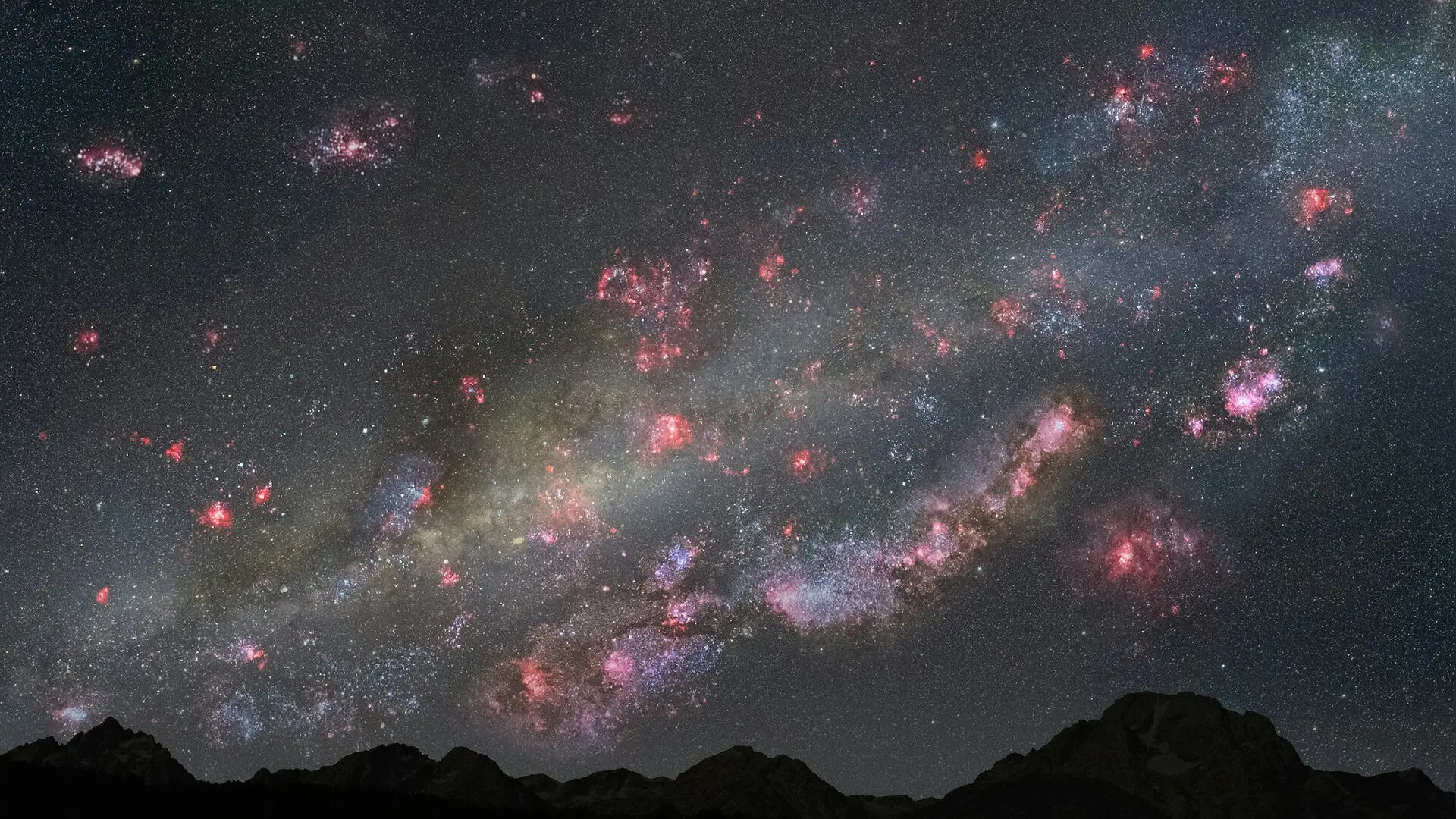
When a dying star explodes and slams into a dense cocoon of material it shed just before death, it triggers an ultra-fast flash of soft X-rays that can outshine normal stellar outbursts. An international team of astrophysicists has developed a new semi-analytic model to explain these intense high-energy signals, known as shock breakout events, by accounting for how light travels across expanding shells of stellar debris.
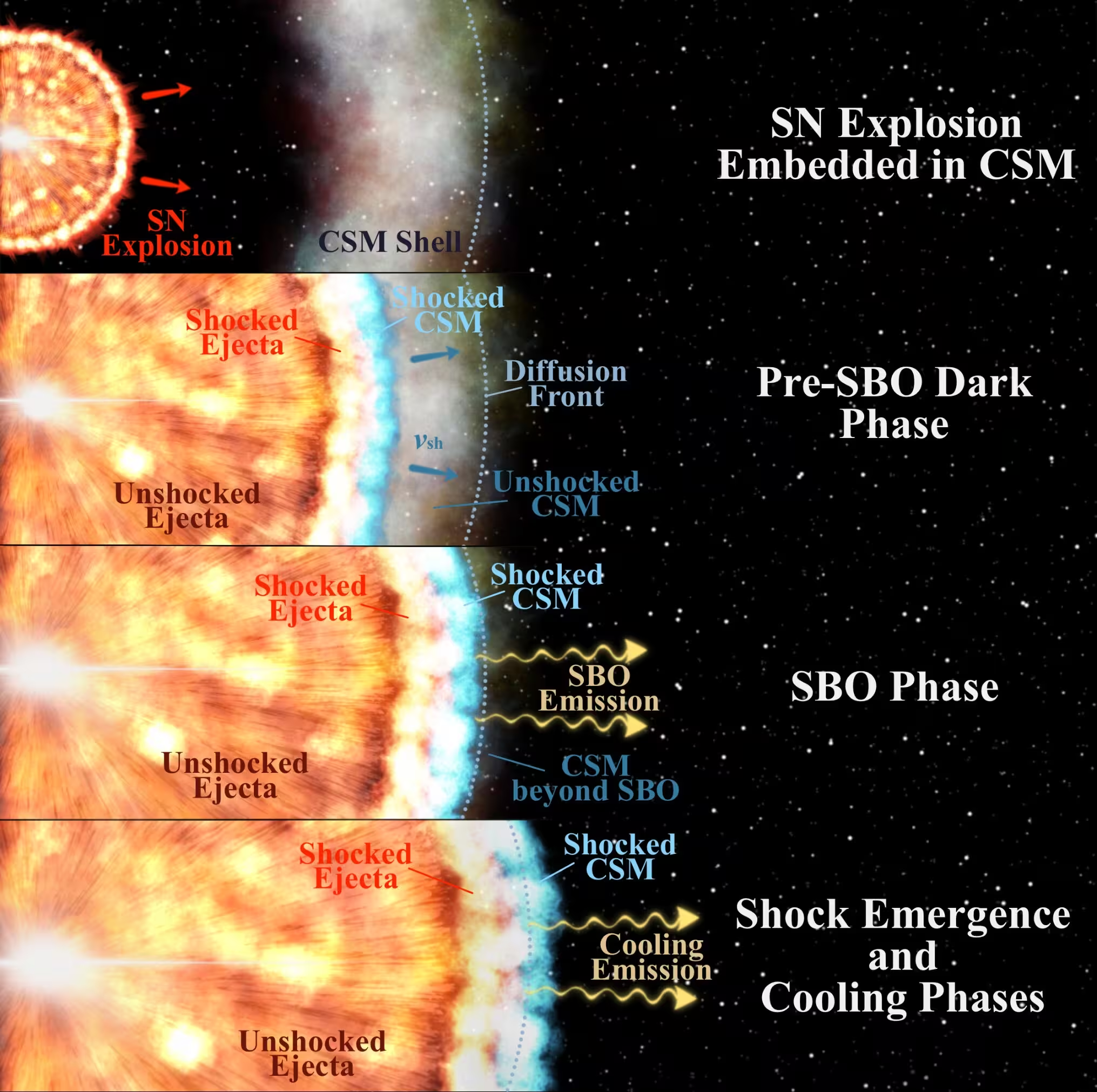
The research, published in arXiv, explores how powerful radiation-mediated shocks race through surrounding circumstellar material (dense gas and dust ejected by a massive star in its final stages) and suddenly burst out as trapped photons escape into space. These fleeting energetic flashes typically last anywhere from a few seconds to several hours, making them difficult to catch with traditional telescopes.
How Star Shocks Create Luminous X-Ray Flashes
When the core of a massive star collapses, a shock wave propagates outward through the stellar interior and into the surrounding circumstellar medium. As long as the surrounding gas is dense and optically thick, photons remain trapped behind the advancing shock front, creating a dark phase where no radiation can escape. Once the shock reaches the outer boundary of this cocoon, the trapped energy is abruptly released in a brilliant shock breakout flash.
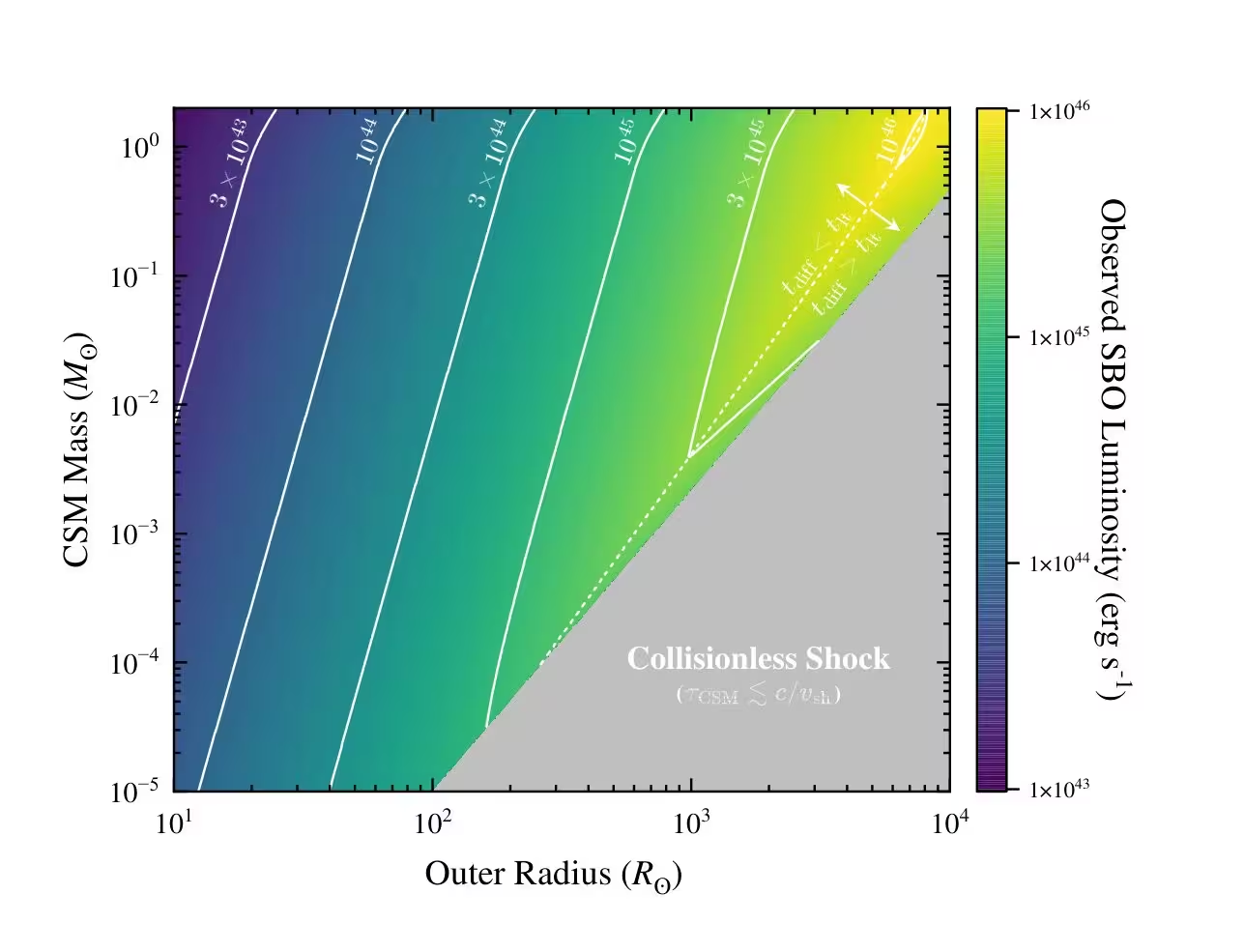
The authors, including Jin-Ping Zhu and Bing Zhang from The University of Hong Kong alongside colleagues in China, found that the peak luminosities of these thin-shell breakouts span between $10^{43}$ and $10^{45}$ ergs per second. Both the luminosity and the peak duration are primarily governed by the light-travel effect, which accounts for the varying arrival times of photons emitted across different parts of the spherical stellar surface.
When the outer radius of the surrounding gas shell is located between roughly 100 and 500 solar radii, the resulting shock breakout temperatures fall squarely into the soft X-ray band. This energy range matches the capabilities of modern wide-field X-ray monitoring missions, such as the Einstein Probe.
Testing the Model Against Three Historic X-Ray Events
To validate their theoretical framework, the researchers applied statistical fitting methods to three well-documented soft X-ray transients: EP260321a, XRF 060218, and XRO 080109. Each of these events was previously linked to broad-lined Type Ic supernovae originating from massive, stripped-envelope progenitor stars.
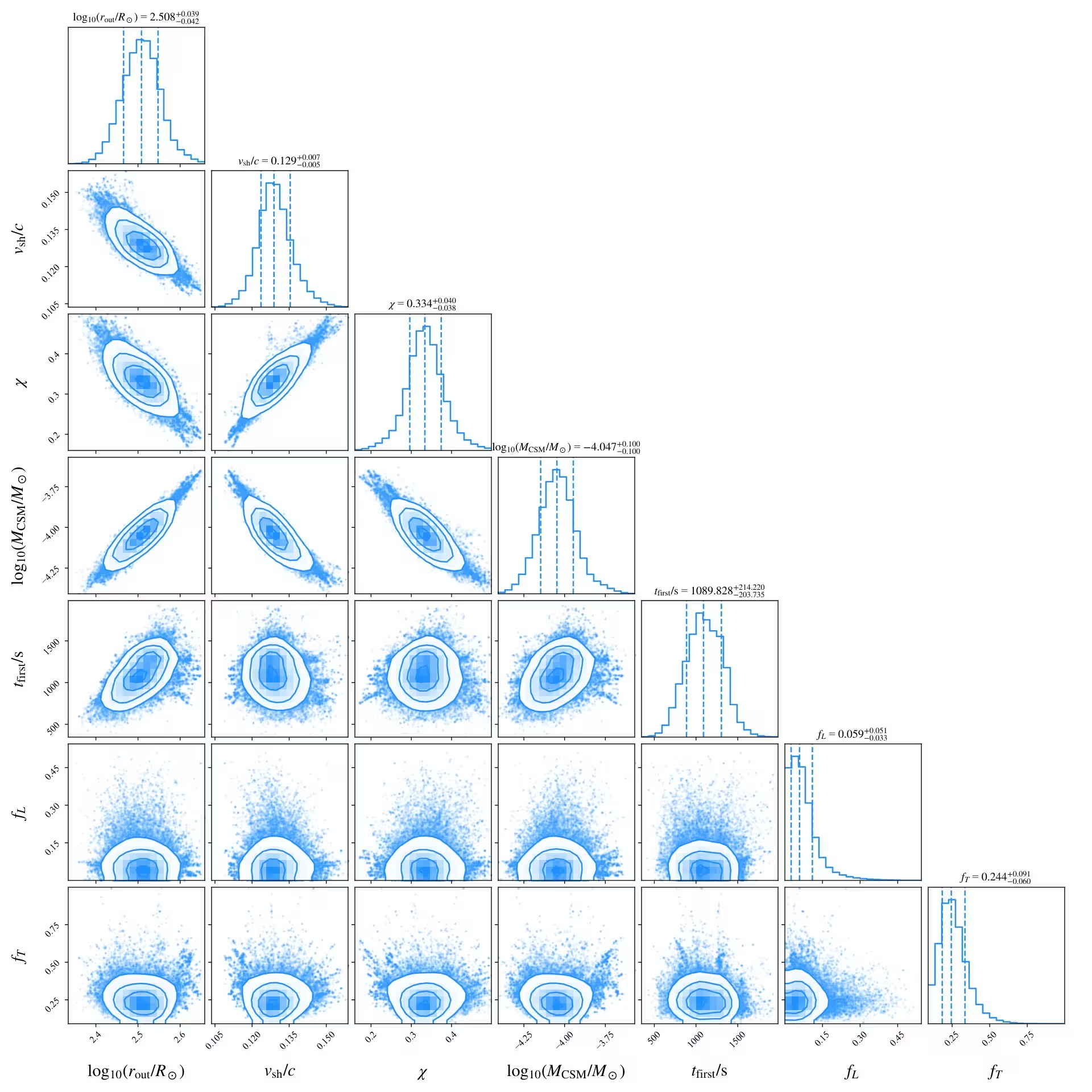
For EP260321a, a transient discovered by the Einstein Probe in 2026 and associated with the supernova SN 2026gzf, the model successfully reproduced both the observed X-ray lightcurves and the temperature evolution. The fitting procedure yielded an outer radius of roughly 322 solar radii for the circumstellar shell, with a shock velocity near 13 percent the speed of light and a shell mass of approximately $9.0 \times 10^{-5}$ solar masses.
The team noted that while the observed spectra appear remarkably similar to simple blackbody radiation, this appearance is partly an artifact of limited instrumental bandpasses. Because the light-travel effect smears out emissions from different radii and temperatures, the true underlying structure involves multi-temperature thermal emission blended together before reaching Earth.
What These Flares Reveal About Stellar Death
Analyzing the diversity of these X-ray flashes gives astronomers a window into the turbulent final years of massive stars. The inferred masses and radii of the circumstellar shells suggest that stars undergo episodic, violent mass-loss events shortly before core collapse, potentially driven by binary star interactions or wave-driven outbursts.
The authors point out that future detections by sensitive facilities will uncover many more soft X-ray shock breakout events. Expanding this observational sample will help researchers chart the episodic mass-loss history of massive stars and clarify the physical mechanisms powering exotic extragalactic transients.
The study was posted to the arXiv preprint server on November 19, 2026.
This article has been fact checked for accuracy, with information verified against reputable sources. Learn more about us and our editorial process.
Last reviewed on .
Article history
- Latest version
Reference(s)
- Zhu, Jin-Ping., et al. “Fast X-Ray Transients from Dense Circumstellar Material Shock Breakout and Cooling Emission.” The Astrophysical Journal Letters, vol. 1012, no. 1, November 11, 2026, pp. L1 American Astronomical Society, doi: 10.3847/2041-8213/aebbb8. <https://doi.org/10.3847/2041-8213/aebbb8>.
Cite this page:
- Posted by Nida Rehman