Invisible Black Holes Eating Neutron Stars Could Power Hidden Gamma-Ray Bursts
A study suggests that primordial black holes consuming dense dead stars from within can trigger bright high-energy flashes without needing a debris disk.
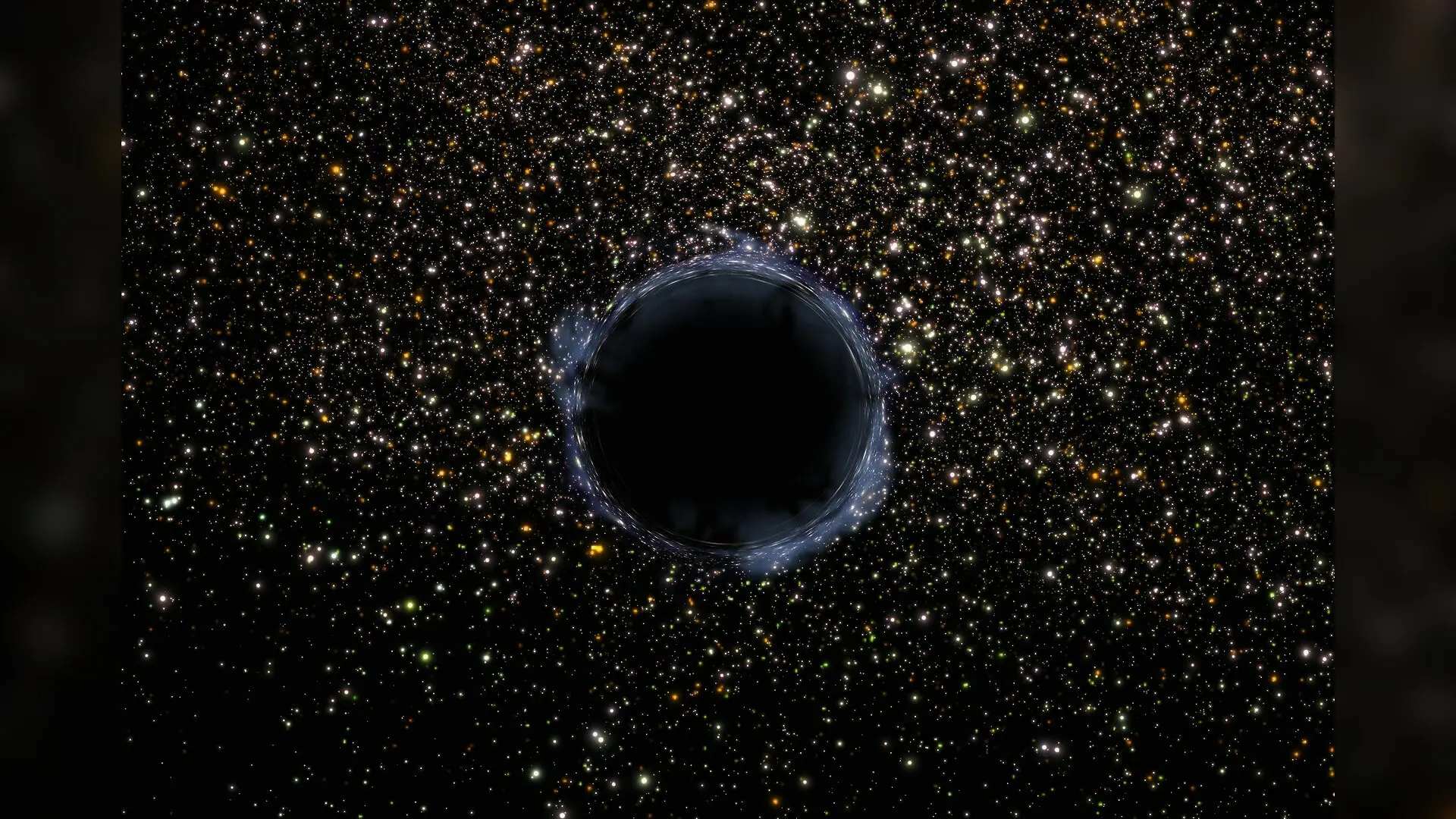
A tiny primordial black hole could burrow into the heart of a dense neutron star, consume it from the inside out, and trigger a powerful gamma-ray burst without needing a surrounding ring of debris. The study, available on the arXiv preprint server by physicists Yu Watanabe, Koichiro Yasuda, and Alexander Kusenko, outlines how invisible black holes born in the early universe might reveal themselves through violent high-energy explosions.
Finding the true identity of dark matter remains one of modern astrophysics’ greatest puzzles. While scientists have ruled out primordial black holes across many mass ranges, a narrow window of asteroid-mass objects weighing between 10 to the 17th and 10 to the 23rd grams remains entirely unconstrained. Neutron stars, which are city-sized remnants of dead stars packed with unimaginable density, act as natural traps for these wandering black holes.
How a Tiny Black Hole Eats a Star From Within
When a primordial black hole flies near a neutron star, it can lose enough speed through gravitational drag to get captured. Once trapped, the black hole settles into the stellar core and begins feeding on surrounding matter via spherical accretion, a process where gas is pulled inward from all directions. The authors calculate that for an asteroid-mass black hole, this internal consumption proceeds relatively slowly at first before culminating in a runaway endgame that lasts only a fraction of a millisecond.
During this final collapse, the contracting neutron star spins faster and faster due to the conservation of angular momentum. At the same time, violent internal churning amplifies the star’s magnetic field through a mechanism called a dynamo. For rapidly rotating millisecond pulsars, which are neutron stars spinning hundreds of times every second, this magnetic amplification reaches extreme levels before the black hole swallows the remaining stellar material entirely.
Powering Cosmic Flashes Without an Accretion Disk
Traditional short gamma-ray bursts usually form when two neutron stars crash together, creating a central black hole surrounded by a swirling accretion disk of hot debris that launches powerful jets. However, disk formation is uncertain and often fails if the black hole eats too cleanly. The authors show that internal consumption bypasses this requirement completely. The amplified magnetic field alone can power a brilliant flash of radiation through magnetic dipole emission and energy release.
The resulting explosion would appear as a millisecond-scale flash of mega-electronvolt gamma rays with an isotropic-equivalent energy reaching up to 10 to the 48th ergs. This signature differs noticeably from typical binary merger bursts or magnetar flares because it features a steep power-law rise followed by an abrupt cutoff lasting roughly one-tenth of a millisecond as the event horizon forms.
Multimessenger Signals and Future Detection Prospects
Beyond gamma-ray bursts, these internal black hole events could generate several secondary signals. As the black hole swallows the star, the sudden disappearance of the magnetic field anchored to the stellar surface can launch a fast radio burst. Furthermore, the violent ejection of neutron-rich matter could synthesize heavy elements and power kilonova-like glow, while asymmetrical collapse would produce high-frequency gravitational waves.
The researchers suggest that archival data from the Fermi Gamma-ray Burst Monitor and future missions such as NASA’s Compton Spectrometer and Imager could spot these unique bursts. If asteroid-mass primordial black holes make up even a small fraction of dark matter, current and upcoming space telescopes might soon uncover these hidden stellar cataclysms.
The study was posted to the arXiv preprint server on November 19, 2026.
This article has been fact checked for accuracy, with information verified against reputable sources. Learn more about us and our editorial process.
Last reviewed on .
Article history
- Latest version
Reference(s)
- Watanabe, Yu. “Gamma-Ray Bursts from Primordial Black Hole-Induced Neutron Star Collapse.” arXiv.org <http://arxiv.org/abs/2611.25876v1>.
Cite this page:
- Posted by Nida Rehman