Primitive Galaxy Shocks Astronomers With Impossibly Early Magnetic Field
Advanced simulations reveal that a young cosmic system bypassed billions of years of slow dynamo growth to become strongly magnetized in just 40 million years.
A primitive galaxy just 550 million years after the Big Bang has startled researchers by harboring a powerful and well-ordered magnetic field roughly one-tenth the strength of our own Milky Way. Classical astrophysical theory dictates that early cosmic structures should remain virtually unmagnetized on large scales because galactic dynamos require billions of years of rotation to amplify tiny primordial seed fields. However, advanced computer simulations reveal that a young system named Magnolia achieved microgauss magnetic strengths as early as redshift 9, forcing astrophysicists to rethink how magnetic fields shape cosmic evolution from the ground up.
How Did Magnolia Grow a Magnetic Field So Fast?
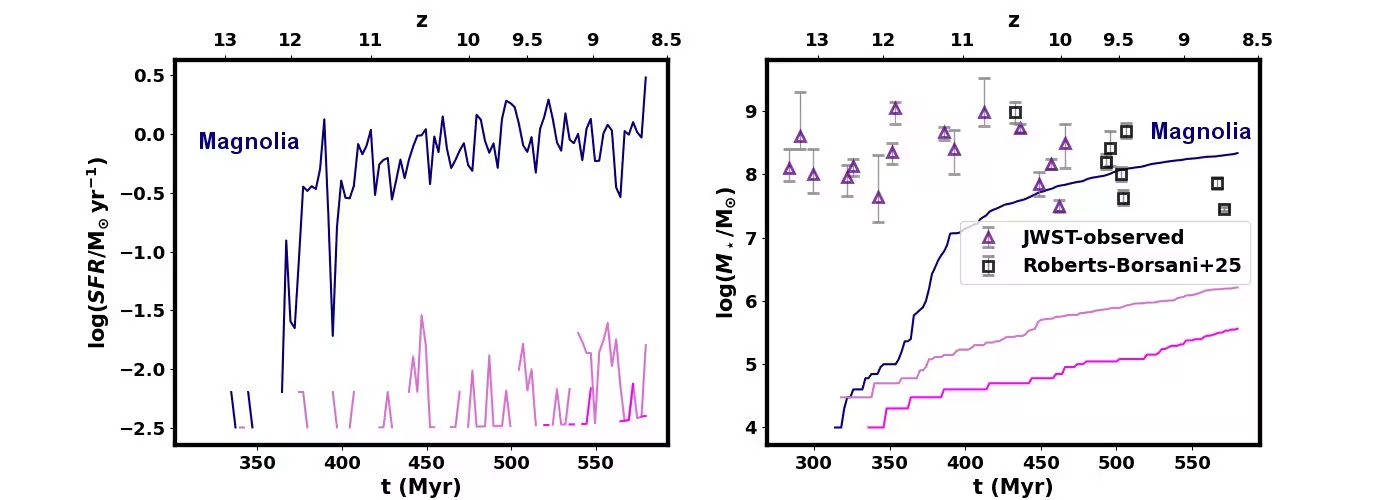
To investigate the mysterious origins of early cosmic magnetism, the researchers designed a sophisticated suite of high-resolution cosmological zoom-in simulations named MAGNA SERRA. Led by Evangelia Ntormousi and colleagues, the work is available on the arXiv preprint server, modeling the radiation, magneto-hydrodynamics, and non-equilibrium chemistry of the early universe. The team traced the formation of Magnolia within a massive dark matter halo, reaching a stellar mass of roughly 168 million solar masses by redshift 8.6. Rather than relying on slow rotational amplification over billions of years, the simulation indicates that intense gravitational turbulence, rapid clump mergers, and powerful gas compression rapidly supercharged the infant galaxy’s magnetic field over a span of just 40 million years.
What Does This Rapid Magnetization Mean for Galaxy Growth?
By analyzing the energy densities within Magnolia, the authors discovered that the magnetic energy eventually came close to thermal equipartition, completely overwhelming the non-thermal energy driven by supernova feedback. Spectral energy transfer analyses demonstrated that the kinetic-to-magnetic energy conversion was primarily driven by compressive work rather than standard turbulent dynamo action. Furthermore, the researchers observed an inverse energy cascade, where magnetic energy spontaneously reorganized from smaller spatial scales up to larger, coherent structures spanning thousands of parsecs. This challenges the long-held assumption that early galaxies are magnetically inert and suggests that strong magnetic fields can influence star formation and cosmic ray propagation for almost an entire galaxy’s lifetime.
What Are the Limits and Next Steps for This Discovery?
While the findings provide a compelling explanation for recent James Webb Space Telescope observations of polarized dust emission in distant galaxies, the authors note important technical constraints in their model. The simulation achieved a spatial resolution of about 10 parsecs, which is too coarse to fully capture small-scale turbulent dynamos that require resolutions of 2 parsecs or finer. Additionally, the team only tested one specific initial magnetic seed configuration, meaning future studies must explore a wider parameter space of primordial field strengths and morphologies to determine how universally applicable these results are across the early cosmos.
The study was posted to the arXiv preprint server on November 19, 2026.
This article has been fact checked for accuracy, with information verified against reputable sources. Learn more about us and our editorial process.
Last reviewed on .
Article history
- Latest version
Reference(s)
- Ntormousi, Evangelia. “Magnolia: a highly magnetized galaxy at redshift $z\simeq9$.” arXiv.org <http://arxiv.org/abs/2611.25937v1>.
Cite this page:
- Posted by Karan Das