Webb Telescope Unveils A Chaotic Star Nursery Hidden Behind Cosmic Dust
Webb’s infrared vision unveils hidden protostars, powerful outflows, and a vast stellar cavity within the vibrant star-forming region NGC 7129.
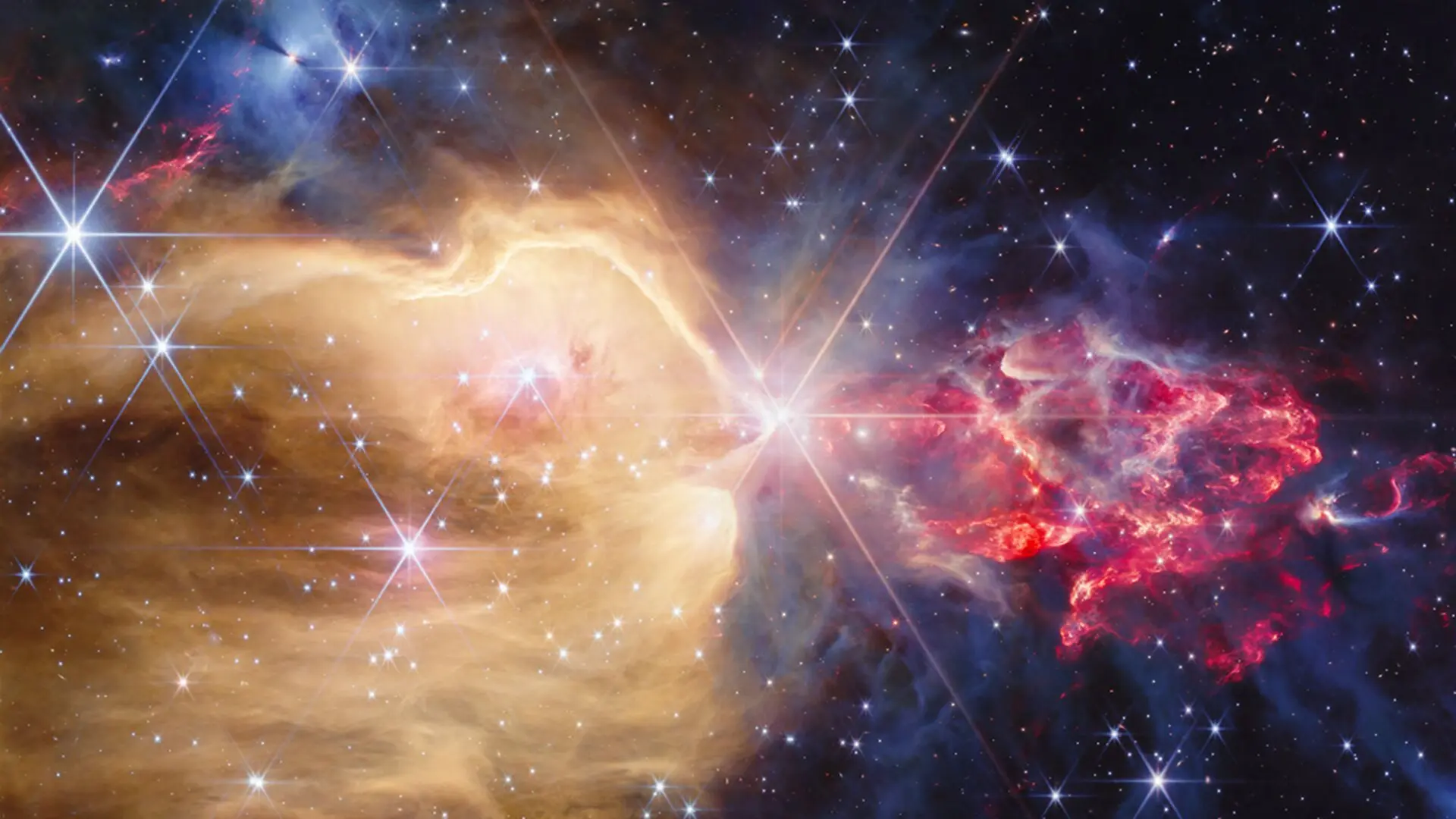
The James Webb Space Telescope has unveiled the chaotic inner workings of NGC 7129, a stellar nursery located 3,300 light-years from Earth. By peering through the thick curtains of dust that have historically obscured this region, the telescope has provided astronomers with an unprecedented look at the violent and creative processes that define the birth of stars.
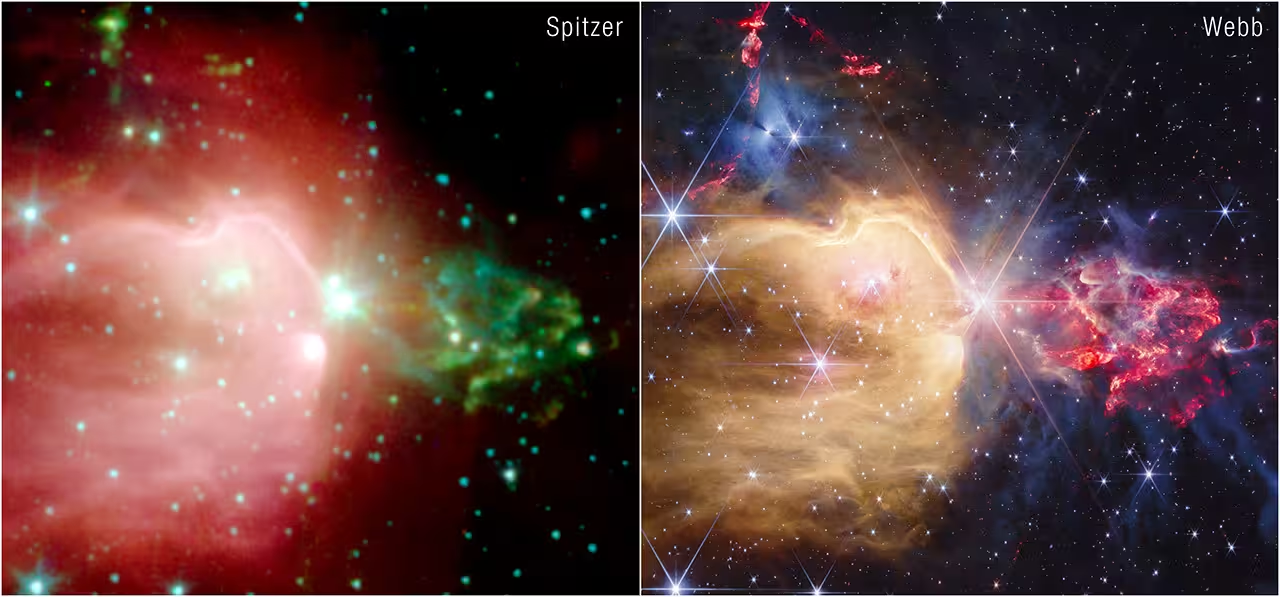
The new imagery, shared by NASA and the European Space Agency, captures a complex ecosystem where star formation, radiation, and stellar outflows collide. Because Webb operates primarily in the infrared spectrum, it can resolve fine details within the cold, dense molecular clouds that are typically invisible to standard optical telescopes.
A Massive Engine of Change
Dominating the center of the field is LkHα 234, a pre-main-sequence star with a mass estimated at five to eight times that of our Sun. While it has not yet begun the steady hydrogen fusion that powers a mature star, its influence on the surrounding environment is immense. It has carved a vast, golden-hued cavity in the gas that stretches roughly 3.5 light-years across.
This cavity represents a dual-action process of cosmic construction and destruction. As the star emits intense radiation and powerful winds, it clears away nearby gas, potentially halting star formation in its immediate vicinity. Conversely, the shockwaves generated by this activity can compress distant gas, triggering the collapse of new, smaller star clusters in the outer reaches of the nebula.
Mapping the Anatomy of Stellar Feedback
The nebula functions as a high-stakes laboratory for studying stellar feedback. Webb’s data reveals a “photodissociation region” along the edge of the central cavity—a boundary where high-energy radiation breaks apart molecular hydrogen, fundamentally altering the chemistry of the cloud. Within this area, astronomers can observe bow shocks, where stellar winds slam into the interstellar medium like the wake of a ship moving through water.
These features allow researchers to quantify how efficiently a molecular cloud can produce stars before the stars themselves dismantle the very reservoir of gas that allowed them to form. By studying these stars in various stages of development simultaneously, scientists gain insight into the lifecycle of stellar nurseries that would be impossible to obtain by observing isolated objects.
Protostellar Chaos and Hidden Development
To the right of the central cluster, the environment grows even more turbulent. This region is packed with protostars—the youngest objects in the scene—hidden behind dense, red-tinted veils of dust. These protostars are currently in the process of gathering mass, but they are also launching high-velocity jets of gas back into the surrounding cloud.
These outflows crash into the ambient material, creating a series of complex shocks that give the region its textured, chaotic appearance. Because several of these systems are active at once, their outflows often overlap, providing a map of how energy and momentum are transferred from newborn stars into the wider galactic environment. Together, these observations offer a vivid look at a crowded stellar construction site, where the competing forces of gravity and stellar feedback determine the fate of the next generation of stars.
This article has been fact checked for accuracy, with information verified against reputable sources. Learn more about us and our editorial process.
Last reviewed on .
Article history
- Latest version
Reference(s)
- McCoy, Marty. “NASA's Webb Captures Commotion From Nebula’s Stellar Jets - NASA Science.”, October 6, 2026 NASA <https://science.nasa.gov/missions/webb/nasas-webb-captures-commotion-from-nebulas-stellar-jets/>.
- “Webb captures commotion from nebula’s stellar jets.” <https://www.esa.int/ESA_Multimedia/Images/2026/10/Webb_captures_commotion_from_nebula_s_stellar_jets>.
Cite this page:
- Posted by Karan Das