The Man Who Spent 90 Days Secretly Stealing a 15 Ton Meteorite Only to Lose It in Court
A man’s ambitious plan to transport a massive object home required a horse, immense dedication, and 90 days of grueling labor.

In the autumn of 1902, a Welsh laborer named Ellis Hughes stumbled upon an anomaly while clearing timber near Willamette, Oregon. When his shovel struck a large, partially buried rock, it produced a resonant, bell-like chime rather than the dull thud of stone. Recognizing the object was far from ordinary, his neighbor, Bill Dale, speculated it was a meteorite. Their assessment proved correct: the object was a massive, 15.5-ton iron-nickel mass, the largest meteorite ever discovered on American soil.
The discovery presented a legal complication. The hillside where the object rested was property of the Oregon Iron and Steel Company, not Hughes. Attempting to claim the fortune for himself, Hughes initiated a covert, three-month operation to relocate the 10-foot-tall space rock to his own nearby farm, a feat of engineering that ultimately led to his downfall in court.
An Audacious Heist Across Three Months
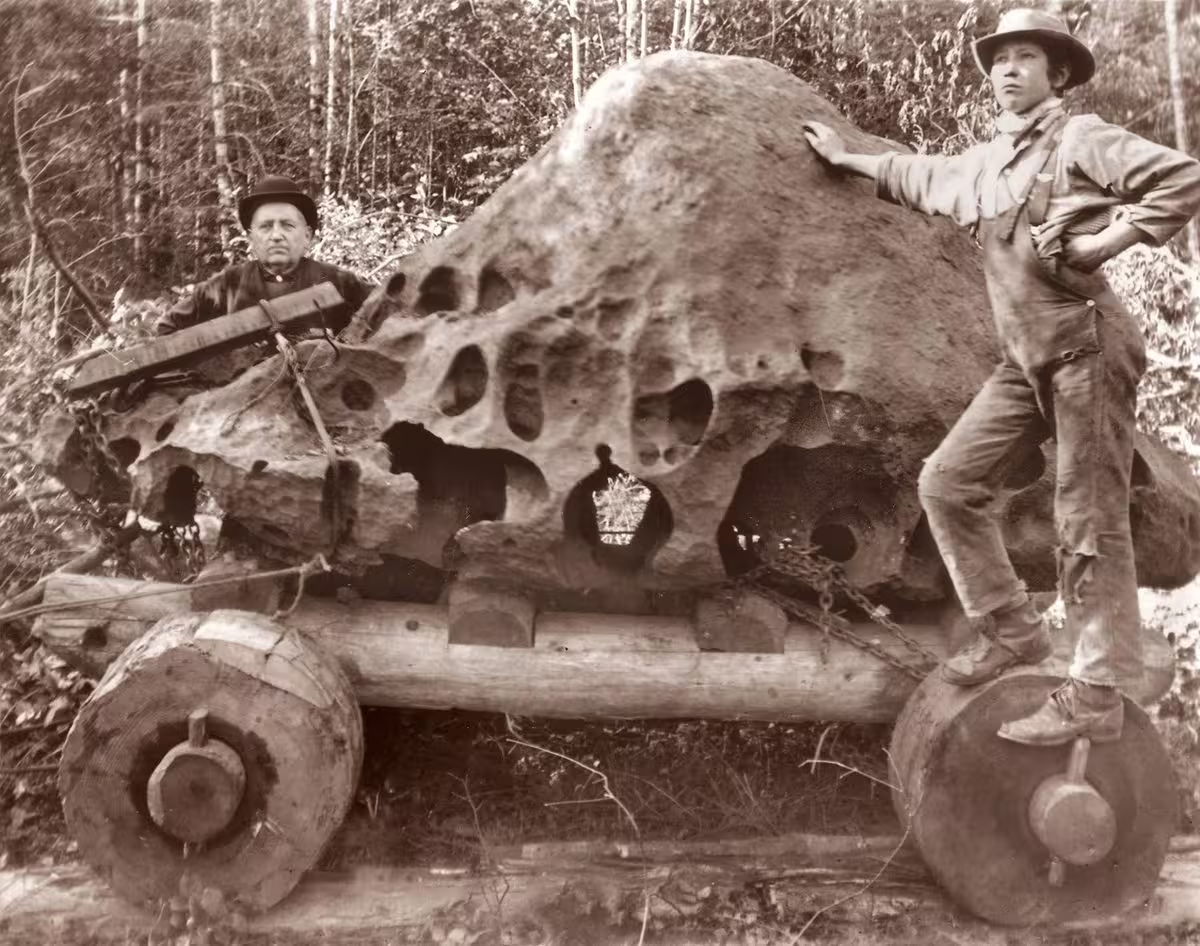
After failing to secure the land through a purchase, Hughes turned to sheer persistence. Working with his wife and son, he cleared a three-quarter-mile track through dense forest and constructed a heavy-duty wooden wagon capable of supporting 30,000 pounds. To shift the massive weight, he employed a capstan—a winch mechanism anchored to trees—that allowed a single horse to drag the meteorite forward by mere inches at a time. Muddy conditions often slowed their progress to a crawl, but after 90 days, the meteorite sat securely on Hughes’s property. He promptly erected a shed and began charging onlookers 25 cents to witness the celestial relic.
Legal Battle and the Definition of Property
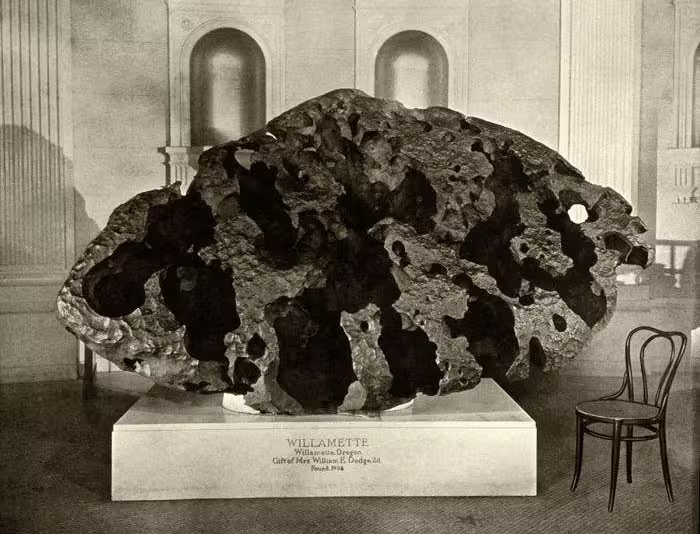
The enterprise collapsed when an attorney for the Oregon Iron and Steel Company visited the site, noticed the freshly cut road, and recognized the object as the company’s own. A lawsuit followed, prompting Hughes to argue that the meteorite was a culturally significant object belonging to the Clackamas people rather than a fixed piece of real estate. Testimony provided by Clackamas descendants highlighted the stone’s sacred role in tribal history, noting that warriors traditionally used its rainwater-filled basins for rituals. However, in 1905, the Oregon Supreme Court ruled that the object was legally part of the land, affirming the mining company’s ownership. The meteorite was eventually sold and donated to the American Museum of Natural History, where it has remained since 1906.
Origins of a Cosmic Traveler
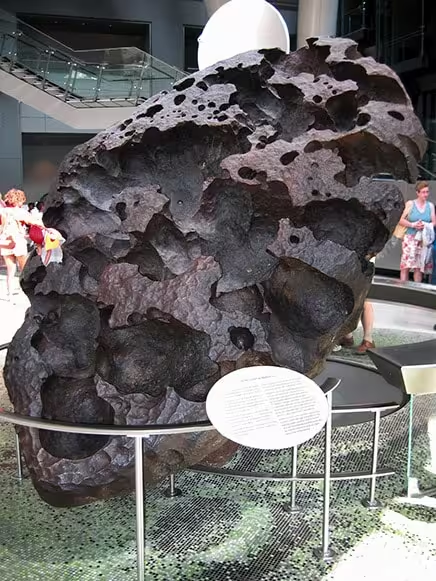
Geological analysis reveals the meteorite is composed of approximately 91 percent iron and 7.6 percent nickel. Its distinctive, hollowed-out surface was not formed by atmospheric entry but through long-term exposure to terrestrial elements. Over millennia, sulfur compounds within the iron reacted with rainwater to produce acidic corrosion that slowly etched deep pits into the metal. Because there is no impact crater at the discovery site, experts conclude the object landed elsewhere—likely atop an ice sheet in the northern Rockies—and was transported to Oregon via the cataclysmic Missoula Floods approximately 13,000 years ago, encased within a massive iceberg.
To the Confederated Tribes of Grand Ronde, the stone remains Tomanowos, a sacred entity and emissary of the Sky People. While the museum retains physical custody, a landmark agreement reached in 2000 provides the tribe with the right to conduct annual private ceremonies at the museum. The artifact continues to draw massive public attention, standing as a testament to both geological history and enduring cultural heritage.
This article has been fact checked for accuracy, with information verified against reputable sources. Learn more about us and our editorial process.
Last reviewed on .
Article history
- Latest version
Cite this page:
- Posted by Zara Tariq